

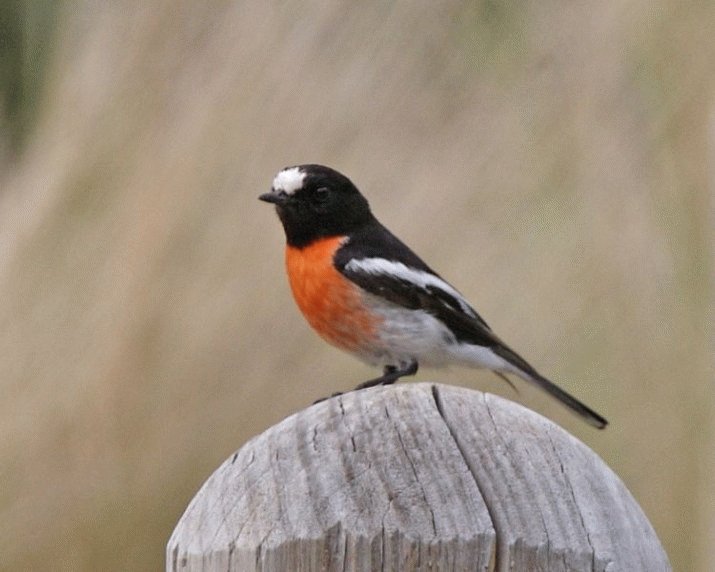
The bird of Christmas, the robin, perched on a white post on Pillinger Drive, singing its merry yuletide song.
It wasn’t the true Christmas robin, of course, the European one that graces Christmas cards sent from Britain (and even Australian ones) but an exiled Pom like myself takes what he can get during his search for Christmas symbols at this time of year and the scarlet robin would have to make do.
Perhaps the flame robins higher up the mountain were a better substitute for the European one, the breast of the males carrying the same flame-red hue of hot coals as their European counterparts. I won’t say cousins, because the robins of Australia belong to a totally different family to those in the Old World. They have just evolved along the same lines, with some of the Australian species not only similar in appearance but in behaviour, perching on stumps and posts to pounce on insects on the ground after short flights.
I hadn’t found many scarlet robins on the mountain and, feeling the Christmas spirit, I stopped the car to observe this one. The male was a beauty, dazzling scarlet breast with crisp black and white plumage on its head and back, shaking and quivering as it hit its highest notes in a soft, understated warbling song, a Christmas carol for the mountain.
A car coming down from the summit flashed by and startled the robin, prompting it to fly into the grounds of an extensive property at the point where the leafy suburban gardens of Fern Tree merge into forest at the Wellington Park boundary. The garden of his home was adorned with exotic plants found in colder regions of the northern hemisphere, mainly rhododendrons, camellias and azaleas. And looming above them was a tall spruce, the tight conical foliage decorated with oversized Christmas decorations. Giant stars and candles and fairies and reindeers dangling from the spruce branches rocked in the breeze. The robin did not give them a second glance, preferring instead to plunge into the base of a spreading Christmas bush on the mountain side of the garden.
It was not only the Christmas bush, along with the spruce Christmas tree, that signalled the festive season was upon us. Hikers on the mountain were wearing Santa Claus hats.
Black currawongs were in festive mood, too. During the tourist season – especially on busy days like holidays and Sundays – they always keep a firm watch on Sphinx Rock. They know children will gather there with their parents for a view of the city down below, and where there are children there would be hand-outs of potato chips and lollies.
Strangely, the canny and cunning black currawongs – who always seem far bolder and aggressive than the grey ones – do not harass tourists further up the mountain at the summit lookout, or gather there. Sphinx Rock, nestling below the shelter of the Organ Pipes, is far less inhospitable. The currawongs are smart enough to avoid places where they would be buffeted by high winds, and feel the cold. That’s only for humans.
One beetle stood out however …
I now disturbed more and more butterflies on my walks and continued to struggle to identify them. And the wider world of insects, too. One beetle stood out, however, on my travels through the drier sections of woodland, one of the jewel beetles. This one was in shining bottle green, as though someone had dabbed it with a paintbrush and the paint was still wet. It clung to a daisy bush, like a green Christmas decoration.
Birds are our contact point with nature, animals and reptiles to a lesser degree because they are less obvious. Wellington Park is dominated, however, by invertebrates with an estimated five to six thousand species, with new ones continuing to be discovered. As with birds, it is mainly flying ones, the butterflies and moths and dragonflies, or the brightly coloured, the jewel and other shiny beetles, that catch the eye.
It is estimated that approximately one-third of the leaf area of eucalypts is lost each year to animal activity on Mount Wellington. A large proportion of this loss is attributed to invertebrates, which in forested environments consume leaves, and suck sap for food. The insects especially play a major role in the breakdown and recycling of organic matter on the forest floor and in the soil. They also provide sustenance for a large number of bird and animal species.
Towards the end of the year I was now scouting tracks I had not visited before, generally shorter ones that would give me more time to study the different habitats they revealed. This was not so much about walking the mountain, and covering considerable distances, but clocking bird species I had not seen before and to do that I took a steady approach, exercising patience and taking my time.
I was driving to Big Bend again in search of the striated fieldwrens and pipits I had missed previously, confident I could find them there by venturing further from the road along the unexplored Big Bend Trail to the Tom Thumb outcrop and an off-shoot, the Collins Bonnet Track to Pulpit Rock on Mount Connection.
A profusion of flowers, and the bird activity lured by the blooms, attracted my attention just before Big Bend and as I slowed I saw a trail signposted that I had not noticed before – the short Panorama Track that for walkers cuts off the hairpin bend at the far north of the Pinnacle Road, giving an exhilarating steep climb through alpine woodland before it hits the road again after about three quarters of a kilometre.
The endemic bushman’s bootlace …
After I had parked the car and set out to make the climb, new plants revealed themselves: Alpine heath myrtle (Baeckea gunniana), a small shrub with tiny crowded leaves and five round white petals rising from a disc; tree groundswell with its yellow flowers, and long and narrow straight leaves; the untidy speedwell bush (Veronica formosa) with its purple flowers clustered at the tops of erect stems.
There was also mountain rice flower (Pimelea servicea), a curious plant with clusters of pale pink flowers rising from a tight tower of leaves. The plant, only about 50 centimetres in height, had silky hairs on the leaves, giving it a silvery appearance.
Among this new world of alpine plants just below the mountain summit was another rice flower, the endemic bushman’s bootlace (Pimelea nivea), with tiny white flower clusters atop thin stems of glossy dark-green, spoon-shaped leaves. Alpine heath (Epacris serpyllifolia) spread blow me into the snow gum woodlands and the flower heads of pink swamp heath, or sprengelia (Sprengelia incarnata), thrust from the sheathed stems of this tall and spindly shrub.
The alpine plants were like nothing I had encountered before on the mountain, mainly because my expeditions had been confined to the lower slopes, where birds were more prolific. I had arrived at the higher slopes in good time to see flowering profusion of these fascinating, hardy plants. I didn’t neglect plants I had seen and studied already. Golden rosemary at high elevation was still in yellow flower, the blooms already dead on the mountain’s lower slopes.
As I climbed through a landscape of low shrubs and stunted snow gums, weaving between dolerite boulders and mini-billabongs formed by springs, my footsteps attracted not only fantails dancing on the wind, but Tasmanian thornbills in low scrub and, on the ground, scrubwrens. In turn other species not necessarily reliant on my disturbance of the ground, my rumble in the grasslands, emerged, to feed in the low trees along my route and amid birds already following me. Birds will often flock together, although feeding on different food sources, where there is safety in number, many eyes and many ears to hear the alarm calls if a predator is about.
Although it previously had escaped my notice, the Panorama Track became my favourite short walk: ahead of me flowers and birds, and at my back an uninterrupted view over the city and beyond, as though I was flying in an aeroplane. It was just as good a view as that experienced at the summit, with a bonus. The track is in the lee of the mountain and protected from high wings.
On this day, as I looked across the city, tree martins had taken to the wing and soared between me and Hobart, darting across the sky, fluttering, banking and turning in their pursuit of flying insects. The martins on the mountains would be nesting in their traditional sites of cave or tree cavities, attaching mud nests to natural wall or hollow. In the city I had seen tree martins exploiting holes in man’s world, cavities in awnings over shops or in the walls of Georgian and Victorian buildings. Unlike the martins, the welcome swallows merely attach their nests to the outside of buildings, and I rarely saw them on the mountain as such, only on its lower slopes where it abutted suburbia nearer to Hobart.
The next day after discovering the Panorama Track I headed there again, setting aside my mission to see the pipits and fieldwrens at Big Bend.
As I left Hobart I could see a thin band of white cloud covering the face of the mountain, but the summit looked clear above the Chalet. I pressed on. I hit the mist just below the Springs and drove through it, the trees at the side of the road in silhouette. A kilometre or so along the road the mist cleared and sunlight flooded across my dashboard, blinding me momentarily. I pulled over to the side of the road, blinking. Far below me the white cloud I had just driven through was spread out across the city. I appeared to be floating on the cloud itself.
Heady with the view, I felt a sense of exhilaration at being in sunshine on the mountain, when those subjected to the pre-Christmas hustle and bustle, and stress, of the city below me were literally under a cloud. I was Jack in the Beanstalk, up there above the clouds, above the city and life there. I had escaped, climbing higher all the time, in an adventure of my own. The sensation of floating above humanity was as powerful as the folklore of my childhood; the magic of the Christmas period, pantomime season in my homeland of Britain, where Jack in the Beanstalk and Cinderella ruled the stage. The cloud floating below me, gently undulating, kneaded by the breeze, sparkled and shone, so white and dazzling I held my hand to my eyes again. I searched for metaphors, similes, and all I could come up with was the image of Jack and his beanstalk from another time and place. But that’s the way it was, a few days before Christmas, magical, and I’ll always remember it. Did Jack search for a pot of gold, or gold coins? I couldn’t remember, but there was reward for me for daring to tackle the cloud, and climb the beanstalk: golden rosemary in my sights, and golden whistlers.
Above the long white cloud, I’d only been on the Panorama Track for a few minutes, crossing a carpet formed of the white flowers of alpine heath, when a flame robin flew across the track in front of me. Another symbol of the European Christmas now firmly in my pantomime thoughts. The male bird had food for a brooding female, or young, in his bill.
Overnight I had swotted up on plant identification and now more species revealed themselves: snowberry, eyebright and, in sheltered places, woody tea-tree and tree groundswell, the latter with yellow flowers and long, narrow straight leaves.
An ivory backdrop …
The snow gums were in fine flower, the blooms forming an ivory backdrop to the alpine environment, and a white-and-red collage when set against the waratahs, like an exotic ice-cream bought along Salamanca’s restaurant strip. And less showy. the miniature paper daisy flowers of mountain spice (Ozothamnus ledifolius), perched at the ends of single multi-leaved stems, spread out before me at the top end of the trail. It is the dominant plant at the top of the alpine zone
Christmas day and for once family came first, with a planned trip to my sister-in-law’s home on the Eastern Shore. But at least I would still be able to view the mountain from there as we celebrated the holiday and tucked into Christmas dinner. The television news reported yet another gun outrage in the Untied States – a massacre at a school – and we turned it off. Nothing would spoil our family day.
Earlier, before leaving for the other side of the Derwent, I had taken a peek at Mother Mountain from the Waterworks Reserve, curious to check on the swallows nesting in the BBQ hut. The hut was occupied by Christmas revellers, cooking steaks instead of turkey on a nearby barbecue. A few days earlier I had seen three yellow beaks thrusting from the nest as the parents arrived with food. The nest was empty now, the young on the wing and I could see them at times perched on the wire strands of a fence, watching their parents hawk insects over the grassy embankment of the upper reservoir wall. Soon the chicks would be doing the same.
In the human world a lull falls over the week embracing Christmas and the New Year. Viewed from the mountain the streets appear deserted in the morning and late afternoon, no computer traffic winding is way back and forth. Many of those city folk appeared instead to be on the mountain. It was crowded with visitors escaping a city in celebration, with post-Christmas events starting with the arrival of the yachts taking part in the Sydney-Hobart blue ocean classic.
White sails dotted the Derwent as the yachts slowly began to arrive, following the winner Wild Oats XI, which completed the course in a record one day, 18 hours and 23.12 minutes – the mountain its landmark to guide it to port from the Southern Ocean.
The laughter and excited chatter of children at BBQ sites and look-outs, attracting mountain currawongs and their own young. Christmas a family time for both man and bird. The mountain from mid-December had been awash with young birds and their attentive parents. Fledglings had to be taught to fly, taught to feed and taught to obey commands and warnings that told of predators about. I had searched for summerbirds from early spring without success and now they were one of the most common birds on the mountain, with growing numbers of young. Right in front of me at the Springs an adult bird plucked a juicy caterpillar from a leaf and fed it to a downy, fluffy youngster on a branch.
The end of the human calendar year loomed overcast and grey. Once again I viewed the mountain during the holiday week from the distant Eastern Shore. A storm loomed and soon forks of lightning struck the mountain with a crack, followed by the rumble of rolling thunder. It was early evening and the clouds, scalloped and layered now in different shades of grey, began to thin, having delivered their lighting and rain. Pools of orange light from a sun vanished beyond the horizon defined their retreating margins.
On New Year’s eve the mountain stood in silence above the city before the festivities and revelry begin in the city at midnight. A cruise liner, the Seven Seas Voyager, lie in port, decked in lights from bow to stern and as the clock struck twelve its siren sounded. And then the fireworks, which threw not only exploding stars and roman candles into the sky, but red hearts.
What did Mother Mountain make of it all? Another year for humans, another milestone, but in her 300 million-year history 2012 was just a fleeting moment, as would be 2013, 2014, 2015 and years beyond; a heartbeat, a blink of a frogmouth eyelid, the flutter of a dead flame-red leaf falling from a yellow gum.











