The “Respect the Mountain” forum ( here, here, and here ) at the Hobart Town Hall earlier this year prompted Don Knowler to return to a diary he compiled after daily rambles on Mt Wellington during the previous year. In what promises to be a momentous year in the modern history of Kunanyi, the weekly diary gives the mountain and its wildlife its own voice. All Don’s Mother Mountain columns – and much more by this superb writer – can be found under the Category, Don Knowler, here
I looked a little out of place on the mountain – black street shoes, neatly-pressed grey trousers, light blue button-down-collar shirt, no hat or drink bottle.
I had intended to go Christmas shopping but on my way to town I met a birdwatcher who said that the showy shrub, Christmas bush, was in bloom on Mount Wellington. The sun was shining after a day of rain and I couldn’t resist driving to the Springs to have a look at these tall, leafy shrubs that always flower towards the end of December. This year they were a little early … and Christmas shopping would have to wait.
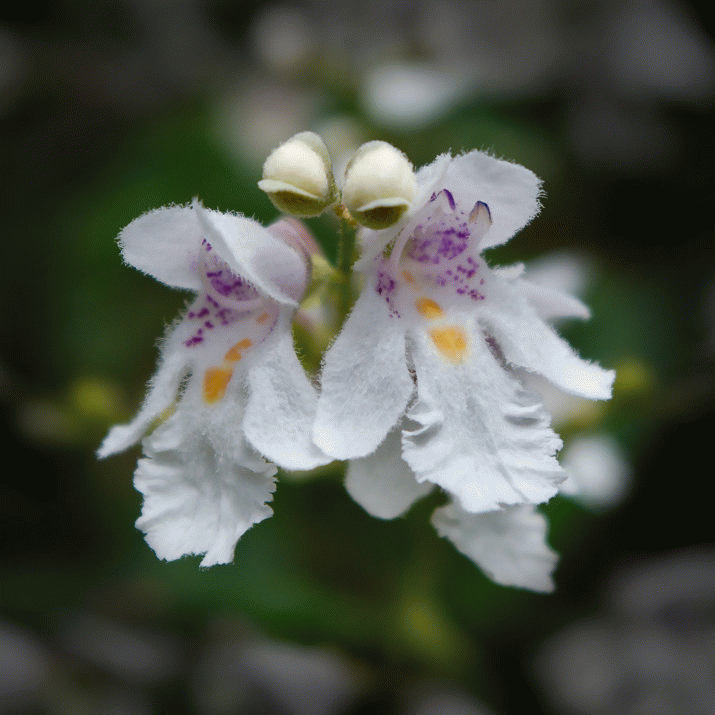
Flowering Christmas bushes are as big an attraction on the mountain as the red blooms of waratah but they eluded me at first. The tube-like, two-lipped flowers come in white and pale lilac and are spotted with purple. I couldn’t find them on a short walk at the Springs and the prospect of seeing them, and hearing the mountain birds, lured me higher and before long I was in a full-blown four-kilometre hike along the Pinnacle and then Organ Pipes tracks.
Mount Wellington is like that. Seductive and beguiling, taking you to places you do not necessarily want to go.
An olive whistler sang at the Springs at the start of my latest adventure and it seemed a good idea to go in search of not only the Christmas bush but the bird species that frequently hides from me on the mountain.
The sightings of whistlers had been non-existent during the year and I had dusted down a CD of Tasmanian bird sounds and learnt the song once again, just in case I was getting it wrong.
As I made my way up the mountain, crescent honeyeaters sang all about me, as they always do on the higher slopes where they migrate to breed in summer. After a short time, climbing ever higher, I came across a whole family: parents and three fluffy juveniles, drinking in the cool waters of a spring.
At last I noticed a Christmas bush in flower. Not only this but the red blooms of waratahs and the tiny, white daisy-like ones of satinwood fought for sunlight under a canopy of snow gums. I was lured even higher by the beauty of it all, although the wind was now getting up and I struggled to move forward in exposed locations at the junction of the Organ Pipes and the Zig-Zag trails, the latter climbing to the summit. The wind whipped flower petals from the shrubs and now the way ahead of me was a carpet of red and white petals.
I had the trail to myself before another walker came into view, coming towards me in full hiking gear – stout boots, sensible shirt, waterproof trousers, and gaiters to ward off leeches. I hadn’t even thought of the menace of leeches.
I had seen the hiker before, an elderly gentleman possibly in this 70s whose stout and purposeful stride belied his years. He never spoke before, beyond a nod as he passed but now he paused and said he had started out early to climb to the summit and the flowers along the Organ Pipes Trail had been the highlight of the day.
When he described them – briefly, not wishing to engage in conversation, just merely mentioning the profusion of flowers – I felt compelled to press on. I had after all reached the point of no return and it would be easier for me to hike to the end of the Organ Pipes Trail at the Chalet and return to the Springs on an easier route down the Pinnacle Road.
It proved a magical walk, not just the flowers and birds, but the panorama that spread out at every turn. To my right, alternating wet and dry woodland swept away towards the city, framing the blue waters of the Derwent and the Tasman Peninsula beyond. Ahead and above me the Organ Pipes loomed, towering vertically into the sky. The trail took me through a range of habitats interspersed occasionally by a floor of dolerite scree, formed of large boulders that I had to climb over in places.
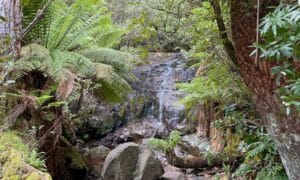
Every now and then a shallow stream cut through the track, and this was crossed by stepping stones. There was reward for my efforts to complete the track beyond the rich floral landscape, as any effort made in the name of the mountain is rewarded one way or another. Before me, in a cluster of satinwood trees around a rockpool, a male olive whistler, in crisp plumage, busily plucked flying insects off a wind-bent urn gum. The trail rose and dropped, moving from sheltered forest into more open, grassy areas at the treeline.
At higher elevations than where I had previously found them along the Lenah Valley Track, Richea dracophylla were just now bursting into flower, pink and white spikes contrasting in shape and form, and colour, which the fists of scarlet waratah. Snow berry dotted the landscape, the white vase-shaped flowers with pink centres clustered at the ends of branches.
Tired and sunburnt, an hour after finding the olive whistler, I slowly made my way down to the Springs after reaching the Chalet. As I walked two new birds for the mountain emerged, First a pair of new holland honeyeaters busily feeding in the waratahs, and then a brown falcon following me for part of the way down the hill.
The bird drifted in slow flight on the ocean side of the road, surveying the terrain around its flight path. Although it was flying quite high, it was still level with me because of the steep gradient that fell away towards the Derwent. I could see the wind ruffling the feathers of its chocolate-brown body, its outer wing feathers quivering as it adjusted its course to avoid tall trees. It turned its head to look at me, keen eyes nestling in the two black facial moustaches running down to below its bill. Then it banked into the wind, rose and was gone.
The sight of the honeyeaters and brown falcon, the exhalation at seeing new species, had taken the sting out of my exhaustion on such a hot day, and now I rested on a sandstone wall guarding a sheer drop below the road. A kindly motorist stopped. Had I broken down, he asked? Did I need help? I might have had binoculars strung around my neck, and a book on plants hanging out of my pocket, but my muddy town shoes and grey trousers suggested I was not a man for the mountains after all.
Two days after recovering from my unplanned walk, I hit the mountain again. It was time to check on the fantails. Approaching nests I had found previously, I always felt a sense of dread that this time all would not be well. Nests, and the birds guarding them, are always vulnerable and often fall prey to predators. The pink and flame robins, and the Bassian thrush had survived so far and I was happy to see that the fantails were also well on the way to success. Three juveniles were on the wing, flitting around the serrated leaves of the waratah, wary of venturing further afield. They were agile and nimble in flight but their reluctance to leave their parents and their dishevelled and mainly brown plumage betrayed their inexperience and youth. Parents and young flew in tight formations around the home bush, the young stabbing at flying insects but ultimately landing in the waratah with a crash, and calling to their parents for a feed.
The days grew hotter again, and at mid-day birds fell silent, as they rested in the shade. After so much frenzied activity in the proceeding months it was disconcerting to see the air devoid of flying birds from just before lunch-time to late afternoon. When I came across watercourses, thirsty birds were invariably taking a drink. A family of grey currawongs here, forests ravens there. The bigger birds, including sulphur-crested cockatoos, were noisy and showy at the creeks and streams and ponds and pools. Amid the splashing and dunking, the smaller species found their own drinking and bathing spots, usually hidden under palm fronds and layers of spreading dogwood and myrtle.
As at nests, birds are vulnerable at watering holes, where popular ones attract the birds of ambush, brown goshawks and sparrowhawks, to say nothing of a currawong, a raven or even a kookaburra out for a quick meal.
The birds may have largely fallen silent but the two species that provide the low background music of the woods, brush and common bronze-wing pigeons, kept up their songs, often in unison. Along a section of the North-South bike track following a mountain contour, dividing wet forest on one side and dry woodland on the other, I could hear a pigeon duet. The rhythmic booming of the brush bronze-wing, an incessant “hoot” timed at exactly one second intervals which sounds to some like the warning horn of a reversing truck, rose from a hidden spot in the wet forests. And the even slower, but booming, song of the common bronze-wing pigeon, could be heard from clearings catching the sun in dry woodland.
I sought shelter increasingly on the wetter parts of the mountain, where stringybarks and dogwood and myrtle released moisture into the air, creating a micro-climate. Cheeseberry was in white flower, along with pink mountain berry. New growth gave the plants layers of contrasting colours; shiny new maroon leaves adorned gums and wattles, light green leaves formed a mantel over bottle-green banksias.
Walking the North-South Track, I looked from a scree platform towards the east and could see parched paddocks and fields, cooked by the sun in subtle shades of brown and yellow; umber, ochre and sienna. The colour of the land indicated what season held sway throughout the year. I didn’t need a calendar to know it was now summer, instead of spring, winter or autumn. Or more precisely the hottest of the three seasons recognised by the Aborigines which I translate as burned ochre, following the emerald of spring and the teal of winter.