RICH or poor, young or old, living in the northern or southern hemisphere, climate change is an international problem which threatens us all equally. Environmental threats in one part of the world have far-reaching consequences and they need to be tackled collectively, wherever they arise.
I am interested in protecting our common environment, and that to me is more important than allegiance to party or country. So I have campaigned against massive carbon emissions in the US, the destruction of unique peat bog habitats in the UK and indeed the deforestation of old growth forests in Tasmania.
I started campaigning about Tasmanian deforestation back in 2004 after I was approached by Australians asking for my help. So I laid a parliamentary motion on Tasmanian old growth logging before the UK parliament. This Motion condemned the destructive practices of the Tasmanian logging industry and called on Britons planning to visit Tasmania to consider whether they really wanted to support a state where the government was clearly content to sanction such damaging environmental practices. The motion received the support of 106 MPs, including the well-respected former Secretary of State for the Environment, Michael Meacher.
More importantly, I received overwhelming support from Australians. The positive messages of thanks that flooded into my inbox outnumbered complaints by 5-1 and backed up the Doctors for Forests poll which revealed that 85% of Australians are in favour of protecting old growth forests. Indeed, many environmentally conscious Australians tell me that they despair at the Tasmanian government’s inaction and have therefore asked me to come out to Tasmania to internationalise the issue. The Tasmanian government have also challenged me to visit to see for myself the activities of the logging industry, so presumably everyone will be happy I’m here!
All the biodiversity of a car park
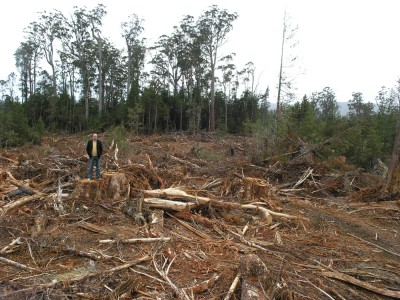
I believe that the current situation in Tasmania, the most heavily forested state in Australia, is extremely worrying. Tasmania is a natural wonderland, home to Australia’s greatest temperate rainforest and magnificent hardwood forests. Yet an estimated 15,000 hectares per year of native forests are clear felled, fire bombed by helicopters and left to burn. This includes some of the tallest hardwood forests in the world, Eucalyptus Regnans, which grow over 70 metres tall and are up to 450 years old. These ancient trees are the natural habitat of many endangered species including the Wedge-Tailed Eagle, the Yellow-Tailed Black Cockatoo and the Eastern Pygmy Possum who live and nest amidst the top-most branches or in the holes and hollows that occur when ancient branches naturally fall. The vast patches of scorched land which are then replanted with fast-growing monoculture plantations have all the biodiversity of a car park.
To make the situation even worse, some of the logging companies then use a ghastly poison, 1080, to carry out a deliberate mass-slaughter of any indigenous species that might browse on the growing saplings.This inhumane practice has apparently been phased out on public land, but continues on private land owned by companies such as Gunns. This is in violation of a promise made by the Australian Prime Minister before the last election. Although Gunns, the company responsible for 85% of Tasmanian deforestation, claim that logging in public native forests is sawlog driven actually almost 90% of wood felled is turned into woodchip. Only 3-4% of logs extracted from native forests on public land become sawn timber.
Increasingly, the trade in unsustainably sourced Australian timber is becoming an international issue. Gunns will doubtless point to their certification under the Australian Forest Standard (AFS), one of the national schemes under the umbrella of the Programme for the Endorsement of Forest Certification (PEFC). But the AFS has been widely criticised by environmental groups who have highlighted a vast array of its deficiencies, and it remains an interim standard only. In fact, only recently when answering one of my parliamentary questions the UK’s Minister of State for Climate Change and Environment, Elliot Morley, commented that while PEFC has adapted its guidelines to provide credible assurance of sustainably sourced timber ‘on paper’, it is questionable whether the national schemes it encompasses are realising these changes in practice. And, just last month, the House of Commons Environmental Audit Committee released a report expressing grave concerns that, because PEFC does not demand a common minimum standard of sustainability from its national members, it may need to be struck from the UK government’s ‘approved’ list.
This is unacceptable in a democratic society
One of the most worrying deficiencies of the AFS was the lack of environmental NGO involvement in the initial standard setting process, which appears to be symptomatic of a wider lack of transparency and public involvement in Tasmanian forestry. Australian friends tell me that the forestry industry in Tasmania is notoriously defensive and, shockingly, largely exempt from Freedom of Information (FOI) law. This means logging companies retain total control over what information is placed in the public domain and, of course, what is withheld. This is quite simply unacceptable in a democratic society.
Forestry Tasmania is the manager of a vast public asset and it is only right that the public should have the right to ask questions, even the awkward ones, without having to fear a “slap suit” such as the $6.8m damages writ which Gunns has served on 20 conservation groups and activists. This is a disgraceful bully-boy tactic clearly designed to stifle free speech and, in response to it, I have tabled a second Early Day Motion in the UK parliament condemning the lawsuit and calling on Japanese paper companies to boycott old growth woodchip. I am delighted to say that this motion has now received the support of 107 MPs from all parties, including Labour, Lib Dem and Conservatives.
Australia is a wonderful, modern and diverse country with a wealth of natural treasures, amongst them the beautiful forests of Tasmania. You cannot help but be overawed by the majesty of the kings of trees, some of which were standing when Abel Tasman first landed on Tasmanian shores back in 1642. Every year 550,000 Britons travel across the world to see these natural wonders for themselves, making them nearly the single largest group of international visitors to the state. 200,000 jobs are supported by tourism in Australia compared to just 8400 created by the logging industry in Tasmania (and fewer than 1000 in oldgrowth logging).
Unfortunately, as the unsightly scars of clear felling and swathes of uniform plantations increasingly blot the Tasmanian landscape, the logging industry has begun to seriously conflict with tourism as the former destroys the lifeblood of the latter. As the profile of Tasmanian deforestation rises in the UK the question must of course be asked whether Britons, and indeed the rest of the world, will continue to come to Tasmania only to see forest clearings where once there were trees. Or whether they will vote with their feet and holiday elsewhere.
Norman Baker is Lib Dem Shadow Environment and Rural Affairs Secretary