The “Respect the Mountain” forum ( here, here, and here ) at the Hobart Town Hall earlier this year prompted Don Knowler to return to a diary he compiled after daily rambles on Mt Wellington during the previous year. In what promises to be a momentous year in the modern history of Kunanyi, the weekly diary gives the mountain and its wildlife its own voice. All Don’s Mother Mountain columns – and much more by this superb writer – can be found under the Category, Don Knowler, here
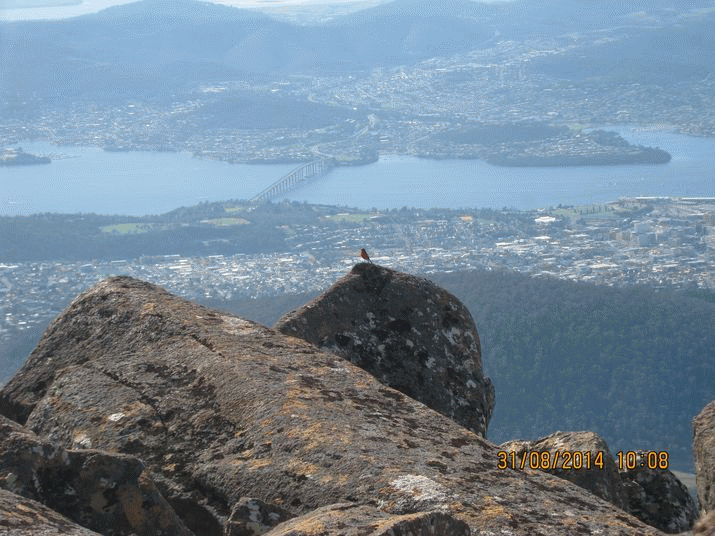
As fleeting and fragile as a snowflake, the tiny flame robin flitted across the summit of Mr Wellington, singing a sweet melody as it went.
In an instant the flame robin was gone, vanishing as fast as it had first been carried on the wind, its song lost to a snow drift piled high against the rocks, the soft snow swallowing the merry twitter.
The rugged, unforgiving mountain peak is not home to sweet birdsong during the winter months, ringing instead with the harsh sound of the raven’s caw and the mountain currawong’s lament. All the same I had defied reason to travel the Pinnacle Road looking for the first of the spring migrants, those that also defy reason and arrive in Tasmania when snow still lingers in the high country.
It was a long shot – although already I had found a fan-tailed cuckoo in recent days – but I had a specific bird in mind, the beautiful flame robin which I had glimpsed fleetingly in the lowlands of Richmond a few days previously, in the last week of winter before spring officially made its appearance on the calendar.
I’d seen a single flame robin at the summit in early spring in the past and I thought that if I was to record the first of the species to arrive on migration, and possibly other early arrivals, a slow drive from Fern Tree to the upper slopes of the peak might reveal them.
Such hunches rarely work for me, but on this occasion I was to surprise myself.
I had only been out of my car at the summit car park for a few minutes when I heard the flame robin’s song and I immediately went in search of it. It wasn’t hard to find. There it was on the northern side of the mountain, its delicate beauty set against the backdrop of the peaks of the Tasmanian Wilderness World Heritage Area, the distant mountains to the south-west brushed with snow.
The flame robin is the only one of the four family members found in Tasmania that travels north over Bass Strait for the winter and each year I eagerly await their return. The scarlet robin that lights up our suburbs during the winter months might also be a stunner, but the male flame robin has a different, more subtle kind of beauty. Its breast is not scarlet-red but more of a fiery orange and this alone sets it apart from its near relative. On closer observation the flame robin has an orange throat, the colour of the breast reaching right up to the chin; the scarlet robin has a black throat. The flame also has a charcoal-grey head and back, instead of the scarlet’s black.
I lingered on the mountain summit and cast my eyes north from where the flame robin had come. The green valleys meandering between the mountains and lower hills stretched into the distance before they were lost in mist and low cloud and I pictured all the other birds on their way, following ancient trails that lead them to their breeding rounds. Somewhere out there were summerbirds, welcome and dusky swallows, tree martins, and pallid, shining and horsfield’s bronze-cuckoos.
I didn’t immediately see the flame robin again and I thought that it might still be travelling, heading further south with the mountain merely another obstacle in its way. He soon started singing again, however, and was clearly establishing his summer territory with its cheerful and optimistic tune in what would soon be a less hostile world. For this tiny bird the long, perilous migratory journey was over, at least until the autumn.
The next two days were spent down in the Waterworks Valley, and checking the lawns outside Parliament House in central Hobart, a popular welcome swallow haunt in summer. And I was rewarded on September 3 with the sighting of two swallows hawking insects over the Waterworks Reserve. It was official, spring had arrived.
On slender, streamlined wings the swallows carry with them all the hope and aspiration of the new season after the dark days of winter. From ancient times, humans in both the old and new worlds have looked for them eagerly to give shape to the seasons. From the time humans living around the Mediterranean first learned to plant and cultivate crops, it was swallows who told them when to sow, and when to reap. And I’m sure that the Aborigines also looked to the swallow, and perhaps too the black-faced cuckoo strike, for confirmation the seasons were about to change for the better.
When the first Europeans arrived they brought the European – and American – folklore related to swallows with them. The settlers thought that welcome swallows returned to Britain in the Australian winter, not so far-fetched a notion considering the settlers in Africa knew that the swallows there made the journey to Europe.
The settlers were not only wrong about the destination of the swallows but confused the European species with a similar Australian one, which has a less dramatic migratory journey, merely travelling to the warmer areas of the Australian mainland.
The knowledge of the European swallow’s lengthy migration was gained at about the time the first Australian colony in New South Wales was marked out. Previously it was believed swallows in England either hibernated in mud during the harshest winter months, or flew to the moon.
The Waterworks Reserve, linked to the mountain by the pipeline trail that follows the route of the water supply for the city, can be as seductive and beguiling as the mountain, mixing walks through a range of habitats, all with distant views of the Eastern Shore, the mountain or the waterworld of the two reservoirs. Because the reservoirs have grassy embankments, and forest coming down to the shoreline on one side, the term “waterworks” to describe the location is an injustice.
In the year I monitored the mountain, though, I had to pull myself away and not linger there. The view of the mountain towering over the reserve was not enough, and it would not supply the birds I had to see.
A chill in the air, but the birds knew at least it would not last. There was work to be done as the weather warmed: territories to be staked out, and territories proclaimed in song from branches high and low. The resident birds had to get in quickly, because the migrants were on their way to claim territories of their own.
The woods in the first week of September, with just a hint of sunshine, exploded into song. A pink robin singing and displaying to attract a female, throwing its head back and pushing out magenta breast; a scarlet robin a little more restrained, a thin twitter without dramatic posturing. Golden whistler, grey-strike thrush, brown thornbill. They were all at it.
Against the background music, a flutter of wings, and brief contact calls, as other birds that had not reached their destination moved through the valleys below the mountain and made their way up its slopes. The metallic “egypt” of crescent honeyeaters, the “tick” and then rapid twitter of eastern spinebills. In slow flaps, a grey currawong joining the black currawongs on the mountain moved skywards, with “clink, clink” calls as they went. In Tasmania, the grey currawong is known as the “clinking currawong” because of its song.
I took note of the domestic migrants, making relatively short journeys from lowland to high country but was more interested in the trans-Bass Strait ones. But a north-westerly wind bringing warm air and mainland birds suddenly changed to a southerly one bringing chill air. Migrants would not be moving and even the resident ones kept low and silent.