The “Respect the Mountain” forum ( here, here, and here ) at the Hobart Town Hall earlier this year prompted Don Knowler to return to a diary he compiled after daily rambles on Mt Wellington during the previous year. In what promises to be a momentous year in the modern history of Kunanyi, the weekly diary gives the mountain and its wildlife its own voice. All Don’s Mother Mountain columns – and much more by this superb writer – can be found under the Category, Don Knowler, here
The tiny marsupial blinked through pin-prick, shining eyes. I was blocking his path as he tried to scurry into the undergrowth on Mt Wellington.
Sharing a track with a dusky antechinus half-way up the mountain, we had both been caught out by a sudden change in the weather, which brought a blizzard swirling around the peaks to the south.
I did not have a winter coat, or a hat but my problems paled into insignificance when I considered those of the antechinus. A brown falcon hovered, spotting the antechinus as the snow clouds gathered, and I raised myself to my full height after crouching in the snow, to let the falcon know the marsupial had a friend.
And he needed someone to watch over him. It’s not easy being an antechinus out on a mountain track, pursued by a falcon with an even greater fate at the unforgiving hand of nature just around the corner.
The antechinus had been out and about looking for a mate, and in the process sealing his own death warrant, which would come regardless of the intrusions of the falcon or any other predator stalking the mountain.
My passion is with birds and specifically how they interact with humans where suburb and city meet the bush but our feathered friends are only part of the bigger picture and I cannot ignore what else I observe on my rambles.
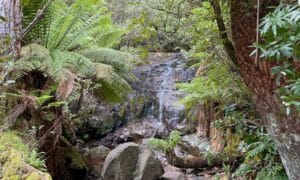
Bennett’s wallabies, pademelons and potoroos also share my wildlife world, as does the platypus I spotted recently at the Silver Falls on Mt Wellington, and now the mercurial, mysterious dusky antechinus.
The species is small for one to be tramping the mountain at night. It’s only between 10 and 16 centimetres in length without its long tail, and weighing a mere 65 grams, the females even lighter. It’s a carnivore, its diet comprising insects, worms, lizards and, occasionally, even small birds, and this is supplemented with fruits of the forest.
As with most marsupials, the dusky antechinus is nocturnal, spending the day-light hours within a nest in a hollowed log or among the thick leaf litter and ground vegetation of the forest floor.
It is its mating behaviour, though, that sets this marsupial mouse apart from other animals. The males in winter are driven to frenzied sexual activity due to raised testosterone levels and they compete vigorously for females. Within three weeks, almost all the males in the population are dead. The male die-off is largely brought on by the high stress levels associated with the physiological changes brought on by the breeding period.
The female gives birth after a four-week gestation period. Six to eight young are born and carried in the pouch for up to eight weeks. Young are then left in a den before becoming independent at about three months
All these facts were presented to me when I sat at home after leaving the mountain, reading about the antechinus in an animal book as I sat in front of a roaring log fire.
I was thinking of an over-sexed marsupial mouse roaming a mountain track, and grateful evolution had sent me along a different path.
The mountain is about more than birds, as I have said, and the joy of monitoring such a complete, unfragmented environment is what it turns up on any given walk. Beyond birds I have a good knowledge of mammals, reptiles and amphibians but what of insects, and trees and shrubs and flowers?
Work on the latter led me to another field of discovery – that of fungi, and armed with a little knowledge in this field my walks took on another dimension.
I mention fungi directly after writing of the encounter with the dusky antechinus simply because during my fungi experience I learned that the world of mycology has more in common with the animal world than plants. Mushrooms and toadstalls and bracket fungi are, in fact, closer to animals than plants.
When the birds were refusing to sing in the autumnal and early winter months – the peak fungi fruiting season – I started to look down at the forest floor, instead of up.
I discovered golden tops – the notorious magic mushrooms, but not to be eaten in Tasmania – nestling in leaf litter and coral and jelly fungi, stinkhorns, puffballs and the paint fungi that adorn logs in a worn white or beige coat of primer or under-colour.
There were earth stars – a form of puffball that explodes in such fashion to leave their skins forming a star-shape – and leather fungi, which as their name suggests have a smooth, polished brown skin.
These are the fungi with common names that more or less describe their appearance. Many of the most beautiful hide behind Latin names, like my favourite, Mycena interrupta. These are small but spindly tall fungi with sky-blue caps. They are found on logs, and litter the forest during the fruiting season.
A pink robin hopping among the blue-caps, the sun cutting through the canopy to provide a floodlit stage for nature’s showpiece. On a winter’s day, I’m spellbound.