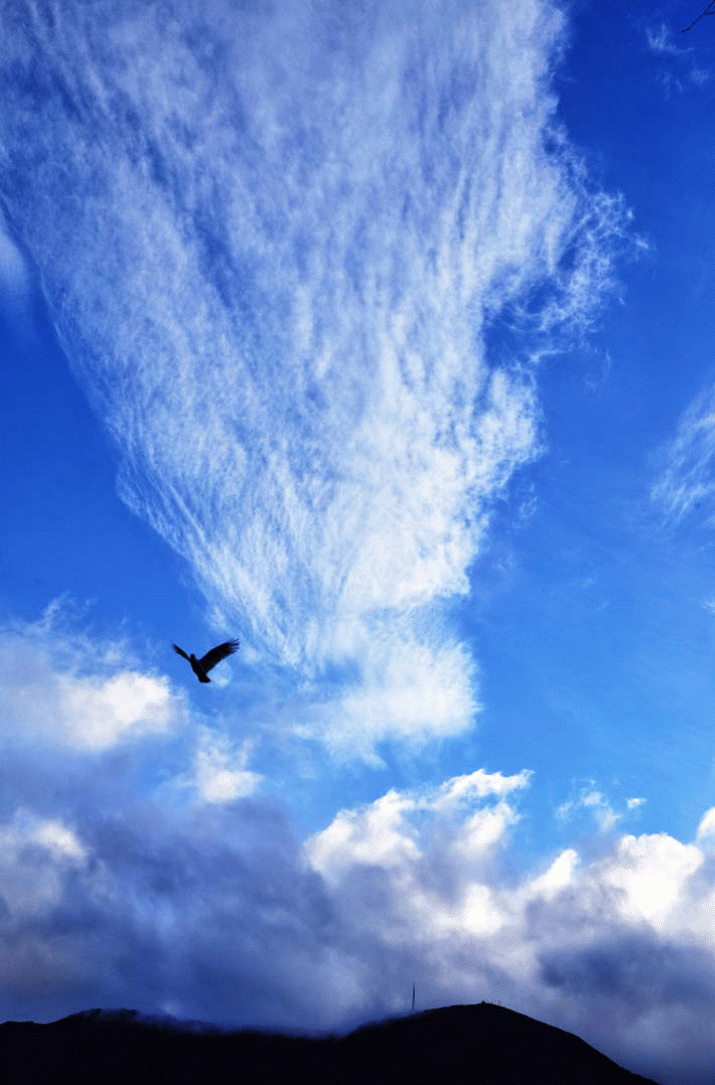
Cloud, cockatoo and our mountain … Pic: Rob Walls, http://robertwalls.wordpress.com/
The “Respect the Mountain” forum ( here, here, and here ) at the Hobart Town Hall earlier this year prompted Don Knowler to return to a diary he compiled after daily rambles on Mt Wellington during the previous year. In what promises to be a momentous year in the modern history of Kunanyi, the weekly diary gives the mountain and its wildlife its own voice. All Don’s Mother Mountain columns – and much more by this superb writer – can be found under the Category, Don Knowler, here
Chinese have a saying “listen to nature and she will speak”, and she was certainly speaking this day.
Birds were in full voice, the forests ringing and echoing with the symphony of nature.
Along with the birdsong, there was the gentle murmur, hum and rhythm of the wind in the canopy, a caressing of trunk and bough. And then a new sound, a see-sawing, a scraping, not harsh but soft in an irregular, broken rhythm. I thought I knew it, it could not be termed nature’s music at all, more nature’s percussion, nature’s drumming.
Strong-billed honeyeaters probe and scrape at bark in their hunt for insects, and if enough of them do it, it provides a unique sound that firmly belongs to nature and is not of man’s world. The falling of flakes and splinters of bark accompanies the see-saw sound, the scraping, but I could not see a tree confetti drifting to the ground. I strained to look again, gazing into the canopy of the trees above me and I saw two trunks, swaying in the wind and rubbing against it each other.
The long-gone Aborigines who trod these lands before me had a name for the sound tree trunks make when they rub together in the breeze, Retakunna. There is no equivalent of it in the English language.
It was not only the simple observation of trees rubbing together that gave the Aborigines a different perspective, a different priority to that of the people who were to follow them. The first Tasmanians also viewed the seasons differently. They only recognised three seasons and I think these correspond more appropriately with the moods of sun and moon, the whiles of the weather. Winter in the Aboriginal calendar was called Tanna, and this stretched the four months from the start of May to late August. A short spring, Pawenya Peena, covered September, October and November, followed by a five-month summer stretching from December to April. Although the Aboriginal calendar might seem more fitting to the natural cycle of the mountain for the purposes of my diary, I decided to stick with the traditional European division of the year, mainly because in the previous 12 months I started my diary at the start of a calendar month, June, which was also the official start of the Tasmanian winter laid down by the first European settlers 200 years previously.
The birdsong suggested it would be a good morning for bird-watching and I was not to be disappointed. Only the usual and more common species occurred, but it was good to see them all the same.
As I walked the upper Lenah Valley trail a Tasmanian thornbill was on the track ahead of me, bathing in a small stream that crosses the track between sandstone blocks carved into paving stones. I halted, giving the thornbill time to complete its wash, and when it was finished splashing in the water, it hopped to a low-lying branch and shook off the water rigorously, before flying on in a flutter.
There are 12 species of bird found only in Tasmania and I had seen every one of them on the mountain, expect the most elusive, the forty-spotted pardalote, which is confined exclusively to white gum habitat in the sandy soils nearer the coast. The forty-spots might be down to a mere 1200 to 1500 birds left in the world – and not known to the mountain – but I can put them in a Mount Wellington contact. Bruny Island is the last area where they are relatively common and I have often watched them in the white gums at Dennes Point on North Bruny, set against the blue hue of the mountain’s outline in the distance.
The mountain calls to me and I can’t escape its grip and its pull. I’m not alone to feel the urge to communicate with nature, to visit the wild world, and I’m grateful that such a vast, untrammelled alpine area is within easy reach, an easy escape when the pressures contained in brick and glass get too much for me.
Growing up in southern Britain, I always envied the people from the north who had mountains and moorland towering over their cities. People in the Thames Valley west of London where I lived took to boats on the Thames at weekends, in the industrial cities and towns of Lancashire and Yorkshire they donned hiking boots to walk the fells as an antidote to life in the city.
This notion of escaping the city appears in much English literature and drama and a favourite playwright, Alan Bennett, has described in his work the pull of the moorlands surrounding the Yorkshire city of Leeds where he spent his youth.
The words of Bennett came to me when I visited Mona in early May to see a filmed version of his play, People, being screened in the cinema there. The play had nothing to do with outdoor places, nature, the moors, mountains but all the same I dug out a tape of Bennett’s monologues when I returned home. In one of these Bennett observes how the human world intrudes inexorably on the natural one. And both nature and man pays the price.
Bennet described how as a child he loved to be taken to the moors by his father, a butcher, on Sunday afternoons. But the advent of World War Two was to end these outings, along with other simple pleasures enjoyed by a boy in a northern industrial city. All of a sudden, the cinema and the swimming pool and the ice-skating rink had signs erected outside them, reading “Closed for the duration of the war”. And when Bennett asked his father to take him to the moors, his father replied: “Closed for the duration.”