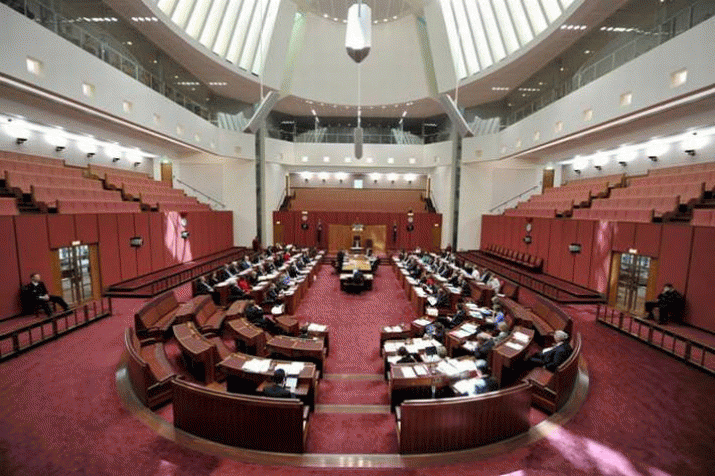
The Australian Senate is, as Paul Keating so aptly described it, unrepresentative swill.
Everyone knows it and everyone knows why. But will those who are responsible for perpetuating the problem, and for exacerbating it, do anything about it?
It’s downright pathetic and irresponsible that the electoral system for the Senate be allowed to continue unreformed. As the Melbourne Age editorialised shortly before the election, the system is thoroughly undemocratic and should be scrapped.
Back in 2004 when Victorian Steve Fielding, Family First’s first senator, was elected with less than 2% of the primary vote, there was a small ripple of concern in some quarters that something was amiss.
The “above the line” vote was introduced in 1984, ostensibly because of the high level of informal senate votes. That issue, as anyone with half a brain knows, could have been dealt with by simply allowing people to vote for as many candidates as they wish to give their preferences to, rather than continuing to force people to vote for candidates they don’t want to preference one way or the other. But no, they didn’t adopt the most obviously democratic solution because it didn’t suit their own partisan political interests.
It has always suited the main parties to encourage the “above the line” vote for the Senate because it enables them to control the flow of preferences. None of them were keen to suggest that the election of Fielding was totally at odds with any reasonable interpretation of the notion of “representative democracy”, and that any system which enabled such a result to occur was completely flawed and untrustworthy in reflecting the voting intentions of the electorate.
The reason is obvious enough. The Lab-Libs believe that if they can control the preference flow to their advantage – irrespective of who they make dirty deals with – they give themselves a good chance to pick up an extra seat than they really deserve. For example, they try and rig preference deals so that if they get 2.6 or so quotas they can transform it to three quotas. It all came unstuck in 2004 when both major parties made preference arrangements which fell into Fielding’s lap.
The Greens are now saying they want the system reformed. It will be interesting to see what they propose given that they have probably been the chief beneficiary of the current undemocratic nature of the system in the last decade or more, albeit for slightly different reasons than the Lib-Labs. It’s very rare that a Greens Senate candidate gets a quota in their own right in a half senate election, although it has occurred in Tasmania. In 2010, for example Christine Milne got about 20% of the vote. Usually however, the Greens depend on persuading their supporters to give the party the power to determine preferences. For example, in 2004 Sarah Hanson-Young got elected to the Senate from South Australia with about 7% of the primary vote.
So will the Greens support a reform which interferes with their ability to shape preference flows, especially a reform which allowed voters a true democratic vote? If, for example, “above the line” was scrapped, and voters were given the option of voting for as few or for as many candidates as they chose to vote for – a completely democratic process – it would not only eliminate the possibility that someone like Fielding or Sports Party and Motor Enthusiasts Party candidates could get elected with less than 1% of the vote, but it would make it almost impossible for the Sarah Hanson-Youngs across the country to get elected too.
To be blunt, the failure of the main political parties to ensure, after 2004, that the Fielding debacle could not be repeated – indeed deliberately imitated – indicates that none of them cares about the principle of “representative democracy”.
Whatever the dirty wash of the Senate election system ends up dumping on the cross-benches with the balance of power, whether it be a combination of a couple of PUP senators, one from the Australian Motorists Enthusiasts, one from the Sports Party and another from Family First – or some such similar combination of unrepresentative swill – let us be clear about one thing.
The Senate is a travesty of the very idea of democracy, and the introduction of the “above the line” system in 1984 has made it worse. It has been reduced – perhaps traduced is a better word – to a farcical status, completely stripped of its two main functions as envisaged under the federal constitution, a house of review akin to the US Senate, and a house which protected small states against the interests of the more powerful.
Those days have long gone, swallowed up in the successful quest to transform the Senate into a rubber stamp for the government or an obstructionist chamber, all based on party lines, without any nod to either the intentions of the constitution or the main legislative functions of the Senate in terms of the public interest. The Senate is a waste of public funds, most of its members party apparatchiks pure and simple, and most of the rest a loose amalgam of opportunists seeking to hold the balance of power. The reality that it no longer serves any purpose as a house of review or a states’ house reinforces the fundamental undemocratic basis of its structure and composition. There is nothing democratic about the fact that Tasmania, with a population of 500,000, has 12 senators, while the ACT, with a higher population – and growing – has only two.
Even with reforms which give the electorate greater control over who gets elected, such as the abolition of the“above the line” vote, a reform which allows voters to make their own choices about how many candidates they vote for, or increasing the quota required to be elected, there is little likelihood that the Senate will effectively operate as a genuine house of review in the public interest. The only time it can effectively operate as a states’ house is by chance, when the balance of power is held by a genuine independent – but that in itself is undemocratic, albeit not as bad as Fielding having an important negotiating power between 2004 and 2012.
It is certainly not as bad, for example, for Nick Xenophon to hold the balance of power in the Senate as it is for the Fieldings of this nation – or even the Greens – because Xenophon at least has won a quota in his own right. But nevertheless, that power is too great if and when it occurs.
2004 should have been the last straw, the catalyst for reform. The situation now is not merely worse, not merely absurd, not merely ridiculous and not merely laughable. It is a black comedy.
The current system makes possible for the Senate to be controlled by someone who ran for office as a joke, for a bet, for a bare-arsed streak. The Fielding precedent has opened the floodgates to whole new ways of exploiting the vacuous virtues of compulsory voting.
It is to be hoped that the Sports Party and the Motor Enthusiasts Party candidates don’t end up as senators, but it is still quite possible, of course. It is also quite possible that the tails of Palmer’s PUPs will be wagging the rest of us around for a few years.Who’s for building a replica of the Titanic?
• Inside Story: From little margins, big margins grow The electorate of Indi has been changed forever, write Cambell Klose and Nick Haines from Cathy McGowan’s campaign • Here
• ABC: Predictions Palmer party will split Tasmania’s conservative vote
• ABC: Report finds Tasmania’s June retail quarter nation’s worst
• Jenny Weber: Ta Ann is still selling Tasmanian forest destruction to customers in Japan
• The Age, Bob Brown: How to reform Senate voting in one easy step
• Tim Slade’s poetic view, here
• ABC: Tasmania dubbed the ‘rotten apple isle’ in health rankings … as … • Jobless rate continues to climb … as … • Politicians trade blows over Tasmania’s rising jobless rate
• Independent Australia: The Police State election
• Guardian Australia: Adam Bandt’s victory in Melbourne is no fluke …
• The Age: Bill Shorten nominates for Labor leadership as … • Sophie withdraws from frontbench contention … as … As Albo and Shorten go head to head for the Labor leadership Bill Shorten and Anthony Albanese will contest the Labor leadership in a ballot that essentially pits union power against rank-and-file party members.