Together we can, says Venerable Economic Development Minister David O’Byrne, on his website: http://www.davidobyrne.net/497
Well you can only agree … but who’s the “We”?
You can’t help but wonder. “We” in Tasmania can be a very select group of mates. When I first staggered into Tasmania I could not help but be astonished at the cartels …
I remember meeting an anaesthetist frustrated by the impregnability of the local medical cartels. She was here for three years and simply could not break in … relying for the occasional gig when the medical mates were desperate.
I suppose it’s true everywhere … it’s not what you know … it’s who you know; that of course is magnified in a sparsley populated isle like Tassie.
It’s certainly true of the controversial forestry exit grants ( TT: Committee to shine light on forestry exit grants ).
There are some intriguing grants under the TFA process.
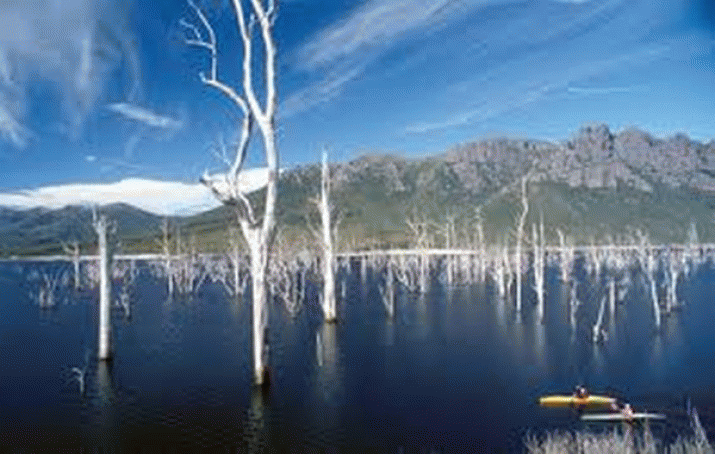
SFM Forest Products – http://www.sfmes.com.au/ – received $5 million through the Tasmanian Forests Agreement process to develop “hydrowood”.
What on earth is hydrowood?
The UTAS School of Architecture and Design – http://www.utas.edu.au/__data/assets/pdf_file/0006/375702/Arch-Des-Newsletter-Issue16-April2013_small.pdf – explains it thus:
Lastly, we are just starting a project on wood from Hydro dams.
The Centre for Sustainable Architecture with Wood’s (CSAW) is participating in Sustainable Forest Management (SFM) Forest Products’ HydroWood project. This project is the recovery of log and other wood resources from land inundated by Hydro Tasmanian dams. The intention is to sell the logs to mainstream timber producers.
CSAW’s role initially is to provide SFM and mainstream timber producers with confidence that the recovered logs can be economically and efficiently converted into suitable appearance and other sawn products. This confidence is essential if SFM is to sell the logs to wood processors in volume.
There are considerable unknowns in this. Timber submerged for long periods may have acquired characteristics both beneficial and detrimental to milling with the processes and major equipment suite currently used in Tasmanian indus try. Potential factors include:
• Bacterial degradation and discolouration of the wood
• The removal of water-soluble extractives and the impact this may have on drying and wood colour.
• Relief of internal stress.
• Potential mineralization of the wood.
The aforesaid David O’Byrne is immensely excited:
“I am particularly excited to see funding for projects that take advantage of new market opportunities in forestry such as $7.5 million for Ta Ann’s new plywood mill, $5 million for SFM Forest Management to develop Hydrowood and $4 million for Oak Tasmania to produce Hardlam.”
“This funding would not have been possible without the Tasmanian Forest Agreement, which is helping the community move on from decades of division and securing the future of regional communities.”
Read more here: http://www.davidobyrne.net/497
Wonderful isn’t it? That wondrous teat – Government Largesse – creates the conditions to Make Work …