

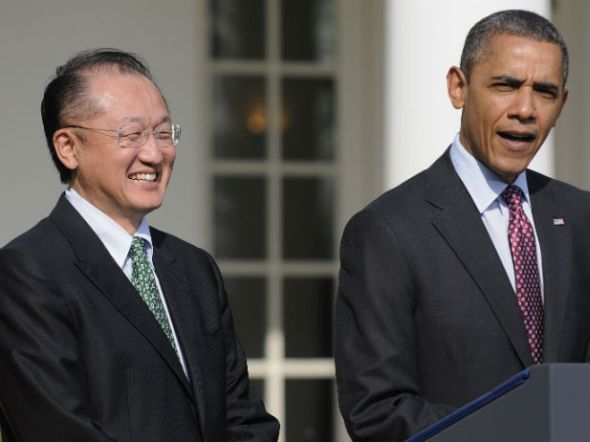
Towards the end of March, President Obama announced that he is nominating physician and Dartmouth College President Jim Yong Kim to lead the World Bank. This likely appointment was greeted with approval by many long-time critics of corporate globalization. And it came after an unprecedented level of debate about who should be the institution’s next president.
By tradition, the World Bank president has been a political appointee named by the White House. Europe has agreed to go along with this arrangement, with the tacit agreement that a European, in turn, would be named as director of the International Monetary Fund. As for the rest of the world… well, the International Monetary Fund (IMF) and World Bank haven’t traditionally put too much weight on what the Global South thinks.
This year things have been a bit different. For the first time, there’s been a concerted – and effective – effort to intervene in the nominating process and prevent a crony coronation. To this end, a variety of developing countries and progressive leaders got behind the candidacy of economist Jeffrey Sachs, who in recent years has refashioned himself as an anti-poverty crusader.
But other critics of the status quo were sceptical of this pick. Although Sachs now tries to highlight his anti-poverty credentials, he was previously known as a neoliberal ‘doctor shock’, advising on ‘stabilization’ programmes in countries such as Bolivia, Poland, and Russia in the 1980s and 90s. This history earned him a place as a leading villain in Naomi Klein’s The Shock Doctrine.
Sachs has never been big on apologizing. And many followers of Latin American politics, including me, find his lack of remorse for his role in Bolivia to be a big problem. But, in a debate hosted at the Nation (in which John Cavanagh and Robin Broad made the case against Sachs), progressive economist Mark Weisbrot – an outspoken defender of Latin America’s ‘New Left’ – wrote in the nominee’s defence. Weisbrot contended:
‘Sachs has a reform agenda for the Bank, including having the Bank focus more on treatment and prevention of infectious diseases, support for small farmers, education and primary healthcare, and renewable energy (as opposed to fossil fuels). He also has a track record of having fought for debt cancellation, an end to the World Bank’s policies of imposing user fees for primary healthcare and education, for the Global Fund to Fight AIDS, Tuberculosis and Malaria (which has saved millions of lives), increased access to essential medicines, and having been outspoken against war and other abuses by the US government.’
Weisbrot and others also made a few arguments on the strategic level. First, they contended that Sachs was far preferable to Larry Summers, who was seen prior to the Kim announcement as Obama’s likely pick. (I can hardly argue with them on that point.)
Read the full article and an interview in New Internationalist HERE:











