FT head Bob Gordon and Forests Minister Bryan Green

Picture at Hadleys: Doug O’Neil

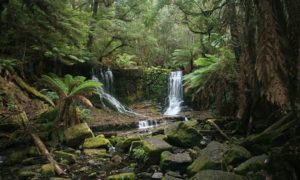
Picture at Hadleys: Thomas Moore

Dr. Thomas Moore, PhD. Thomas Moore Photography Blog: http://www.thomasphotoblog.com

Dr. Thomas Moore, PhD. Thomas Moore Photography Blog: http://www.thomasphotoblog.com
• John Biggs:
RETHINK FORESTRY TASMANIA: THERE’S GOT TO BE A BETTER WAY!
Indeed there does have to be a better way, as five expert speakers have made brilliantly clear at a meeting convened by Environment Tasmania, The Wilderness Society and the Florentine Protection Society.
Associate Professor Graeme Wells, Dr. Frank Nicklason, Dr. Phil Pullinger, Geoff Law and Dr. Andrew Lohrey, from their expertise and inside knowledge, explained to this no-standing-room meeting at Hadley’s Hotel on Tuesday 3rd April exactly why Forestry Tasmania needs to be rethought.
Graeme Wells spoke to the economic bottom line. It is devastating. Since 1970 the price of wood pulp has halved, in real terms. Demand is down, jobs are down. The reason is not because Tasmania has been talked down by environmentalists, but because the demand for paper has gone down, competition from South America is too strong, the Australian $ is at record highs. In 2008 there were 7,000 jobs in forestry operations, today there are less than 3,000. At best, forestry jobs comprised 2.8% of the Tasmanian workforce: today that figure is 1.2%.
Forestry Tasmania’s mantra that this is all about “jobs, jobs, jobs!” is patently false.
Wells pointed out that FT’s annual financial rate of return is 1.7%, which even puts superannuation entitlements at high risk. This situation in a private company would have the shareholders baying for the blood of the CEO and the board of directors. And we, the Tasmanian public, are FT’s shareholders, if we but knew it. The Treasurer (Premier Lara Giddings) and the Minister for Energy and Resources (Deputy Premier Bryan Green) are also shareholders: they are the two ministers to whom FT is accountable, as a tabled document informed us. Yet FT’s performance is so dismal that it has lost $20 million in two years and has had to be supported with more and more public money: the Auditor-General’s 2011 Report noted that FT had received $223.465million; the Wells Report noted that between 1997-98 to 2007-8 the Tasmanian forestry industry as a whole had received $632.8 million from State and Commonwealth governments.
FT’s performance, as Frank Nicklason pointed out, has other human and environmental consequences. Clear-felling, particularly on slopes, has greatly damaged water supplies and destroyed habitat of endangered species. The forests are not, as Dr Julian Amos has repeatedly insisted, FT’s property to do with as it will; the forests are the property of the people.
All this has done exponential damage to public trust in both Forestry Tasmania and in the Government that allows it such license – which includes (largely) exemption from Freedom of Information and from environmental and endangered species legislation. FT is guilty even of infringing the Forest Practices Code, which surely should be enforced by law.
Geoff Law drew our attention to FT’s website, where we are told that FT is committed to sustainable forestry management, to “working with nature”, to “responding to research”, to “thinking long term” – as if FT was a cross between a national parks service and the CSIRO. Law cited example after example where FT’s actual operations were not sustainable, worked against nature and was engaged in unscientific, short-term operations.
In the Wielangta case an expert witness was instructed by FT to alter an affidavit that originally stated that continuing with forestry operations would put one endangered species at high risk of extinction – so much for working with nature and responding to science. Forestry Tasmania was directly responsible for the destruction of Auspine’s two thriving softwood mills in Scottsdale by withdrawing supply from its pine plantations and selling it instead to a company in BellBay that wasn’t at that stage in operation – and has since gone belly up.
This was a direct conflict of interest where FT had entered a Joint Venture with another company – and placed that company’s commercial interests ahead of FT’s chartered obligation to the public interest. By entering into a joint venture, FT becomes non-accountable to Parliament and even to its own legislation, and thus feels free to privatise public property as it wishes. This is essentially what happened in the Auspine debacle, leaving the timber industry in Scottsdale crippled and nearly 300 workers jobless.
Phil Pullinger elaborated in some detail on the over-selling of contracts, in particular to Ta Ann. FT has contracted to supply Ta Ann with timber and peeler logs that existing supplies cannot meet and couldn’t ever meet unless breaking into reserves that have been agreed are protected. After the two signed Intergovernmenta lAgreements (IGAs), when both environmentalists and the industry agreed that areas were to be locked up, three times FT was asked to stop logging and each time they increased logging operations, which may be taken as a deliberate snub to both state and federal governments.
From the early 2000s, the federal and state governments have been encouraging tax havens in the form of Management Investment Schemes (MIS) that have resulted in the destruction of old growth forest and replaced with 100,000 ha of plantation timber – half of which is the notorious eucalyptus nitens. Now that Gunns have exited old growth logging, and more old growth is being locked up as a result of the IGA, the awful truth has come out: the forest industries, including Ta Ann, say all that nitens is unusable for their purposes.
At the cost of $100 million to the taxpayer, FT had planted the wrong species on a massive scale!
Under the original Forestry Act of 1920, forestry operations were to be sustainable and commercially viable, but were also to look after non-wood values of forests (tourism, aesthetics, biodiversity, species protection – and today we would add carbon storage). Extraordinarily, that Act committed a minimum of 317,000 m3 of timber per annum for commercial purposes; this minimum was last set at 300,000 m3 pa in 1991 to give “long term security” to the industry. Perhaps in the 1920s 300,000m3 was sustainable, but that figure is entirely unsustainable today when vast tracts of forests that existed in 1920 have now disappeared. This mandatory commitment places industrial logging as the top priority of FT and it can only be changed by an act passed by both Lower and Upper Houses. Yet under the Government Business Enterprises Act 1995, FT is also committed to operate with sound commercial practice, as efficiently as possible, to achieve a sustainable rate of return, and to perform its community service obligations. FT is doing none of these last named – and can’t do so because of the huge amount of timber that it is required to supply annually.
This is simply crazy.
Andrew Lohrey was, for a brief 8 months, Minister of Forests in the 1970s. He was shocked at the non-accountability of the then Forestry Commission. He demanded to know what the financial situation was – he knew that private businesses were making timber truckloads of money but what was the government getting for this? He set up a commission of enquiry to provide the answers. He was ordered by Deputy Premier Neil Batt to stop the enquiry; Lohrey refused. A cabinet reshuffle quickly saw Lohrey out Minister of Forests to be replaced by – Neil Batt. Then, as now, no questions may be asked about the finances of forestry.
Documents tabled at the meeting, comprising the findings of eight different reports on forestry, filled in the dismal picture of a Government Business Enterprise that is failing badly.
The conclusion to be drawn from this important meeting is clear: Forestry Tasmania has failed on virtually all of its obligations: economic, societal, moral and environmental.
It must be restructured.
How that might best be achieved is of course the question. Should it be returned back into a governmental agency that is accountable to parliament? Should it be privatized, to run on proper business grounds? Whatever, Tasmanians deserve better than the current rogue agency Forestry Tasmania has become.
A baffled and enraged public may well ask: Why have both major parties mollycoddled this uneconomic and failed industry with protective legislation and vast sums of taxpayers’ money? And not only that, they have promised to support it unchanged into the future!
Can we have an answer to this please?
• Graeme Wells:
Forestry Tasmania, Market Trends and Financials, presented at This Public Meeting
Many have argued that it’s a poor economic strategy to focus on production of undifferentiated primary products.
Try telling that to Gina Rinehart, Andrew Forrest and Clive Palmer.
The more important issue for profitability is the long-run trend in prices. If prices are falling, it might be wise to think about alternative strategies.
The chart* shows the world price of chemical pulp, expressed in real Australian dollars.
It’s hard to argue that so-called eco terrorists have had any impact on this price series. The price trend is not a pretty picture.
Download to read the chart … and Graeme Wells’ superb presentation:
Future_of_FT_Talk_TT.pdf
• Dr Frank Nicklason,
physician and foundation member of Doctors for Forests:
Thankyou to the organisers of this event and to the excellent crowd we have in attendance.
The social commentator Eric Hoffer said; “Every great movement becomes a business and then a racket.”
I believe that ecologically sustainable native forest management is a great ideal – but one yet to be achieved in Tasmania. Similarly I believe forestry is a noble profession and that foresters and forest contractors are amongst those who have suffered under the current industrial forestry regime in Tasmania.
The role of Forestry Tasmania (FT) is to manage the publicly owned State forests on behalf of all current and future Tasmanians – it is an awesome task.
Dr Julian Amos, then Chairman of the Forest Industry Association of Tasmania, writing in the Mercury on 21/1/2009, said: “The commercial forest sector in relies on wood from production forests in the State system, owned (yes owned!) and managed by Forestry Tasmania. (I pointed out, in a letter published on Tasmanian Times to Dr Amos (Freudian slip, here) that he should not really use the term ‘owned’ to describe FTs relationship to the State forests; tellingly he read it but did not feel the need to make a correction).
Surveys have consistently and repeatedly shown that the majority of Tasmanian people are not happy with the way their forests are managed by FT. 70% or thereabouts are opposed to the clearfelling of native forests. Surveys also disclose widespread concern regarding governance issues such as accountability, transparency, inclusiveness and the upholding of the rule of law (these issues are particularly relevant when considering FT’s joint ventures).
There are prevalent concerns that wood production holds too much sway over non production, including conservation, values of native forests, that other important Tasmanian industries, such as agriculture, aquaculture, viticulture, leatherwood honey production, and nature based tourism, are negatively impacted by broadacre industrial forestry. It is held by many that there is insufficient recourse to compensation/correction when such impacts occur.
There is concern for the Tasmanian brand.
It is a pity that Dr David Leaman is not able to be here tonight to give his scientific modelling of the water yield decreases associated with conversion of biodiverse native forests to rapidly growing young trees, either as a result of plantation establishment, native forest regeneration after clearfelling and burning, or as a result of a catastrophic fire. Water catchment management is high on the list of FTs failings.
Dr Jeffrey Young (1998) described a number of maladaptive personality schemas and described possible aetiological factors in terms of early family experiences. I suggest that the personality schema most resembling that of FT (I am not talking about individuals now) is entitlement and grandiosity. The characteristics associated with this schema are the belief that one is entitled to special rights and privileges and is not bound by the rules of reciprocity. One should be able to do whatever one wants regardless of the impacts on others or what others may regard as reasonable/unreasonable, or the cost to others. This personality style is related to deficiency in internal limits, responsibility to others, or long term goal orientation. It leads to inability to respect the rights of others, co-operating, making commitments, or setting and meeting reasonable goals. The typical family of origin is permissive, over indulgent, lacking in direction, and has a sense of superiority.
How should we expect Tasmanian people to fare in the face of the destruction of human habitat and loss of heritage landscapes associated with broadacre industrial conversion forestry? What are the impacts on mental health?
Solastalgia is a psychological malaise associated with these sorts of landscape and environmental changes. The term was initially coined to describe the devastation of Australian people in the setting of recent droughts. It could equally be experienced by people witnessing the destruction and waste of clearfelling.
Solastalgia is surely a risk factor for depression and suicide. ( Please read the Rolf Roos story of 2004 on these pages Vale Roelf Roos and Circles within Circles: A Lament ).
Whilst FT continues to justify the practice of clearfelling and burning, citing the research of Gilbert in the late 1950s, it is now the 21st century. We have bigger and broader issues to deal with and our forestry must reflect this. Global climate change and peak oil imply that we need to secure our food, water and energy resources for ourselves and our descendents. We need to be able the preserve biodiversity, store carbon in our forests (mindful of fire risk) and in solid timber products and we should be able to have an intelligent and mature debate about bio fuels and biomass energy from native forests, but only if we are able to manage forests in a way that is genuinely sustainable. This will only be possible if we have a newly trusting Tasmanian community, now free from the tyranny of our past experiences. (Prescription: some radical surgery and bitter pills at Forestry Tasmania)
If we achieve that it would be the realisation of native forestry on publicly owned lands as a noble profession in the service of all of us.
• TT was unable to upload Geoff Law’s Powerpoint presentation. It will be added as an article next week
First published: 2012-04-04 01:21 PM
Ed: The MR detailing the attack on the HVEC was first published on this thread, inviting a host of comments. It has now been restructured onto a separate thread here.
• ABC Online: Probe into Forestry Tas over-cutting claims
Forestry Tasmania’s harvesting practices are under review after allegations the state-owned company over-cut the state’s native forests.
After leading a five-month review of Tasmania’s forests, Professor Jonathan West found that the native forest industry was unsustainable.
The allegation was made in a report initially suppressed by the State Government.
Prof. West found Forestry Tasmania had committed to harvesting sawlogs from native forest at about double the sustainable yield.
He also said its peeler billet contract with Ta Ann required the company to deliver more than twice what was sustainable.
An international forest certification company has picked up on the claims.
The Programme for the Endorsement of Forest Certification is investigating whether Forestry Tasmania has breached its requirement to manage forests sustainably.
Forestry Tasmania says it is confident it will pass the investigation.
• ABC Online: Forest industry rejects peace offer
Tasmania’s peak forest group is refusing to resume peace deal negotiations to stop most native forest logging in Tasmania.
The Forest Industries Association left the talks in February, claiming the anti-forestry action in Japan was damaging its members.
A coalition of green groups outside of the peace talks offered to suspend their Japanese campaign against timber company Ta Ann if logging was suspended in areas being considered for protection under the deal.
The association’s chief executive Terry Edwards has told ABC Radio’s The World Today the offer was not genuine.
“What it will take to bring us back in, is a cessation of the market campaign without ridiculous caveats put on that.”
“They intend to continue their domestic campaign.
“Now anyone who believes a domestic campaign being run in Tasmania is not going to be heard in Japan is just simply fooling themselves.
“We’re not prepared to accept conditions imposed on us that are more restrictive than those imposed on us in the IGA,” he said.
• Mercury: Call for Forestry to be axed
NICK CLARK | April 07, 2012 12.01am
FORESTRY Tasmania should be disbanded and turned into a department responsible to a minister, former Lowe government forests minister Andrew Lohrey says.
Mr Lohrey said the alleged overcutting of forests was a result of a lack of transparency and oversight of Forestry Tasmania.
“It has almost no oversight and doesn’t even seem to do what [Deputy Premier Bryan] Green wants it to do,” he said. “It is in charge of a large public resource and has no accountability.”
He said the situation was completely different to that in 1994 when Forestry Tasmania was established.
“What is needed is a department of forestry that is answerable to a minister who is answerable to Parliament, making the whole process transparent to the public,” Mr Lohrey said.
http://www.themercury.com.au/article/2012/04/07/316271_tasmania-news.html