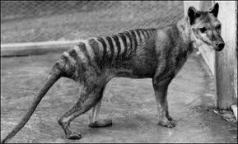
The Tasmanian thylacine, hunted to extinction last century as a notorious sheep killer, had such weak jaws its prey was probably no bigger than a bandicoot, according to a new study.
University of NSW researcher Marie Attard has overturned more than a century of lurid myths about the thylacine’s role as a pastoral pest, showing its reputation as a sheep killer ”was at best overblown”.
Using medical scanning equipment to map thylacine skull sections and advanced computer modelling used to detect wing stress in aircraft, Ms Attard spent months piecing together a three-dimensional biomechanical model of the thylacine’s head. The model enabled her to trace the thylacine’s jaw muscle movements and compare them to Australia’s two biggest living carnivores: the Tasmanian devil and spotted-tail quoll.
”We were able to look at the way the thylacine’s jaws would operate when it was biting, tearing or pulling at prey. Any stress points show up on the model as red areas, so we could identify any stress patterns those biting motions created in the skull,” Ms Attard said.
”What we found was a high level of stress on the snout, which is typical of a predator with quick bite, like a fast snap, followed by a crunch. So there’s no way the thylacine would have been able to hassle and take down large prey, like a sheep. It would have been more likely to ambush smaller prey animals like bandicoots and possums.” The results of Ms Attard’s biomechanical study are published today in the Zoological Society of London’s Journal of Zoology. She has spent the past three years analysing minute chemical traces on thylacine whiskers obtained from museums around the world, hoping to learn more about seasonal changes in the animal’s diet. The study also involves collecting roadkill in Tasmania to match samples to these historic whisker deposits.
”We should be able to tack what kind of prey the thylacine was targeting, look at how its diet changed, and how flexible it was in its prey choices,” she said.
The thylacine was trapped and shot in large numbers from 1830 to 1909.
The Tasmanian government paid a bounty to hunters of 1 pound a head for dead adults and 10 shillings for pups. The last known thylacine died in Hobart Zoo in 1936.