“Tasmanians were deliberately given the most dangerous tasks during the First World War. Which accounts for why the 15th Battalion, a unit comprised of Tasmanians and Queeenslanders, had the highest casualty rate on Gallipoli, and the 12th Battlion, the majority of whose men were from Tasmania, had the highest casualty rate of any AIF battalion throughout the entire First World War.
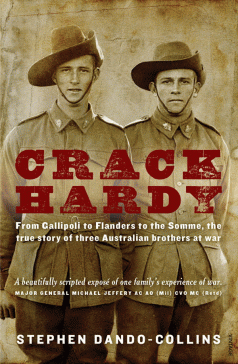
Award-winning Beaconsfield author Stephen Dando-Collins tells it like it was in his latest book, Crack Hardy: From Gallipoli to Flanders to the Somme, the true story of three Australian brothers at war, which centres on the Searle brothers from Westbury in northern Tasmania, who all enlisted in 1914 and went on to fight in some of the most horrendous campaigns of World War One. Only one of the three brothers survived to come home in 1918, and he had been wounded four times.
The 12th Battalion was one of the so-called ‘outer states’ battalions chosen for the first wave of the Gallipoli landing of April 25, 1915, and the 15th landed a little later the same day. Dando-Collins says that there is no proof the British commanders who planned the Gallipoli landing chose the outer states battalions to preserve men from Melbourne and Sydney, although some might suspect that. On the other hand, he says, perhaps the higher-ups thought the country boys would be tougher than city boys.
Tasmanians, says Dando-Collins, punched well and truly above their weight throughout the war. Because both battalions performed so heroically on Gallipoli, men of the 12th and 15th were invariably used as the AIF’s first choice shock troops on the Western Front between 1916 and 1918. The 52nd Battalion, which also features in Crack Hardy, was a spin-off from the 12th, and likewise its Tasmanians made a name for themselves. The 52nd’s 44-hour stand during the Pozieres assault of 1916, in which one Searle brother fought, was described by war correspondent Charles Bean as ‘one of the most bitter fights in the history of the AIF.’ The 52nd was the only unit in the entire Pozieres assault, Australian or British, to hold the ground it took.
Crack Hardy will have its national launch in Canberra on Thursday April 14, where the launcher will be Professor Bill Gammage of the ANU, one of Australia’s foremost authorities on the First World War and historical adviser to Peter Weir for his movie ‘Gallipoli.’
The book will also have a Tasmanian launch, on Wednesday April 20, at 6.00 pm, appropriately at the Westbury RSL, where the launcher will be Richard Mulvaney, Director of the Queen Victoria Museum & Art Gallery. All welcome – no RSVP required – and there will be free drinks and nibbles.
The book has already grabbed national attention, with former governor general Major General Michael Jeffery describing it as ‘a beautifully scripted expose of one family’s experience of war’, while Dr Peter Stanley, Director of Historical Research with the Australian National Museum says, ‘Stephen Dando-Collins skilfully braids together the Searle brothers’ story and that of Australia in the Great War.’
Stephen will be talking with Richard Fidler about Crack Hardy for an hour on ABC Local Radio’s national ‘Conversations’ program at 11.00 am on Wednesday April 13.