This man’s cry from the heart paints a very dismal picture about the mismanagement by the DHHS of patients from Rosebery diagnosed with heavy metal poisoning. For those people facing the possibility of living downstream of the Gunns Pulp Mill, the Rosebery story is a stark warning that the DHHS will find no ‘truth’ in any future diagnosis of health effects from the mill. Kay Seltitzas follows the story of Ross Whitney.
“I had been degraded enough by a health system that didn’t care and had failed.” – Ross Whitney
Ross Whitney, who has been diagnosed by several doctors and specialists with heavy metal poisoning, has spoken out in an interview with Isla MacGregor on his experiences with the Department of Health and his time living in Rosebery. This interview was published for the first time last week in the West Coast Bulletin.
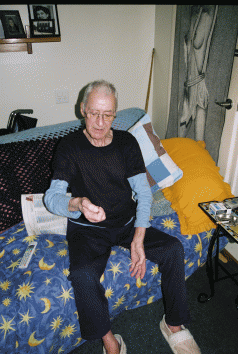
Ross Whitney is a former west coast miner and resident of Rosebery. Ross is now retired and sadly he has been diagnosed with heavy metal poisoning and his health is slowly deteriorating. Nevertheless he is always cheerful and living every day to its fullest.
Some other former miners and residents who have suffered the same symptoms as Ross Whitney have been diagnosed with other illnesses such as motor neurone disease, neuromyopathy, neuralgia, parasthesia or peripheral neuropathy.
In the recent history of the Rosebery mine there has been no acknowledgement by the DHHS or publicity about any miner or resident who has been diagnosed, suffered serious effects or died from heavy metal poisoning.
The Department of Health has not conducted any clinical examinations, research or supported comprehensive testing of any miners, former miners or residents presenting with typical symptoms of heavy metal poisoning.
* * * * *
“I worked for the Hydro for twenty four years mainly at at Gowrie Park and Strathgordon on the west coast of Tasmania. I lived in various Hydro villages until 1988. After this I got a job with the Hellyer mine (lead, silver and zinc,) about 45 minutes north of Rosebery. I was working in a multi skilled capacity driving machinery, drill rigs, blasting and working on a bogging machine. While I worked at Hellyer I had regular blood lead testing and my results were always fine. I did not know of anyone who worked there who had an unacceptable blood lead reading. Mates I used to work with at Hellyer still come to visit me today. Most of them worked at least another five years at Hellyer after I left in the same type of jobs that I did and none of them have lead poisoning.
In 1996 I hurt my back while working on a bogger and I went out on workers’ comp. I could not work again and I was put on a disability pension.
Up until leaving Rosebery I has been a very active bushman, hiker and adventurer. I would often go bush for a week at a time around Strathgordon, the Western Tiers or down to Pullinger along the Bird River track and beyond. I explored many other places where there is little public access. Today, my brother at 76 years of age, still does guided bushwalks for tourists.
While I was working at Hellyer I was living in and building a house at Waratah. When I bought a house at Rosebery in 1999 I took my dog with me. I bought the house in Rosebery as an investment property and worked on this for four to five nights at a time and then went back to Waratah. In the first spring I was in Rosebery I put in a veggie garden in the back yard and I grew everything – lettuce, potatoes, carrots, beans and tomatoes too. The veggie garden was situated next to an open drain that drained seepage water from up above my property.
After two years I sold the property and moved up to Waratah full time. A few months after leaving Rosebery my dog started to lose control of his legs and would shake and collapse from fits. I had to put the dog down.
Twelve months after I left Rosebery my fingers and then hands started to go numb and I couldn’t do up my shoe laces.
Then my feet, backs of legs and arms started to go numb. My hands and arms would cramp up.
I started to seek medical help around 2002 from Dr Castellino in Burnie. I was put onto various medications which were unsuccessful and I then insisted that I see a specialist. I went to see Dr Stan Siejka in Launceston who did a Nerve Conduction Test and told me that I had nerve damage. He arranged for me to get more tests at the Hobart Hospital.
After several months waiting and three cancelled appointments for which I turned up each time at the Hobart Hospital, I finally had the Sural Nerve Biopsy taken from my left ankle. The results of the nerve biopsy came back from Dr Siejka in around 2005. Dr Siejka sent them to Dr Waugh, my GP at the time, and he told me that my results showed a diagnosis of heavy metal poisoning from lead, cadmium and other heavy metals. I was finally diagnosed with Severe Progressive Sensori-Motor Polyneuropathy.
In 2006 I had to leave Waratah to stay with my brother and sister in law in Burnie. I applied for a Housing Commission Unit and moved to my current address in 2007. By this time I could only just look after myself .
By 2009 I started to have in-home care. Now my hands do not work at all. I can only just walk and I have to be bathed, dressed and fed. I am on slow release morphine all the time which occasionally I have to top up.
In November 2008 I read in the newspaper that some people living in Murchison Street Rosebery were having trouble in the area near where I had lived. I rang and spoke to Marsha Stejskal and at this time I realised that I may have been poisoned while living in Rosebery.
Dr Roscoe Taylor had discovered that I had been diagnosed with heavy metal poisoning. He rang me in January 2009 and asked me for my medical records which I agreed to. He asked to come and see me in my home which I also agreed to but he never turned up and he never spoke to me again. No one in the DHHS wanted to find out where the exposure to cadmium had come from or where I had been poisoned.
A Professor from Palliative Care in the DHHS made an appointment with me, asked me questions and took notes. I was later contacted with a request to take photos of my symptoms which I refused.
I had been degraded enough by a health system that didn’t care and had failed.
The next time I heard from the DHHS was in January 2010 when I received a call from Dr Chrissie Pickin asking me to provide a blood sample. I refused, as I had already been diagnosed and I knew there was no point in taking this blood sample as it was too late.
I have friends and family that come to visit and a very good friend who is a carer …
My main concern is that I do not want what happened to me and others to happen to anyone else. I want the West Coast Council, the Health Department and the Mine to admit there is a problem, that something is wrong, and that things have been covered up for years. I want the problems fixed up and I will do whatever I can to help make this happen.”
Ross Whitney … the way he was … and is …