

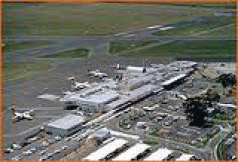
The sinking feeling came upon me as soon as I opened my carry-on bag in preparation for passing through security at Canberra Airport last Friday evening. Rummaging around in my toiletries bag, I simply couldn’t find the cap which should have been sitting atop the little bottle of shaving cream I take on overnight trips. So it was confiscated by an eagle-eyed official in the interests of ‘security’. Later that evening, I found the lid of my now-surrendered bottle of shaving cream sitting neatly on top of a small bottle of pills that I take every second day to (as the doctor who prescribed them once told me) stop my nose ending up looking like JP Morgan’s (a disfigurement I would perhaps willingly accept if my bank balance also looked like his).
This episode, though trivial, prompted me once again to ponder how utterly pointless, and yet also how utterly wasteful time and money that could be better applied to other ends, has been so much of the regulation imposed in the name of ‘security’ since the terrorist attacks of nearly a decade ago.
What is the point of requiring passengers (‘customers’ or ‘guests’, as we are now known, depending on which airline we’re flying with) to remove the aerosols from their bags, so that someone can confiscate them if they don’t have lids or locks on them – especially since, if anyone was so minded, he or she could easily remove and dispose of the lids, or unlock the locks, immediately after passing through security and boarding the plane?
What is the point of confiscating the duty-free booze that incoming passengers have long bought at their last stop before returning to Australia – other than to boost the sales of the inbound duty-free stores that we now all pass through on the way to the immigration counter? What is the point of requiring all female passengers (and many men)to remove their boots before passing through the x-ray machine at security checkpoints, just because some years back some guy called Richard Reid struck a match on the heel of his shoe whilst en-route between Europe and the United States, a match which as it happened failed to ignite?
What is the point of selecting, supposedly at random, passengers who have passed through security in order to waive some kind of magic wand over their laptops, in the belief that one day, one of them might actually turn blue (or whatever happens when they detect some kind of explosive residue, something that none of the people who have required me to submit to this particular procedure have ever actually encountered).
All of this is supposedly to protect us from the risk that some terrorist might blow us out of the sky. Now I don’t deny that there are some people in this world, including possibly some in Australia, who think nothing of killing large numbers of innocent civilians in the pursuit of nauseous objectives.
And whenever I feel so bold or presumptuous as to question the necessity for whatever procedure I might encounter at an airport (something which some security personnel appear to think amounts to a criminal offence), I am enjoined to consider what I would think if any of my loved ones were blown up by such people.
But we are never told how big this risk is, or whether the measures taken to prevent it are in any way proportional to that risk.
There’s almost certainly a bigger chance that I will be killed in a car accident on the way to the airport, or even every time I step outside my front door. Yet no-one thinks it appropriate that speed limits be reduced to (say) 20 kms per hour on the Tullamarine Freeway, or that everyone be subject to a breath test before getting behind the wheel of a car.
Should I therefore have been petrified when flying to and from Flinders Island for a family holiday last month, I twice boarded planes without passing any kind of security checks whatsoever. The thought did indeed cross my mind that there might have been an uncapped deodorant on board, or a woman who hadn’t had her shoes passed through an x-ray machine, or indeed some elderly citizen with a walking frame who hadn’t been made to shuffle unaided through a metal arch. Perhaps I was just lucky that, as it turned out, there were no terrorists on board the flights which I took to and from Flinders Island.
The ever-increasing range of security procedures people are required to undergo before getting to the departure gates of our airports have undoubtedly created a lot of jobs for people who, judging by the way many of them go about their tasks, might have some difficulty obtaining any kind of work which called for discretion, a sense of humour, or the occasional exercise of judgement. As an economist I can’t help but wonder whether Australia’s unemployment rate would have been higher, or the labour force participation rate lower, had it not been for the creation of tens of thousands of these jobs.
Certainly, having an army of these people stationed at airports has been of no assistance to passengers innocently caught up in outbreaks of violence such as that which occurred between members of bikie gangs at Sydney Airport a few years back. So you wonder what they would do if they ever encountered a genuine terrorist.
What these procedures have of course done is to create large crowds of people at peak departure times milling around on the outer side of security checkpoints waiting to have their aerosols inspected, to remove and replace their footwear, and have magic wands waved over their laptops, who could easily be killed or maimed by a suicide-bomber bent on achieving his or her evil aims – as was amply demonstrated by the most recent atrocity at Moscow’s Domodedovo airport.
No doubt these security checks are intended to re-assure the travelling public that governments are doing everything feasible to protect them from being blown out of the sky by terrorists – without of course giving them any information as to how likely that is – and even though, as British Airways Chairman Martin Broughton has said removing shoes and taking laptops out of consumers were ‘completely redundant’ (would that executives of our own airlines were similarly forthcoming!).
However I can’t help wondering whether there aren’t some more sinister motives as well. Former British Prime Minister Tony Blair’s ‘Third Way’ guru Anthony Giddens once wrote that the real purpose of these measures was to create a climate of fear in which we will accept increases in the resources available to security agencies, and expansions in their powers over individuals, to tap their phone conversations and intercept their emails without warrants, and to lock them up for longer periods without access to lawyers, which in a less febrile environment we would find utterly repugnant.
There’s no doubt that we Australians, who supposedly pride ourselves on our rejection of authority, seem to have meekly submitted to the erosion of civil liberties which have occurred over the past decade in the name of ‘security’, and have been remarkably indifferent to the way in which Australian citizens have been treated at the hands of our own, and other countries’ governments – presumably safe in the belief that it could ‘never happen to us’.
It’s likewise puzzling that Americans, for whom the upholding of ‘liberty’ against sundry tyrants is an integral part of their civic tradition, are more strongly committed to defending their supposed constitutional right ‘to bear arms’, arms which are frequently used to kill large numbers of them, whilst blithely submitting to unprecedented expansions in the powers the State has over them through legislative outrages like the Patriot Act, as well as the obligation to ‘bare arms’ and every other part of their bodies through full-body scanners at American airports, an indignity to which Australians will eventually also be subjected on flights leaving from here for the US.
Isn’t it time we here in Australia asked why we continue to maintain these inane and pointless rituals? And whether the cost, not only in dollars but in wasted time, is really worth it?
Article by Saul Eslake, Director of the Productivity Growth Program at the Grattan Institute, published in the business pages of the Melbourne Age newspaper, and in the online edition of the Sydney Morning Herald, , on Wednesday 16th February 2011











