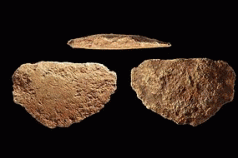
A piece of stone axe found in the Northern Territory has been dated at 35,500 years old, making it the oldest of its type in the world.
The piece has a series of marks which archaeologists say proves it comes from a ground-edge stone axe.
Monash University’s Bruno David led the international archaeological team, which made the find during an excavation in Arnhem Land in May.
Dr David says the find shows the Jawoyn people were the first to grind axes to sharpen its edges.
“We could see with the angled light that the rock itself has all these marks on it from people having rubbed it in order to create the ground-edge axe,” he said.
“We already knew that the oldest evidence of axes in the world were in the late 20s of thousands of years ago.
“Very soon after that we received a carbon result of 35,500 years ago for that piece.”
Dr David says it is an important step in the evolution of modern humans.
“It means that you’re creating a tool that is far more efficient than what you had before, and that you also have to create a tool not just through a simple series of actions of hitting against it,” he said.
The two-week dig was held at a spectacular rock art gallery on the traditional lands of the Jawoyn people.
Lost ancestors
The Jawoyn call it Gabarnmung, which means “hole in the rock”, and it is covered in spectacular paintings.
The site was rediscovered three years ago and is one of thousands that have been found across Jawoyn country in recent years.
Jawoyn traditional owner Margaret Katherine invited the archaeologists to the site so she could find out more about her lost ancestors.
“They study about rocks and bone and everything and I wanted to know the truth,” she said.
“Now that I know the truth I am very happy deep inside.”