

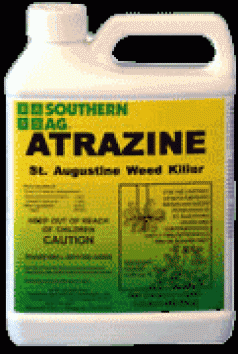
The Tasmanian Public and Environmental Health Network (TPEHN) has today released a list of 77 dangerous pesticides currently used in Tasmania that have been included in an Australian new Toxic Pesticide Hit List.
The new Hit List recently released by the National Toxic Network and the WWF includes more than 80 dangerous pesticides which have been prohibited overseas because of the risks they pose to human health and the environment.
TPEHN Spokesperson Dr Alison Bleaney says that the Tasmanian Government is failing to apply the precautionary principle to protect human and environmental health from dangerous chemicals that are known carcinogens, endocrine and hormone disruptors.
“The Tasmanian people, wildlife and ecosystems are not getting the same levels of protection that are applied in Europe or the United States,” said Dr Bleaney.
“ More than 20 chemicals classified as either extremely or highly hazardous by the World Health Organisation are available for use on Tasmanian farms.”
Based on an assessment of pesticide use in Tasmania, Dr Bleaney has found that:
• 12 of the 19 pesticides currently being monitored for detection in Tasmania’s raw water sources for drinking, agriculture and aquacultiure are ON the list of Australia’s most dangerous pesticides.
• Tasmania’s groundwater monitoring (pilot study) in 2009 – found 4 pesticides which are all ON the list.
• Tasmania’s forestry uses 6 pesticides ON the list
• Tasmania’s agriculture uses 55 pesticides ON the list
“Pesticides applied by air do travel long distances from where they were meant to be deposited. A landmark legal case in Queensland has highlighted the dangers of pesticide spraydrift. Ash Geldard a Queensland cotton farmer was recently awarded a damages payment of $467,000 after herbicide spray drift from over 20kilometres away poisoned his cotton crop. We can prevent this from happening to farmers in Tasmania.”
“The Tasmanian Government must take urgent action to protect public and environmental health and bring Tasmania up to international standards by banning from use many of these dangerous pesticides” said Dr Bleaney.
Tasmanian Public and Environmental Health Network
21st July 2010
Pesticides in Tasmanian water catchments ON the list of Australia’s most dangerous – Dr Alison Bleaney
• 12 of the 19 pesticides currently being monitored for detection in Tasmania’s raw water sources for drinking, agriculture and aquacultiure are ON the list of Australia’s most dangerous pesticides.
Alpha-cypermethrin (I)
Atrazine (H)
Chlorothalonil (F)
Chlorpyrifos (I)
Fenitrothion (I)
Haloxyfop-methyl (H)
Hexazinone (H)
Pendimethalin (H)
Permethrin (I)
Simazine (H)
2,4-D (H)
MCPA (H)
Only 7 of the 19 are NOT on this list.
clopyralid (H)
metsulfuron-methyl (H)
sulfometuron-methyl (H)
glyphosate (H)
metalaxyl (F)
spinosad (I)
terbacil (H)
and cyanazine and diazinon and picloram (3 pesticides ON the list) have also been found in raw water sources.
• Tasmania’s groundwater monitoring (pilot study) in 2009 – found pesticides which are all ON the list.
2,4-D (H)
atrazine (H)
hexazinone (H)
MCPA (H)
• Tasmania’s forestry uses pesticides ON the list
atrazine (H)
alpha-cypermethrin (I)
haloxyfop (H)
hexazinone (H)
methyl bromide (F)
simazine (H)
Not on this list are
clopyralid (H)
fluazifop (H)
glyphosate (H)
metsulfuron-methyl (H)
spinosad (I)
sulfometuron-methyl(H)
tebufenozide (I)
terbacil (H)
terbuthylazine (H)
• Tasmania’s agriculture uses pesticides ON the list
2,4-D (H)
acephate (I)
alpha-sypermethrin (H)
amitraz (H)
atrazine (H)
azinphos-methyl (I)
bifenthrin (I)
bromoxynil (H)
carbaryl (I)
carbendazim (F)
chlorothalonil (F)
chlorpyrifos (I)
cyanazine (H)
cyproconazole (F)
dazomet (B)(F)(N)(H)
diazinon (I)
dichlorvos (I)
difenoconazole (F)
dimethoate (A)(I)
diquat (H)
dithianon (F)
diuron (H)
endosulfan (I)
fenamiphos (N)
fenoxycarb (l)
glufosinate (H)
fenamiphos (N)
fenitrothion (I)
fenthion (I)
fipronil (I)
haloxyfop (H)
hexazinone (H)
iprodinoe (F)
linuron(H)
mancozeb (F)
MCPA (H)
metaldehyde (Mo)
methamidophos (A)(I)
methomyl (I)
mevinphos (I)
melthylbronide
omethoate(I)
paraquat (H)
parathion-methyl (I)
pendimethalin (H)
permethrin (I)
picloram (H)
pirimicarb (I)
propachlor (H)
propiconazole (F)
simazine (H)
tebuconazole (F)
tetraconazole (F)
thiram (F)
Ziram (F)
References
http://ntn.org.au/2010/07/18/toxic-hit-list-shows-australians-exposed-to-dangerous-pesticides/
Toxic hit list shows Australians exposed to dangerous pesticides
http://www.dpiw.tas.gov.au/inter.nsf/WebPages/SSKA-7JA425?open Tasmanian River Catchment Water Quality Initiative
Bleaney, Alison. Pesticides and the Tasmanian Forestry Industry [online]. Chain Reaction, No. 105, Apr 2009: 13-14.
Earlier:











