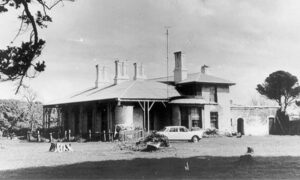
I came to the old Parliament in the depth of winter 23 years ago—the first Tasmanian to win a seat for the Australian Labor Party for more than a decade. Only four on my side of the House remain of the small band that now can remember how ministers and members from government and opposition alike had to rub along side by side in small rooms along common corridors and shared public lavatories. Something has been lost in the passing of that enforced intimacy. In 1988 Parliament moved up the hill to this most extraordinary building where the Executive is isolated in a separate wing, we all have offices larger than ministerial suites in the old house and you can fire cannon down corridors without risk to life. This is majestic public architecture yet an isolating work environment. We cannot change those design elements—but those who remember another way regret it.
Times like this throw up odd memories. One that came back to me was of Kim Beazley describing the members of caucus who survived the 1996 defeat of the Keating government as the political equivalent of cockroaches—nothing could kill us.
Yet, sadly, to stick with the Beazley entomological metaphor, most who cross this threshold more resemble the mayfly or the moth—a brief life in the light before oblivion. A member of this House serves an average of less than 6 years. Every one of us who gets the chance to make a valedictory speech reflecting on one or two decades of service is outnumbered by those who win only one or two terms.
I thought it was likely I would be one of those.
It has become orthodox to describe Denison as safe for Labor—but that was not how anyone, myself included, saw it in 1987. Denison was then a litmus seat. Since federation it changed hands with every change of government until Michael Hodgman QC finally broke the mould. It was him I had to defeat.
But when I stood I had some weights on me—and perhaps even the smell of political failure. I had first contested a federal seat in 1977. This was when Gough took Labor to his final election. I was 26. I campaigned using my double barrelled name. In Braddon, my roots in the south of Tasmania and my reputation as a member of the left were, politely, not an advantage. Gough went backwards nationally and, bluntly, I was soundly beaten by Ray Groom, later a Tasmanian Premier.
When Bill Hayden took over as Labor leader, the national executive repeatedly intervened in Tasmania to break the hold of the left, and more personally, to scotch my chances of Senate preselection. I took the hint and abandoned thoughts of political office.
My future was to be in the law. In turn I became a Tasmanian Crown Counsel, then Dean of the Faculty of Law UPNG and finally Principal Solicitor for the Aboriginal Legal Service in NSW. I made plans to go to the bar in Sydney.
Fate takes odd twists.
But for coming home for a holiday I would never have heard that Labor had opened preselections for Denison. It seems madness now, but crazy brave prevailed. Although living in Sydney I won preselection in a tough contest against a strong candidate backed by the right. Motions were moved at the national executive to dump me and fellow left candidate Warren Snowdon. We were both said to be unelectable. One might have been picked off, but two was a bridge too far and the left threatened war. We survived—just. But this and other events made it clear I was on my own.
I left my job and punted everything on a campaign like none before or since. We ignored cautious national office campaign advice knowing if I lost there would be no second chances. I bought the rights to Slim Dusty’s “ Duncan” and turned its verses into radio spots with the sound track “I’d like to give a vote to Duncan, cause Duncan’s me mate”. My friend and advertising guru Iain Chalmers produced tv ads for me which turned Michael Hodgman’s strengths as the ‘mouth from the south’ and into weaknesses. In return a lot of dirt thrown was thrown at me: the Truth newspaper ran a front page story ‘ALP candidate in AIDS scare’. We hung tough. Finally, the polls showed I was in with a chance and the Party got behind me and funded the last weeks of the advertising campaign it had previously opposed. Helped also by the Wilderness Society’s campaign backing Prime Minister Hawke’s pledge to protect the south west wilderness of Tasmania we won the seat with the slimmest of margins. I became and would remain the only Tasmanian ALP member of the House for two more terms.
Was it an aberration? Michael Hodgman thought so and dubbed me the ‘temporary member for Denison’. He dogged my heels. Whenever I travelled to Canberra I knew Michael would still be at every RSL, flower show and school graduation. I never had the luxury of thinking I could take it easy for a year or so and put in a burst at the end. I owe Michael for teaching me how never to take my seat or my electorate for granted. I won a second tight election against him and by the third, when Bob Brown of the Greens was my main opposition; I won Denison with an absolute majority—and for the first time the seat began to be spoken of as ‘safe’.
I had begun the metamorphosis from moth to cockroach.
I also evolved from backbencher to minister; Attorney General pending the re-run of the election in Dickson and Minister for Justice in the Keating government.
I served on the cabinet committee that dealt with the Mabo and Wik decisions and we braved the Opposition and the mining industry’s scare campaign to confirm the existence of native title. Robert Tickner stands out as a man of courage in a story too long to tell.
Paul Keating’s Redfern speech will outlive us all.
I fear that talking about the things I would like to be remembered for in that government may sound like Rumpole ruminating on the Penge Bungalow murders—triumphs of a time long ago—but some of the measures—legislation intended to become model codes applying throughout Australia in criminal law and the law of evidence—although now deeply entrenched in Commonwealth law and many state jurisdictions—still have not been adopted universally–so the task of ensuring that our legal system is less complex and fragmented, in even these basic areas, remains unfinished. Where I had responsibility we reformed legal aid, expanded the network of community legal services to include EDOs and womens legal services, brought in new copyright laws to fit the digital revolution, made substantial changes to law enforcement arrangements and passed legislation to criminalise overseas child sex tourism. We ended the shame of criminal prosecutions of homosexual men by national legislation overturning my own state’s anti-sodomy laws.
There was something very special about that time—and for me something very special about personal and professional trust I enjoyed with Attorney General Michael Lavarch. True friendship is a rare thing in Parliament. We enter here past the age when friendship comes easily and the engine of politics is competitive and sometimes cruelly destructive of trust. Only in retrospect do I realise how extraordinary was the way we worked together—bringing our offices together and sharing the administration of the Department. It was a tragedy for our movement when Michael lost his seat in 1996 with the defeat of the Keating Government.
However his example in the years that followed shows there is much to look forward to after politics—and his defeat spared him the frustrations of 11 years of Opposition.
I have twenty minutes to encompass twenty three years—less than a minute a year, so I will pass over that decade, save only to mention two things.
First my admiration for those who worked in this parliament and outside to keep alive notions of indigenous rights, the dignity of refugees and the civil rights of minorities during a time dominated by the politics of fear. I pause to mention former Senator Barney Cooney who showed me that achieving ministerial office is never the measure of a man.
Second my work as an advocate in the High Court case Plaintiff S157 of 2002 v The Commonwealth. I took on that case because I was convinced that the Howard government’s legislation that removed all rights of judicial review in refugee cases was not merely cruel and wrong but was also an affront to the rule of law.
From the first I had resolved always to keep my practicing certificate as a barrister. Those on the other side often speak of their right, albeit rarely exercised and often punished, to cross the floor. Our side has a more collectivist tradition—but we are equally men and women of conscience. I knew when I joined the Labor Party that there might be some, rare issues, like the death penalty where my conscience would not let me follow even if my colleagues felt differently—and I wanted never to be in the position where my economic future was hostage to political fortune. Remaining a barrister allowed me to take the case.
Writing in the Australian Institute of Administrative Law Forum (No. 53) Robert Lindsay has argued that Plaintiff S157/2002 ‘will rank with cases such as the Boilermakers’ case, the Engineers’ case and the Australian Communist Party case as a significant development in the constitutional jurisprudence of Australia.’ In the long run, its vindication of the rule of law, and the cases that have built on its foundations, may stand as my greatest legacy of 23 years as a parliamentarian.
The election of the Rudd government gave me a second chance to serve as a member of the Executive—as Parliamentary Secretary for Pacific Island Affairs. I hope my years in that role have helped restore personal contact with and respect for the people and nations that are our nearest and, in many ways, our most important, neighbours.
So to thanks.
First and so importantly, the electors of Denison.
For a Claremont boy representing the people of Denison, and the Australian Labor Party, in the Federal Parliament for 23 years has been the privilege of a lifetime.
Hobart and Glenorchy have made giant strides over the past twenty years. We live in a more culturally and economically confident, progressive city – and I am very proud of my part in that.
Next my family.
Moments like this bring things back to the surface. As memories have swirled around in my mind nothing stands out more clearly than that the things which have most motivated me and shaped my and my brother’s core values flow from what I absorbed from our mother, father and grandfather—the belief that human reason is capable of resisting primitive fears and transcending racism, their example that decency is not weakness—their insistence that the catastrophes of the depression and totalitarianism that had seen millions dead or brutalised and impoverished should never again be allowed to be our future. They taught us that everyone has the choice, to take or ignore, by great acts or small, to leave the world a little better.
I married young to Penny Goldin and it was she who was with me in my first campaign for Braddon—we parted but our friendship remains.
Celia Taylor and I wed shortly after I entered Parliament and the great love of our lives, our son Hamish, grew into adulthood often with an absent father. Our marriage broke up when Hamish was a young boy—due perhaps to absences and my single mindedness on other things. Politics is tough on families and it is ironic that my achieving ministerial office coincided with the wrenching apart of my personal life. But again I was lucky. Celia remains a wonderful friend and a loving mother—committed always to making sure our separation never cost our son his family.
Others who took me in when broken know how much they still matter to me.
However, my greatest good fortune, beyond all deserving, was to meet Anna Pafitis and for her to look past my flaws. For the past decade Anna has been my partner in life. She treats my occasional pretensions with contempt, my hurts with compassion, my absent mindedness usually with amused tolerance; she returns my love with love.
My son Hamish and her daughters Sophia and Alex have become our blended family with Butch the chihuahua and Wishbone, an aging pound puppy not far behind in Anna’s affections.
I have never risked the ultimatum ‘it’s the dogs or me!’
Then to those who travelled this road with me.
Foremost must be Mayda Flanagan. Mayda has been with me for 22 years. She has managed my electorate office and three of my campaigns. There is nothing Mayda does not know about me—with matching discretion. No one could ever have had a more fiercely loyal member of their team.
It is impossible to properly honour all those deserving recognition for their years of service in my electorate and ministerial offices. George, Peter, Bill, Simon, Cora, Cassy, Peta, Ben, Ella, Bec, Daryl, Reg, Brian and so many others I owe you far beyond what I can say here.
Some final reflections–
In 1974 Bob Pease and I worked together to establish the Tenants Union of Tasmania. Our first act was to make a submission to the then Tasmanian government to establish a rental bond board to overcome the problems of landlords improperly withholding security deposits.
Last year, thirty five years later, the Tasmanian government finally implemented that proposal. It is a reminder— that the work of social change is not always capped with success but also that what looks to be failure is not always as it seems. Seed sown can flourish later.
I hope the views of the cross party Parliamentary Group for Drug Law Reform which I used to co-convene with Dr Mal Washer MP eventually become part of our mainstream debate. A majority of parliamentarians, lawyers and judges privately recognise the damage being caused by existing policies but few speak out. Much of Europe and South America has already taken steps towards reform and away from policies that create economic incentives for organised crime and stand in the way of health focussed programs. I wish the Group well with its work and I welcome the awards in the Order of Australia to Drs Alex Wodak and Ingrid van Beek recognising their efforts in the cause of evidence based drug law policies.
And so on to the present. Soon I will be returning to legal practice. I have always shared a love of the law with my passion for politics. I look forward to a third career at the bar—but as you would expect I am sure there will be moments of sadness and even regrets.
If I were Lot’s wife I suspect my next life would not be the law but as pillar of salt.
So I will not be here to walk the corridors when the Parliament returns after the next election but I until then I remain fully committed to to serve my electorate and do all I can to ensure that Labor returns to this side of the chamber.
Those with longer memories than a week know that the true mark of a leader is not how they are seen, or what they achieve in the easy times, but in the character they demonstrate in the fight they take on for the betterment of their community—whatever the seeming odds. The fundamentals remain strong. The Rudd government’s economic management has kept Australia the strongest OECD economy in the teeth of the worst financial crisis since the great depression. Some things change and some things stay the same. The mining tax again pits the labor movement against a mining lobby that ran similar scare campaigns against native title and for Work Choices. But like Bob Hawke who still carries the flame, I remain convinced of the fundamental good sense of the Australian ut people. Fooling them will be a large task.
So it ends
Prime Minister Kevin Rudd and the then Leader of the Opposition, Malcolm Turnbull both said kind things in this chamber on my standing aside as Parliamentary Secretary. This may be a tough place where true friendship is rare but it is also a place where respect for colleagues can cross party lines. We come with different philosophies but shared hopes for the future. Some will return and others will fall–but even the shortest service in this House puts a member amongst the very few of their community to have shared the highest responsibly a democracy can offer.
Much has been said to me in these last weeks to suggest I will leave here with fewer enemies and more good will than the sandpaper of 23 years justifies. I look forward to the future and thank the House, its members and staff, for sharing such extraordinary life experiences with me over the years.
T’was brillig.