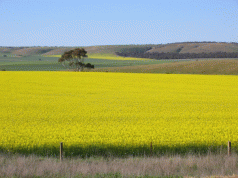
… Sheehan is not alone among farmers who have tried GM canola and are questioning the alleged benefits. Ricky Miles used it on his property in the far western Wimmera for the first two years it was allowed. But he has chosen not to use it this year because of the costs involved.
”Firstly, there are the licence fees you have to pay to grow it, there is the cost of the seeds, there is the risk of Roundup resistance developing and I found I had to spray two applications of Roundup to knock off the weeds.”
Miles also found there was no increase in crop yields and that there were only a few places where he could sell his GM grain – and at $12 a tonne less than non-GM grain.
”I am not opposed to GM so I will probably give it another go when they have sorted out some of the problems,” he says.
If it were only simple as one side of the argument being good and the other bad. There are serious health concerns about some non-GM alternatives, too. Triazene is an organic compound that has been widely used as a herbicide since the 1950s. Many farmers who vocally oppose GM use triazene, but it is a controversial chemical and is banned in the European Union.
It is said to have serious effects on non-target flora and fauna, including on amphibians, and because – unlike glyphosate, which readily breaks down – triazene lingers in the environment and can have a serious impact on the productivity of crops for a year or more.
Triazine is used in more than 80 countries and is said to be the world’s most used herbicide, but studies now suggest it is an ”endocrine disruptor” – a substance that mimics hormones in the body and has possible carcinogenic effects. Its long life is believed to cause widespread contamination of waterways and drinking water supplies. Epidemiological evidence connects triazine to low sperm levels in men and has led researchers to call for its banning.
Despite this, the US Environmental Protection Agency decided it was safe enough and in 2006 decided not to ban it.
On the other side, there is concern about a lack of epidemiological studies on the long-term effects of genetically modified food products in our diets. Adelaide-based epidemiologist Judy Carman was commissioned by the previous Labor government in Western Australia to undertake research into the safety of GM canola, but when the government changed, the former moratorium was lifted before her study was completed.
Carman hopes the results of her findings will be released by the Barnett government this year and, although she is unable to reveal what her findings are, she does say she encountered stiff resistance from the Australian biotechnology industry, which was unwilling to provide her with GM canola seeds to study.
”In the end we had to source our material in the United States and do most of our research there. As a result, the study took years to do.”