To Roscoe Taylor
Director of Public Health
Department of Health and Human Services
March 1st, 2010
Dr Trevor Steele
Magill, SA 5072
Dear Dr Taylor,
Thank you for setting aside time to see Frank Nicklason and me and to allow me to read Richard Bentham’s report prepared for you. I must admit that I was a bit surprised at the defensive nature of his response. He has read my publications and may have heard me talk about my work but seems determined to misrepresent my statements and aspects of my work which are still being confirmed in studies of composts in Europe, Japan and elsewhere. I will try to summarise my opinions and attach a more detailed discussion for you to read at leisure.
1. L. longbeachae serogroup 1 has travelled great distances and spread around the world in sufficient numbers to establish itself in many soil environments in Australia and elsewhere.
2. The most common legionellae found in all composts are L. pneumophila of all serogroups including serogroup 1, L. bozemanii, L. micdadei, L. dumoffi and both serogroups of L .longbeachae. All have caused human infection here and elsewhere. Most of these non-pneumophila species can only be diagnosed by culturing respiratory secretions or lung tissues. A non-aquatic source of L. pneumophila infection is never sought because everyone knows the source is cooling towers, spas or misters.
3. Most if not all composting or decomposing wood products contain detectable legionellae.
4. Bentham reported that stockpiled woodchips sometimes underwent composting. I did not see this when I examined relatively fresh woodchips on the site. It is possible that even without much nitrogen some woodchips eg. those from old growth forests decompose more readily and at a faster rate than from plantation wood
5. L. longbeachae is difficult to isolate from environmental samples. Critical are the culture media and the acid or other sample pretreatment steps. Every batch of medium should be controlled by using a known positive compost sample but this is not done.
6. Dust still enters the Burnie CBD and nearby residential areas. Control may be better in the CBD than in the past but apparently is not in South Burnie.
7. Dust can and probably does cause allergies, asthma and possibly upper airway cancers in persons using the CBD and/or residing in areas exposed to dust. Except when composting occurs or the sacrificial layer is disturbed to release dust or bioaerosols, dispersion of Legionella is very unlikely. I photographed dust from an unloading chute travelling towards other wharf sites on 23/2/10 when a strong wind was blowing.
8. Notifications of Legionella infections in Tasmania are unusually low compared all the southern states. In SA only 13 isolations of L. longbeachae were made from patients though approximately 70 cases were notified in that time. Under-investigation in these relatively uncommon infections means they are often unrecognized even in limited outbreaks. I am not confident that outbreaks will be recognized unless seriously ill patients are fully investigated. Australia now lags Europe in providing rapid sensitive tests to detect all non-pneumophila lung infections.
9. Dust control at the woodchip site should be maintained and preferably further improved to include areas like South Burnie. Adjacent dockside premises were also emitting clouds of dust some of which may have originally come from woodchips when I visited the area. This dust should also be controlled.
10. Unusual clustering of L. longbeachae cases was seen in the Adelaide outbreak in the 1980s, a common source could not be excluded but it was convenient and plausible to attribute the source to be bagged potting mix. One should keep an open mind when investigating outbreaks.
I have tried to be as brief as possible but my response is still very long and for this I apologise.
Kind Regards,
Trevor
TW Steele FRCPA
Report by Trevor Steele
4th March 2010
One can argue ad nauseam about sources of infective organisms, the mode of transmission, infective doses etc. The fact is that from the research and clinical work I personally did, some sources of L. longbeachae are now known and most of the other aspects are poorly understood even for L. pneumophilia. Bentham’s faith in statistics and meta-analysis to pinpoint sources of infection and argue about mode of transmission of infective agents ignores the fact that the most important determinant of infections with Legionella in general is the immune status of the host since we are exposed to infectious agents all the time. Although I have had extensive exposure to all sorts of composts and worked closely with them I do not have detectable levels of antibodies to them. Cellular immunity is critical
It is known that L. longbeachae serogroup 1 which shows remarkable genetic stability, has spread to all continents of the world, probably within amoebic cysts or in another packaged form from its site of origin.. If it can travel these enormous distances and arrive in sufficient numbers to colonise all these countries shown to have it, why should I not accept that it can travel a kilometre or two in dust or in amoebic cysts from some environmental site in Australia. Contact with these organisms is very frequent since serological studies of healthy blood donors in South Australia in the 1980s showed that one in three donors had detectable levels of antibody sometimes up to 1:512. Western Australian researchers recently did an Australian wide study (200 blood donors in each state) and obtained similar seroprevalence results. Between 10 and 27% of donors from the five mainland states had antibody to L. longbeachae serogroup 1 while only 1 to 11% had antibody to L. pneumophila. In all states 4 to 10 times more donors had antibody to L. longbeachae than to L. pneumophila, the organism Bentham believes is more infectious and spreads much greater distances than L. longbeachae.
In our investigations of all types of composting and decomposing materials we found high numbers of other Legionella species including L. pneumophila serogroup 1, L. bozemanii, L.micdadei and L. dumoffi , all known pathogens of humans. These findings have been confirmed in other states in Australia, Holland, Switzerland and Japan. As these Legionella occur in higher numbers in composts than in chlorinated water feeding into air-conditioning plants, I think that soil sources, probably through dust or bioaerosols, are the most important way in which these systems are colonized. Dutch and Swiss researchers in a co-operative study presented at the recent Paris meeting and cited by Bentham, isolated L. pneumophila and L. bozemanni as well as other species from a number of composts and also found them in bioaerosols above the heaps. They did not detect L. longbeachae probably for technical reasons. They concluded and I quote from both their papers:
“Compost facilities seem to be an important reservoir of Legionella. Although the importance for human health of the presence of Legionella spp. is unknown and risk assessment has yet to be defined, bioaerosols produced from these elements should not be underestimated”.
“L. pneumophila and L. bozemanii were also detected in bioaerosols hovering above the heap but not nearby. The study showed that viable amoebae and Legionella are both present in composts. Further studies are needed to investigate the spread from compost to bioaerosol of Legionella and the dispersion of these bioaerosols”.
I contend that L. longbeachae will behave in the same way and we know that infection with this species has occurred in Switzerland and in Denmark and is on the increase in Europe.
As I discussed with you there is plenty of evidence that dust from the woodchip stockpile in Burnie still spreads to adjacent parts of the dock area and into the CBD and nearby residential areas, this in spite of efforts to control the dust when there are strong easterly winds. I accept Dr Ghali’s account of his personal experience with dust and Kim Gale account to me. Kim has not seen steam rising from stockpiles.. A very high stockpile could emit dust even when stockpiling and loading are not occurring if the wind was sufficiently strong. This stockpile is much too close to the city. I just don’t accept that dust from the site does not contain particles small enough to be inhaled into the lungs and besides larger dust particles can cause allergies, asthma and cancers in the upper respiratory tract all of which are reputed to be frequent in local residents. There are many reasons why residents will not complain officially not least of which is fear about discrimination, employment and since 2002 about litigation.
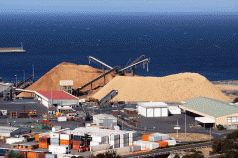
When I visited the site on 22/2/10, it was raining, woodchip stockpiling was in progress. The material comprised clean, damp but dusty wood chips without any obvious bark or leaves. A source of nitrogen, for example green vegetation, is necessary for rapid but not slow breakdown or composting to occur. There was not excessive dust blowing around at the site and no obvious heating of the stockpile within 30cm of the surface. I was advised that the woodchips had been there for only 2 weeks. The sacrificial layer was less than 30cm in many places and was overlaid with fresh woodchips. It did contain decomposed material from old woodchips in some places, which could contain Legionella and other microorganisms and the lowest layer at ground level was considered to be “contaminated” by the site staff. Kim Gale and I were informed that the sacrificial layer had been taken away some time ago but we were unable to learn where it went. I took pictures of the working site on 23/2/10, a fine day, when a strong wind was blowing from the site towards the wharf where cruise ships normally berth. One can clearly see dust blowing away from the discharging chute. I also saw clouds of dust swirling around containers on the TOLL premises immediately adjacent to the stockpiled woodchips. Had the wind been blowing towards the CBD, I believe the dust would have gone there. Does EPA monitoring of dust work? Not in South Australia where quarrying dust is a big issue for truck drivers and adjacent residents but EPA monitoring devices carried by employees apparently never show excessive dust levels.
From my observations of the site, I conclude that the rapid turnover of clean chips would not favour the multiplication of L. longbeachae and the other Legionella. If the material was stockpiled for a long enough period, composting would occur, as observed by Bentham in 2002 and Legionella and many other microorganisms will grow there. In this situation where there is evident composting, dust and or bioaerosols coming from the composting material should be considered a potential hazard for susceptible persons exposed to it on the site or in Burnie. This remains my position.
Additionally, in spite of Bentham’s statements about the sacrificial layer and the tests he performed on it, the 2002 report I read stated only that MDU did the tests. These were limited in sampling numbers and air sampling was used for some tests. I can give you scientific papers showing air sampling markedly reduces viability of organisms and dramatically reduces the ability of Legionella to grow in cultures. Personally I do not think laboratory testing of wood chips for Legionella is worthwhile unless it was part of an extensive research project to see what is occurring when the stockpiles heat up and possibly to look at the sacrificial layer though I think that is unnecessary.
The standard tests for isolating L. longbeachae from environmental samples are not very sensitive and laboratories doing routine tests will not vary the test procedure by changing the composition of media or altering the acid pre-treatment step when they encounter problems of fungal or bacterial overgrowth. I have not seen the testing method used by Bentham but my reading of his limited work in the field does not make me confident about his laboratory’s ability to isolate L .longbeachae serogroup 1 from environmental samples. He recently reported finding only 1 in 8 potting mixes positive for L.longbeachae but all were positive on PCR testing
Bentham’s acceptance of the Public Health Department’s figures for notifications for Legionella infections in Tasmania should not be considered definitive proof that there is no problem. There never was a problem with L. longbeachae in South Australia until we isolated this organism from an ill patient and until Scott Cameron of the SA health Commission and I with good laboratory facilities went looking for more cases and possible sources. It was the statistical association with gardening led me to examine potting mixes. There was a good statistical relationship between the use of potting mixes and illness. However we would have been wrong to assume that the only source of L. longbeachae and other soil Legionella was restricted to commercial potting mixes. Other important reservoirs were found to be home composts, vermiculture products and composted recycled municipal garden waste. Most of these were also considered to be sources of diagnosed infections. Clearly other important sites that sustain the growth of soil Legionella exist and did so before man created new environments for them. I concluded that any wood products undergoing decomposition could harbour Legionella. The growth of L. longbeachae and its dependence on amoebae for growth also make it highly likely that bio-aerosols containing encysted Legionella are easily formed and dispersed. These bio-aerosols can travel some distance and the inhalation of these by susceptible persons can result in infection. Wound infections with Legionella are well documented and have caused death with bacteraemia with several nosocomial outbreaks. It is not known whether wound infections due to L. longbeachae or other soil legionellae occur in Australia or are a way of getting systemic illness as laboratories do not do appropriate tests on wound swabs for Legionella.
If the very low incidence of notified Legionella infections in Tasmania is not due to the innate hardiness of the residents but is due to differences in the way doctors investigate respiratory illnesses in that state, then the absence of documented cases may be illusionary. In the 9 years (2001-2009) based on population size and notification data, Vic, SA and WA notified 70, 135, 142 cases of Legionella infections respectively, for an adjusted population of 500,000 residents. Tasmania over this period notified 13 cases of Legionella infection. This is a very big difference. In SA and WA, L. longbeachae accounts for approximately 50% of these notifications and are considered to be under diagnosed or detected in Qld, NSW and Victoria compared to L. pneumophila because of the more stringent methods needed to grow them in the laboratory or because of the way serological tests are done or interpreted. It seems probably that Legionella infections of all types are being under-diagnosed in Tasmania as one would expect the prevalence to be similar across the southern states. Over those 9 years only 13 specimens from patients in SA grew L. longbeachae though approximately 1000-3000 specimens were cultured in 9 year period.
I realise that the State Health Departments can only response to identified hazards or outbreaks and have sufficient problems to solve without looking for additional work. The notification figures I have discussed raise some doubt about the medical investigations of respiratory illnesses in Tasmania. I would hesitate to use the paucity of L. longbeachae and other legionella infections in Tasmania to support a status quo approach or a relaxing of dust controls at sites of stockpiled woodchips where dust is still a problem.
In South Australia it took a considerable and sustained effort by the SA Health Commission, ID physicians and laboratories to persuade doctors in hospitals and in the community to include appropriate tests for legionellae when ill patients were being seen or treated. Even now a considerable number of cases are missed at the acute stage and only come to light in convalescence or later and this compromises epidemiological investigations. It pays to keep an open mind and question established dogmas.
* Copies of papers I referred to can be sent if required
* A copy of the WA researcher’s poster presentation in Paris 2009 Legionella meeting is enclosed.
Download …
Response to Roscoe Taylor.doc