
MEDIA RELEASE 14.4.10
TREE SITTER DEFENDS ANCIENT FORESTS DEFINED AS REGROWTH
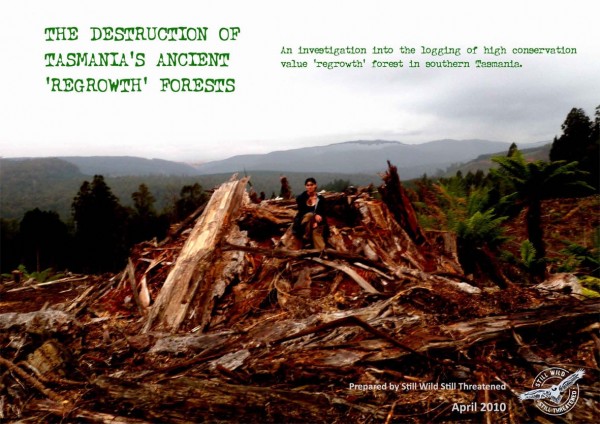
THE DESTRUCTION OF TASMANIAS ANCIENT REGROWTH FORESTS REPORT LAUNCHED
PRESS CONFERENCE 1PM PARLIAMENT LAWNS
Community conservation group Still Wild Still Threatened have released a new report investigating the logging of high conservation value regrowth forests in Southern Tasmania. The report draws attention to areas of forest that are classified by the Tasmanian and Australian governments as regrowth despite the fact they have never been logged and are of exceptionally high conservation value.
The report was compiled by volunteer forest campaigners undertaking comprehensive surveys of high conservation value forests due to be logged and closely monitoring logging operations in these areas. The report has been sent to federal and state MP’s offices today.
The report examines four southern forest logging coupes as case studies, two that have been logged, one that is being logged right now and another due to be logged this year.
The release of todays report coincides with an action in the Wedge valley where a conservationist is positioned in a tree sit attached with rope to logging machinery. The action is taking place in the case study coupe WE005E, contained in the report.
Click on this link to download a copy of the report:
or download, HERE:
SWST_regrowth_report_2010_low_res.pdf
The Regional Forest Agreement defines these wild forests as regrowth, despite the fact they have never been logged and contain trees that were fully mature hundreds of years before European settlement. We are advocating that these areas be defined as high conservation value, due to the role they fill as pristine ecosystems that provide habitat for rare and threatened wildlife, wilderness values, store massive amounts of carbon and are helping to keep our air and water clean.
Mr Hill said old growth forests with high levels of biodiversity and some of the tallest hardwood trees on earth, have been defined by the government as regrowth, including Centurion, the tallest hardwood tree on earth growing in the Arve Valley.
It is absolutely absurd that the RFA defines the tallest hardwood tree on earth as regrowth, this proves the inadequacies of RFA old growth classification and has denied these supposed regrowth forests the recognition and protection they deserve. Said Mr Hill.
For decades the Regional Forest Agreement has been criticised by experts, scientists and NGOs for failing to meet intended conservation outcomes. The RFA process overlooked science and was overwhelmed by political compromise; this has led to the failure of the RFA to fulfil intended conservation outcomes. Said Mr Hill.
We are calling for an immediate moratorium on logging in areas of high conservation value until they are placed into formal reserves and given the protection they deserve.
The logging industry is facing massive downturns and a stagnant woodchip market that is demanding woodchips from certified plantations, not high conservation value forests. There is a clear necessity for re-invention, but instead of transitioning contractors away from high conservation value areas state and federal governments are continuing with a business as usual approach, which is clearly not working.
A solution to the forest issue is needed more than ever, to save what ancient forests remains and ensure a sustainable future for the forest industry, whatever form the new cabinet takes the state government must make this a priority. Said Mr. Hill.
High resolution digital stills from the protest site available later in the day, edited video footage of the protest available at the 1pm press conference, Parliament lawns.
—
Still Wild Still Threatened is a grassroots community organisation campaigning for the immediate protection of Tasmania’s ancient forests and the creation of an equitable and environmentally sustainable forestry industry in Tasmania.
www.stillwildstillthreatened.org
[email protected] www.myspace.com/stillwildstillthreatened
PO Box 295. South Hobart TAS 7004
Still Wild Still Threatened