

March is the month of David in Hobart (although I hasten to add that in this instance I don’t mean the Premier, despite this being his fateful month). No, this is of other Davids, and we need to take a closer look at them in a Hobart context, to show a historically correct perspective.
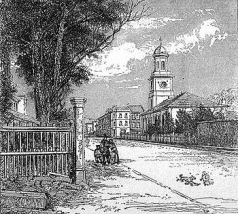
St David’s Cathedral website tells us that on February 26, 1804, the then Hobart Town had its first church service, where the Town Hall now is. Rev Bobby Knopwood, the sole priest here at the time, did the honours.
And the website further informs us that as it was close to St David’s Day – March 1 – it was decided this year to hold an anniversary Sunday service in St David’s Park the day before March 1. It was arranged by the cathedral’s Dean Richard Humphrey. Billed as “St David’s Big Day Out”, there was attendant media coverage, and the dean’s keen to make it an annual event.
The thing is people might now have gained the impression St David’s Cathedral is named after the patron saint of Wales. It isn’t. It’s named in honour of our first lieutenant-governor, David Collins. It’s something I’ve mentioned here before, as has my fellow contributor Percy From The Pews. And it has to be said notable figure that he was in the founding of this city, and even if his name is commemorated in that of the cathedral, David Collins was no saint.
Yes, he was buried in the same park that bears his name and where the first St David’s Church was built – a small, flimsy building that had but a brief existence, being blown down in a gale after a few months. It took some years before a replacement St David’s Church appeared elsewhere and the cathedral much later.
It’s of added interest that Collins did have March links – he was born in London March 3, 1756, and died in Hobart Town on March 24, 1810. I understand there’s to be an appropriate civic function here that evening to mark the 200th anniversary of his passing.
And as the founding father of Hobart’s settlement it’s fiting his name should be honoured on that occasion, as is his name in the cathedral’s title.
As regards that Welsh patron saint, while his birth date was uncertain (ranging over several decades but now thought to have been AD487), it’s probable his death was on March 1, AD589, hence his Feast Day being celebrated wholeheartedly by the Welsh that day, even if they didn’t adopt him as their patron saint until the 18th Century.
He was a teacher and preacher, founding monastic settlements and churches throughout Wales, as well as Cornwall and Brittany. But while St David’s Day honours him, one would seriously doubt that today there would be an embracing (here, there, or elsewhere, by clergy or lay people) of the austere way of life he followed.
The Monastic Rule of David decreed his monks had to pull their own ploughs – no help from animals. It is claimed he ate mostly bread and herbs, probably watercress, which was widely used at the time. His monks had to spend their evenings in prayer, reading and writing. And they were forbidden to have personal possessions.
They were also told to drink only water, and to bathe in cold water. The water connection was an important one to him. As a self-imposed penance he would stand up to his neck in a lake of cold water reciting the Scriptures. Not surprising that he became known as “the Waterman”.
Still, the regime appeared to have been beneficial to him; he was said to be a strong six-footer, and if the records are accurate lived to be 102.
Footnote: the name David is English, from the latin Davidus. He was named Dewidd in Welsh, and more commonly called Dewi (thus Dewi Sant in Welsh). A ruined chapel marks where he was born in Wales, but more significantly today in south-west Wales is the Cathedral of St David. Set on the Pembrokeshire Peninsula that juts out into the Atlantic, it’s on the site of the 6th Century monastery built by St David. The cathedral is the finest and biggest in Wales and for centuries has been one of the most important places of pilgrimage in Great Britain.











