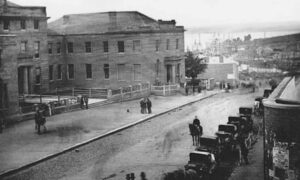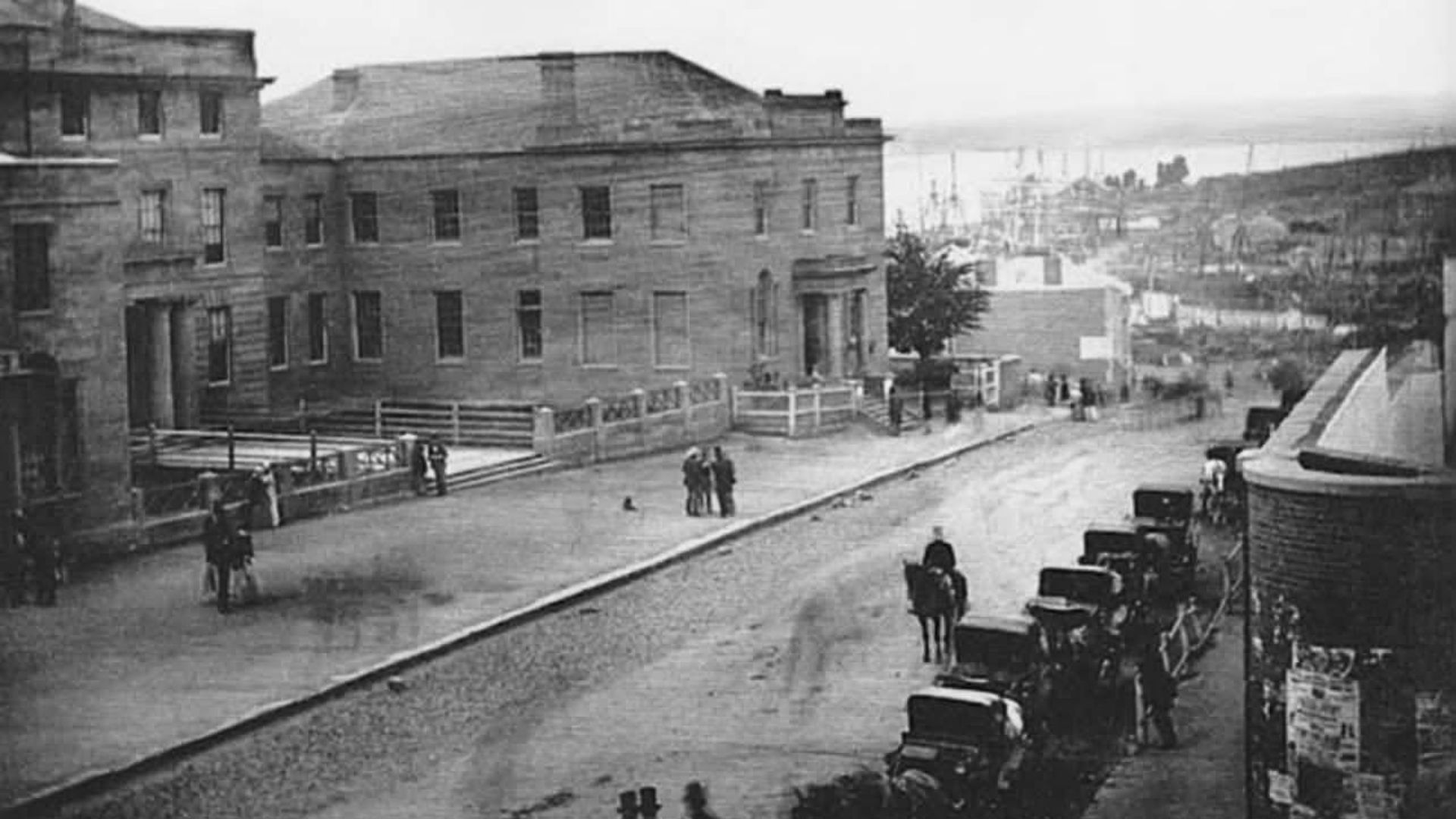
The block of land that would eventually become Hobart’s Treasury complex was reserved for major government functions in 1811, but it wasn’t until 1824 that the first substantial government building – the original Supreme Court – was completed. Generally regarded as the oldest surviving Supreme Court building in Australia, it later became the centrepiece of the Treasury complex.
The Police and Convict Office was added in 1835, followed by the Public Offices in 1841. The latter was the first building on the site to be used by the colonial treasurer and other senior officials, marking the beginning of the block’s long association with treasury administration .
As Van Diemen’s Land continued to develop as a British colony, additional buildings were constructed to accommodate the growing demands of government. They contained office space for treasury and legal administration staff, as well officials involved in executive government, public works, and land registration.
In 1855-56, Van Diemen’s Land became the self-governing colony of Tasmania. As a result, the officials and staff who worked in Hobart’s Treasury buildings became responsible to local parliament rather than the colonial authorities in London.
Further additions were made to the complex during the second half of the 19th century, including office space for the Executive Council and a range of government departments.
Over time, the site evolved into an interconnected group of Georgian- and Victorian-style buildings that overlooked Franklin Square and Murray Street.
Following the Federation of Australia in 1901, the Treasury complex continued to be used by state government departments, as well as the premier and other senior ministers.
The final major construction project on the site was an extension to one of the buildings, completed in 1957, bringing more than 130 years of construction and development to a close.
In 2018, then-treasurer Peter Gutwein announced plans to sell the Treasury complex for redevelopment as a hotel. The proposal sparked public debate over the site’s heritage significance and its future.
Although the sale and redevelopment never went ahead, the future of the Treasury complex remains uncertain. The state government still appears to want to offload it, and various proposals have been put forward, including converting the buildings into museums and cafés.
References & bibliography
- Treasury and Finance Complex (Open House Hobart)
- Treasury Complex and Public Buildings (Purcell)
- Advocacy – Treasury Buildings Hobart (National Trust)
- History-soaked Tasmanian Treasury building ‘open for inspection’ (ABC News)
- Treasury Building in Hobart not suitable for hotel development, expert says (ABC News)
- Museums, cafés, and a hotel: Bold vision for Treasury complex (Herald Sun)
- ‘Secrecy’ over future of Hobart icon criticised, as sale fears grow (Herald Sun)
- ‘We privatise Tasmania’s history at our peril’: Treasury building backlash (Herald Sun)
- Frequently Asked Questions (The Treasury Complex Repurposed)
- A Renewed Mandate for Tasmania’s Civic Heart (Cushman & Wakefield)
- Tas Courts Plans to Repurpose 200-Year-Old Treasury (The Urban Developer)
- Open door for opportunities for the Treasury Building Complex (Department of Premier and Cabinet)
Tas That Was is a column that includes:
- anecdotes of life in Tasmania in the past;
- historical photographs of locations in Tasmania; and/or
- documentaries about locations in Tasmania.
If you have an anecdote or photograph you’d like to share with us, please send it to [email protected].
Callum J. Jones is passionate about telling stories. He studied English, History, and Journalism at the University of Tasmania and lived in Western Sydney from 2022 to 2024 while working as a journalist for Professional Planner, a leading online publication for financial planners. Callum has written for Tasmanian Times since 2018 and has also been published in a range of other outlets, including Quadrant and the BAD Western Sydney anthologies.
If you’re interested in this article, please join our mailing list. It’s all free … and we won’t share your information with anyone!
If you have any comments you’d like to add to this article, please contribute via this form. We’re trialling this while we work through replacing our comments section.
Truly independent media is a cornerstone of democracy.
Remember: once they gain power the first action of every despot in modern history is to take control of the media, so please consider supporting us.
Your kids will thank you and so will your Granny, but the aspiring despots won’t…