
The non-legally binding Heads of Agreement signed by Cricket Tasmania and the Tasmanian Government on 23 November does not confirm that cricket will be played at the Macquarie Point Stadium.
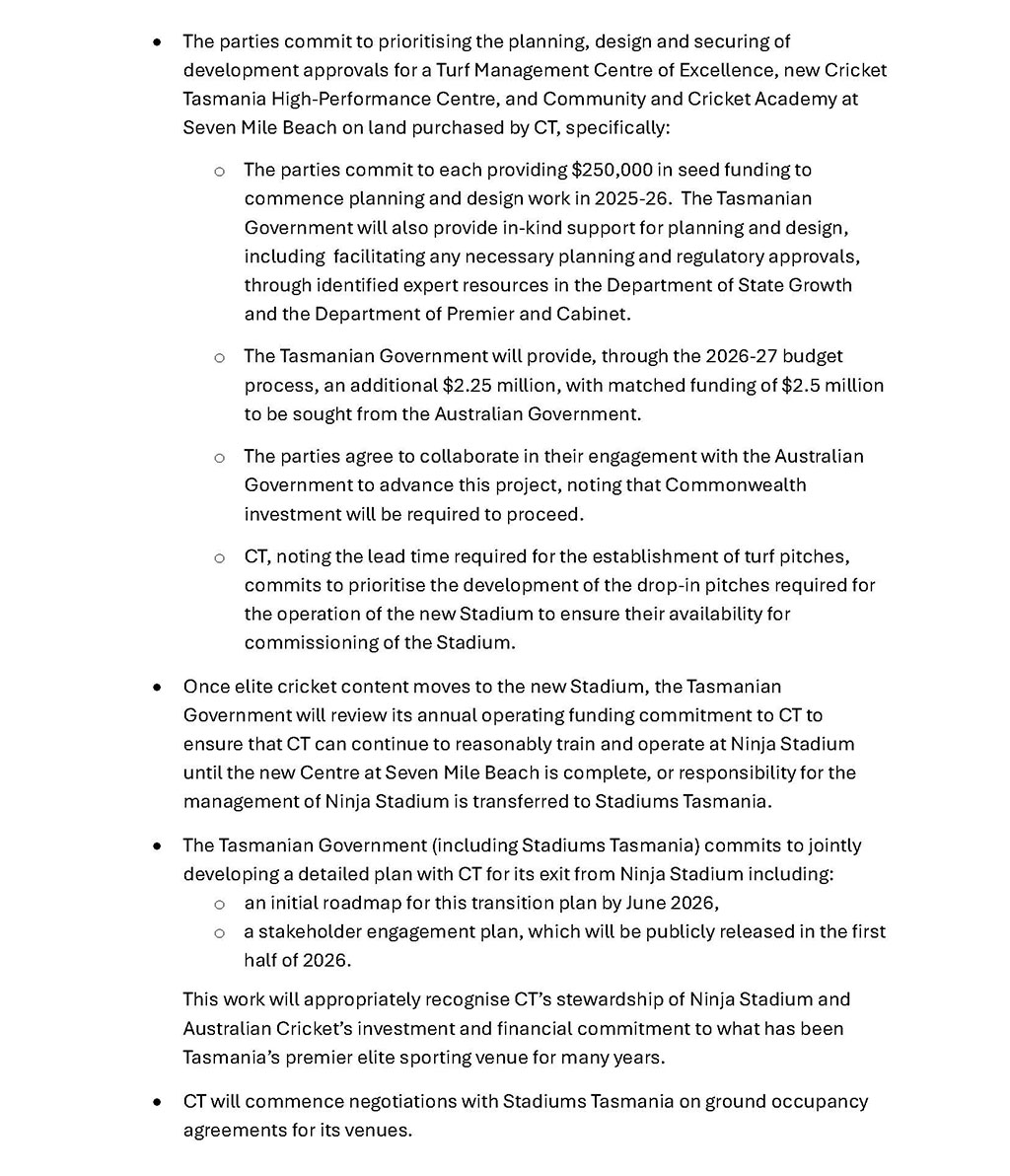
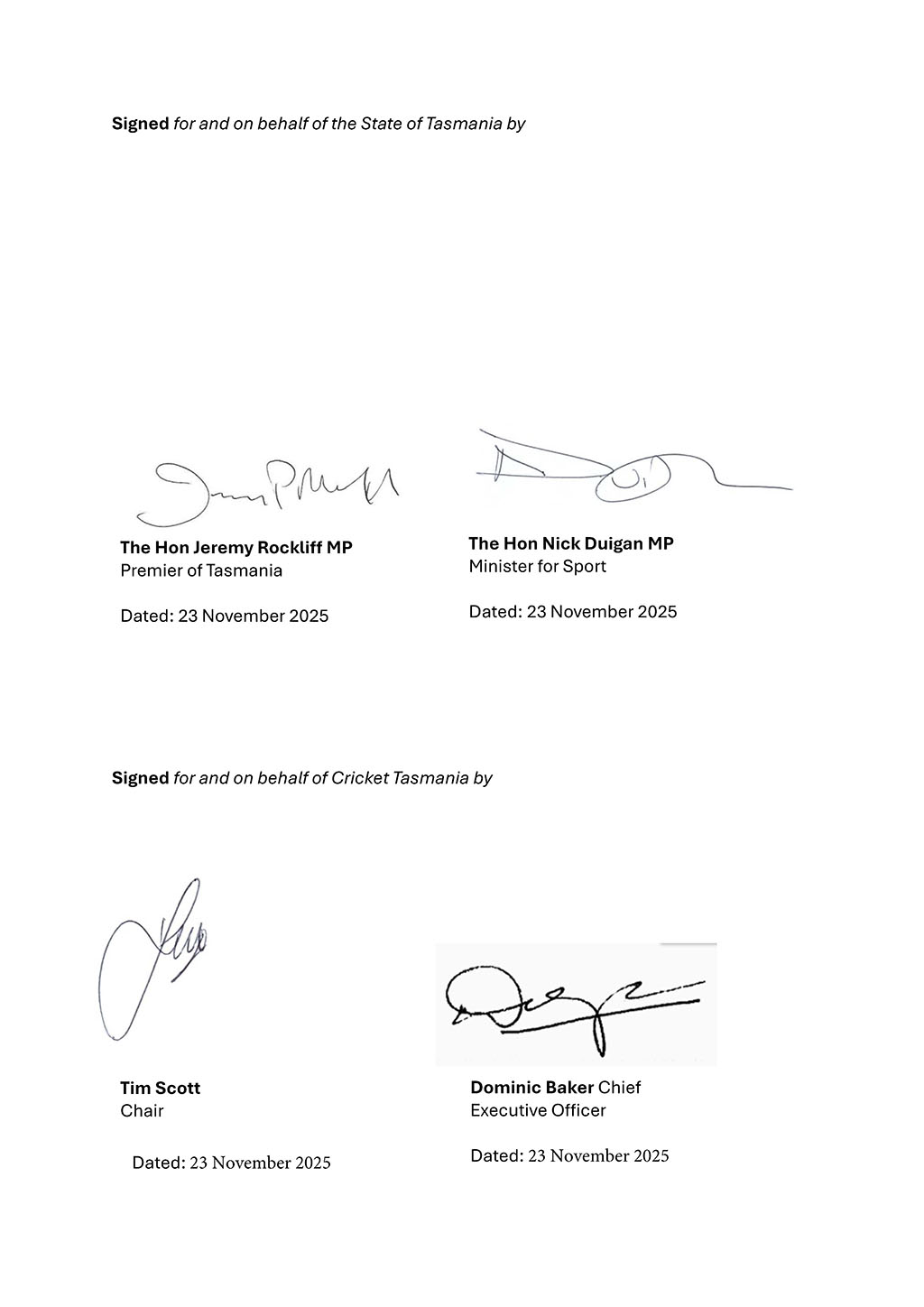
Tasmanian Times has obtained a copy and it is published below.
The document contains no commitment to stage international cricket and explicitly states:
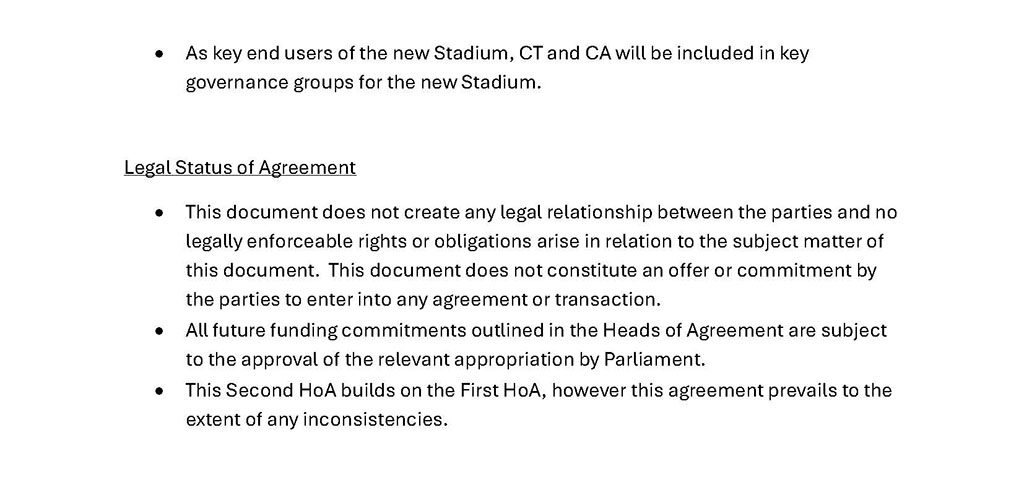
“This document does not create any legal relationship between the parties and no legally enforceable rights or obligations arise in relation to the subject matter of this document. This document does not constitute an offer or commitment by the parties to enter into any agreement or transaction.”
Examination of two successive agreements between June and November 2025 reveals that parties have shifted focus from solving the stadium’s roof design problem to planning logistics and funding, yet the fundamental question of whether international cricket will be played at the venue remains unresolved.
The timing of the announcement is significant.
Legislative Council member Dean Harriss has made cricket confirmation a key condition for his voting decision on the $1.13 billion project. During budget estimates hearings on Monday, Harriss posed a single question to Treasurer Eric Abetz and Macquarie Point Development Corporation chief executive Anne Beach:
“Have we got an update on the status of cricket being able to be played at the stadium?” He noted it was “not approved yet, not signed off.”
Government officials responded they were “supremely confident” cricket would be played at the venue, yet offered no documentation of that confidence.
The announcement of the Heads of Agreement has come four days after that hearing.
Signed on 23 November, it remains unclear whether the agreement has been formally provided to Legislative Council members including Harriss before the 4 December vote. With only 24 hours having passed since signature and more than a week until the parliamentary decision, the critical question for a legislator making cricket confirmation a voting condition is whether he has actually received and reviewed the agreement on which government claims are based.
The first Heads of Agreement, dated 20 June 2025, addressed a fundamental obstacle.
According to correspondence filed with the Tasmanian Planning Commission, the June agreement committed the parties to working on core design issues. The Crown Solicitor’s summary stated the parties were committed to “working together to identify a roof design that aligns with and delivers on playing, operational and broadcast requirements” and to “resolve to the satisfaction of all relevant parties the final design specifications for the stadium roof.”
The focus was narrow and urgent—managing “internal stadium shadowing and lighting issues.”
This was not about confirming cricket would be played at the stadium. It was about determining whether cricket could be played there at all. Without solving the shadow problem caused by the ETFE* roof pillows, the stadium would be unsuitable for any cricket, let alone elite cricket.
By November 2025, circumstances had shifted.
The second Heads of Agreement, signed on 23 November, incorporates resolution of the roof design question and adds new commitments. The government commits to increase annual operating and transition support to Cricket Tasmania from $3.5 million per annum in 2025-26 to $5 million by 2028-29, through annual increments of at least $500,000 from 2026-27.
The November agreement also commits both parties to developing detailed transition plans for cricket’s move from Ninja Stadium to the proposed Macquarie Point venue, including “an initial roadmap for this transition plan by June 2026” and “a stakeholder engagement plan, which will be publicly released in the first half of 2026.” The parties further commit to facilities development at Seven Mile Beach, with each providing $250,000 in seed funding for planning and design work.
However, the November agreement contains the same legal disclaimer as quoted at the outset.
It also states: “All future funding commitments outlined in the Heads of Agreement are subject to the approval of the relevant appropriation by Parliament.”
The progression from June to November shows a shift in focus rather than a resolution of fundamental questions. June addressed whether the stadium could function for cricket. November addresses the logistics and funding of how cricket would transition to the stadium, but leaves the core questions unanswered.
What the November agreement does not do is confirm that international cricket will be played at the stadium.
Cricket Tasmania commits to transfer matches that are “planned to be played in Tasmania” to the stadium “once operational.”
International cricket has not been confirmed for Tasmania.
The commitment is conditional on international cricket being planned for Tasmania in the first place, and then conditional on the stadium being built, tested and accredited.
The ABC reported that the government confirmed the stadium “could not receive International Cricket Council accreditation until after it has been built.”
Cricket Tasmania’s Chief Executive Officer Dominic Baker told the ABC: “I’ve gone from being confident to almost being sure” regarding roof testing outcomes—language that reveals uncertainty rather than certainty. The ABC also reported that first-class matches will likely be required as part of any testing or accreditation process.
The shift from the June agreement to the November agreement reflects confidence among the parties that the roof design problem can be solved.
What it does not reflect is certainty that international cricket will be played at the stadium.
The November agreement addresses transition planning and funding because parties believe the roof issue is manageable, not because international cricket confirmation has been secured.
The Mercury’s reporting that cricket is “locked in” represents a significant departure from what the document actually states. The newspaper asserted that “elite cricket” refers to BBL, State and International cricket without providing quotes from Premier Rockliff, CEO Cricket Tasmania, Dominic Baker, or Cricket Australia confirming international cricket has been secured.
The agreement itself refers to international matches “planned to be played”—not confirmed to be played.
This distinction matters critically for the parliamentary vote on 4 December.
Dean Harriss has specifically flagged cricket confirmation as a key consideration in his voting decision. The Heads of Agreement demonstrates that Cricket Tasmania, Cricket Australia, and the government are aligned on transition and funding. It does not demonstrate that cricket confirmation at the stadium is now certain or locked in. For a legislator concerned with approving a $1.13 billion project on the basis of sporting commitments, a non-binding agreement referencing “planned” rather than “confirmed” matches falls short of what “confirmation” requires.
The timing—just days before the critical vote, and only 24 hours after signature—and the uncertain status of whether the agreement has been provided to Dean Harriss and other Legislative Council members raise accountability questions.
The government has announced the agreement and made claims about what it contains.
Editor’s Note: ETFE*stands for ethylene tetrafluoroethylene—a transparent plastic polymer material used for the roof pillows (panels) of the stadium. The matte treatment is a finish applied to one side of the ETFE. According to the Heads of Agreement and ABC reporting, the matte surface works by scattering light rather than allowing it to pass straight through. Anne Beach, Chief Executive Officer of the Macquarie Point Development Corporation, explained: “The option we have been looking at is a matte treatment where one side is machine ‘roughed up’ and what that does is it disperses the light, instead of having the light go straight through.”
The purpose is to reduce or eliminate shadows on the cricket field caused by sunlight coming through the clear roof. However, this matte ETFE treatment has not yet been tested. Testing is scheduled for early 2026 as part of a “test rig” to prove the material works as intended before the stadium is built.

Tasmanian Times (TT) is a community-based news and current affairs service covering the island state of Tasmania. It exists to provide a diverse presentation of Tasmanian issues. TT creates and supports independent media content utilising the best of modern technologies and tried-and-true practices of public-interest journalism.
Support us in expanding our coverage and developing new content by and for Tasmanians.
New initiatives on the way include … what our contributors and readers suggest! Please get in touch with your suggestions.