George Town Council’s General Manager Shane Power—who in August 2023 faced allegations of drunken and disorderly conduct at a junior football club dinner, allegedly dropped an expensive microphone during his speech to young players, was asked to leave with the door locked behind him and later at Grays Hotel was observed inappropriately approaching an 18-year-old female before staff ejected him—has spent 14 months obstructing Councillor Heather Barwick from accessing routine correspondence about her own complaint to the Ombudsman.
The same councillor who publicly stated she was “extremely concerned by the allegations” and would “urge council to take appropriate action in line with the conditions of the General Manager’s contract and the Employee Code of Conduct Policy” following Power’s August 2023 conduct. Power retained his position and had his contract extended to May 2027 at a salary package amounting to an estimated $400,000.
He has now used his authority to prevent that councillor from seeing how he characterised her actions to external oversight bodies.
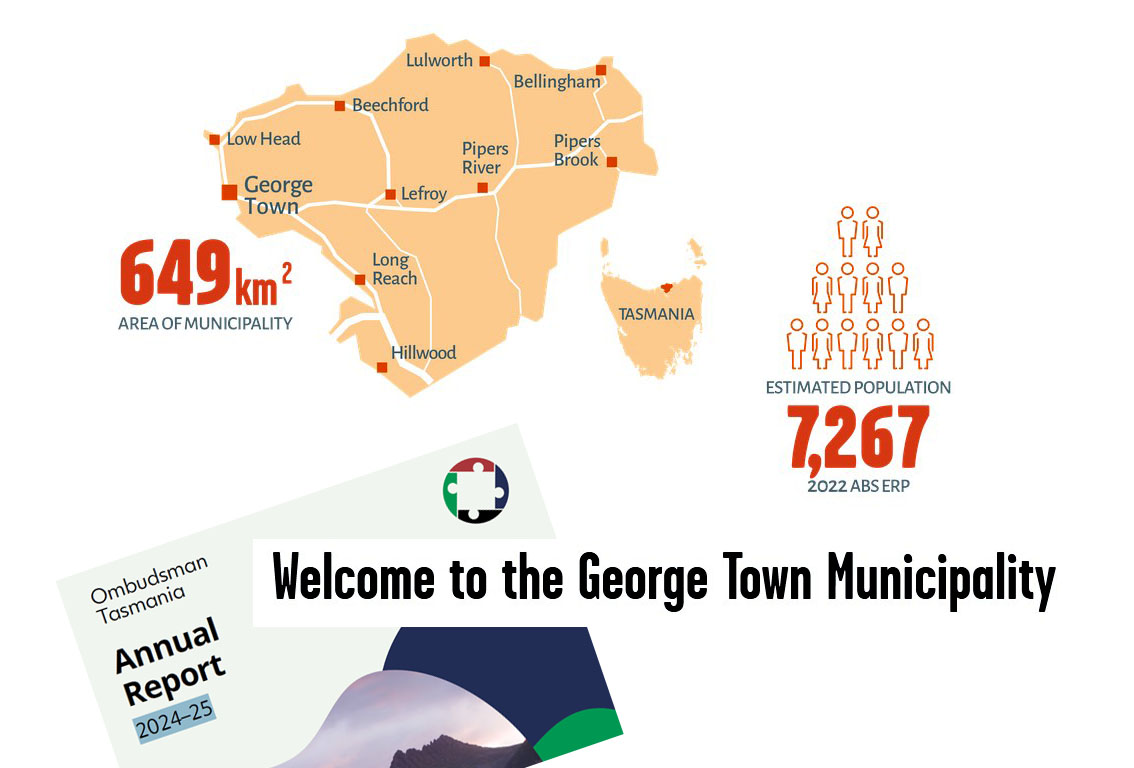
The Ombudsman’s final ruling on 30 October 2025 comprehensively rejected every argument Power and his Director Rick Dunn advanced, finding the withheld information “largely innocuous” and noting “it is not clear how its release would harm the interests of the General Manager.” The decision places George Town Council within the 86 per cent of Tasmanian public authorities whose RTI decisions are varied or overturned on external review—a damning statistic from the Ombudsman’s 2024-25 Annual Report revealing systemic failure in transparency compliance.
On 27 August 2024, Barwick requested all correspondence council sent to Ombudsman Tasmania about her complaint regarding Industry Road line marking.
Dunn refused, claiming parts of Power’s letter were exempt as “internal deliberative information” that could harm Power if “misinterpreted by the public.”
This argument is legally irrelevant—Schedule 2 of the RTI Act explicitly prohibits consideration of possible misinterpretation. Yet Dunn persisted for 14 months, even after the Acting Ombudsman’s preliminary view in August 2025 found council had “not discharged its onus” to justify withholding information.
Any competent administrator would have complied. Instead, Dunn issued a fresh decision on 2 October 2025 using identical arguments already rejected, claiming that “given the complex nature of the professional relationship that typically exists throughout Local Government between General Manager and Councillors, information that is provided as deliberative between public authorities in this instance could reasonably be considered as sensitive.”
This is administrative arrogance suggesting elected members cannot be trusted to interpret routine correspondence.
The withheld paragraph reveals why Power wanted it concealed. His letter notes Barwick “escalated what was initially considered a ‘query’ to a ‘complaint'” and approached the Ombudsman “without having followed the prescribed process contained within the policy.” Power references council’s “Customer Service Charter” and suggests officers found it “difficult to adjudge compliance with councils complaint management process, given no formal complaint has been received.”
Power expected a councillor who has served her community since March 1989, was George Town’s first female Mayor in 1995, and held the deputy mayor role for two years, to follow internal complaint procedures designed for residents before exercising her statutory right to contact the Ombudsman. When she declined, he attempted to prevent her from seeing how he characterised her conduct.
Power’s letter emphasises providing context about “Mrs Barwick having regular briefings and access to information and key staff members beyond what a typical resident may expect.” This reveals fundamental confusion about councillor roles.
Barwick is not a resident with enhanced access.
She is an elected member of the governing body with accountability and oversight responsibilities—functions Power apparently resents being exercised, particularly by the councillor who called for his accountability following the August 2023 incidents.
The obstruction consumed ratepayer resources for 14 months. Multiple RTI decisions. Protracted correspondence with the Ombudsman. Full external review. Continued fighting after adverse preliminary view.
All to conceal Power’s opinion that Barwick should have followed resident complaint procedures—information the Ombudsman found should have been released immediately.
Dunn’s incompetence or contempt is evident throughout. He repeatedly cited legally irrelevant factors, persisted after correction and claimed Council was “unable to conduct” internal review when Barwick requested it, forcing her down the more cumbersome external pathway—obstruction designed to exhaust applicants into abandoning legitimate requests.
The Ombudsman’s 2024–25 annual report documents that local government accounts for 30 per cent of all RTI external reviews, with 86 per cent of decisions varied or overturned. Power and Dunn exemplify this systemic failure. They treat transparency as threat rather than obligation. They treat elected member oversight as adversarial rather than legitimate democratic function. And they persist in legally indefensible positions betting applicants will surrender.
They bet wrong with Barwick.

Councillor Heather Barwick
But how many other requests has this administration frustrated? How many residents or councillors have abandoned legitimate information requests because fighting Power and Dunn for 14 months is too exhausting?
A general manager facing serious unresolved conduct allegations blocks the very councillor who called for accountability from accessing information about how he characterises her actions to external authorities.
This is calculated obstruction of elected member oversight by a senior officer with vested interest in limiting scrutiny.
That Power draws a $400,000 salary package—the highest in Tasmania as percentage of council revenue at 2.5 per cent—while obstructing transparency raises serious questions about value for ratepayers. Included in his package Power has benefited some $60,000 plus travel and accommodation to New Zealand as part of his ANZSOG* training. Council revenue for 2024/2025 is reported as $15,888,229 with operational surplus of $70,000 for the financial year.
The full Ombudsman decision—Case Reference R2411-004—documents in meticulous detail how comprehensively Power and Dunn’s positions were rejected.
Councillor Barwick deserves a formal apology from both men and from council for this 14-month obstruction of her legitimate oversight functions.
Instead, ratepayers are left wondering whether an administration that wastes public resources defending the indefensible while blocking elected member accountability represents the leadership George Town deserves.
*ANZSOG is a unique multi-jurisdictional organisation, created by governments to provide education, research and advisory services that meet government needs and enhance the quality of public sector leadership and management across Australia and Aotearoa New Zealand.
Tasmanian Times (TT) is a community-based news and current affairs service covering the island state of Tasmania. It exists to provide a diverse presentation of Tasmanian issues. TT creates and supports independent media content utilising the best of modern technologies and tried-and-true practices of public-interest journalism.
Support us in expanding our coverage and developing new content by and for Tasmanians.
New initiatives on the way include … what our contributors and readers suggest! Please get in touch with your suggestions.