There comes a moment in every contentious public debate when the spin becomes so transparent, the desperation so palpable, that even those genuinely trying to maintain an open mind must pause and ask – what are we really being sold here?
The Coordinator-General’s eleventh-hour intervention into the Macquarie Point stadium debate represents precisely such a moment. Released selectively to a sympathetic media outlet just days after the government’s formal response to the Planning Commission’s damning assessment, this “analysis” raises more questions than it answers – and the most pressing question is simply, why now?
If the Coordinator-General genuinely possessed compelling economic evidence that contradicted every independent expert assessment to date, why wasn’t it presented to the Tasmanian Planning Commission during the formal assessment process? The Commission, after rigorous analysis, concluded the project would return less than 50 cents for every dollar spent.
As Our Place Hobart have noted, that finding wasn’t made lightly – it came after considering submissions from KPMG, Dr Nicholas Gruen and a range of technical experts.
John Perry’s opinion piece in today’s Mercury attempts to paint a rosy picture of the stadium’s prospects, but what the piece conspicuously fails to mention is equally revealing. Perry’s office was not invited to comment during the Planning Commission’s assessment process; a curious omission if this analysis was genuinely robust and defensible.
Instead, it emerges now, at the most politically convenient moment, championed by a Coordinator-General who appears to have forgotten his role requires independence from government advocacy.
Since that assessment, the project costs have ballooned by “hundreds of millions of dollars”, as stated in the Green’s media release of today. The Planning Commission’s comprehensive rejection was based on the best available evidence at the time. Now, with costs even higher and the economic case even weaker, we’re expected to believe the Coordinator-General has discovered a path to prosperity that eluded everyone else?
Questions must also be asked about Perry’s objectivity in this matter. His enthusiasm for the project and the timing of his intervention suggest something beyond dispassionate economic analysis. When a statutory office holder’s commentary aligns so perfectly with government talking points and emerges precisely when the government needs political cover; reasonable observers might wonder whether institutional independence has been compromised in favor of political expediency.
The Australian Institute of Architects, in their carefully worded statement release yesterday, have done what professionals do – acknowledged the process while emphasising the critical importance of design quality and lasting value.
They speak of “rigour and accountability” befitting a project of this scale. These aren’t merely polite phrases, they’re a pointed reminder that on a site of such significance, shortcuts and spin are inadequate substitutes for genuine analysis.
Perry’s arguments in the Mercury rely on heroic assumptions about visitor numbers, spending patterns and ongoing operational viability that have been tested and found wanting by every independent assessment. The logic presented leads to an absurd conclusion – if a $2 billion stadium generates unlimited economic benefits, why stop there?
By this reasoning, as raised by Our Place Hobart, a $4 billion or $6 billion stadium would be even better. Not even the government’s own economists have ventured into such creative territory.
Meanwhile, Treasury was sounding alarm bells just months ago about uncontrolled and unfunded infrastructure proposals. That warning seems to have been conveniently forgotten in the current public relations messaging.
The truth is brutally simple; when you add the major additional works that will be required, the true cost over ten years reaches $2 billion, or as Our Place Hobart posited recently, as much as $3.5 billion, and what’s more, the government cannot tell Tasmanians where that money will come from. They’re asking Parliament to sign a blank cheque while our hospitals struggle, our housing crisis deepens and our young people leave the state seeking opportunities elsewhere.
What’s perhaps most troubling is how this debate has been conducted.
When a decision of this magnitude is before the parliament, one that will shape Tasmania’s fiscal future for decades, the public deserves more than selective media briefings and hastily assembled rejoinders to independent assessments.
Perry’s piece in the Mercury reads less like independent analysis and more like a government media release with a statutory officer’s signature attached.
The fact that Perry’s office was excluded from the formal Planning Commission process but now takes center stage in the public relations campaign should concern every Tasmanian who values transparent governance. If his analysis had merit, it should have been subjected to the same rigorous scrutiny that demolished the proponent’s earlier claims.
Instead, it bypasses that inconvenient step entirely.
Tasmanians deserve a genuine conversation about priorities. About what kind of state we want to be. About whether gambling our future on a stadium that every independent expert says will lose money represents sound governance or reckless opportunism.
The Legislative Councillors now facing this decision have a responsibility that extends far beyond party politics or pressure from government. They must weigh carefully whether an analysis that wasn’t credible enough to submit to the Planning Commission should somehow prove persuasive now.
They must ask themselves whether Perry’s sudden appearance as the stadium’s economic champion, after being notably absent from the formal assessment, represents genuine expertise or convenient politics.
They must consider whether the timing and manner of this intervention suggests confidence or desperation.
Tasmania stands at a crossroads. We can proceed with a project that independent experts consistently tell us represents poor value, that will cost far more than initially promised and that diverts billions from pressing social needs.
Or we can acknowledge that even the most seductive vision must ultimately answer to fiscal reality.
The stadium’s proponents speak of legacy and ambition. But there’s nothing ambitious about mortgaging the state’s future on a project that fails every credible cost-benefit analysis. The real ambition would be having the courage to say no to a bad deal, regardless of how much political capital has been invested in it.
As the debate moves to the Upper House, let’s hope our legislators show the same independence and rigour that the Planning Commission demonstrated. Tasmania’s future and the futures of our sick, homeless and young—depends on it.
The numbers don’t lie. The question is – will Parliament listen?
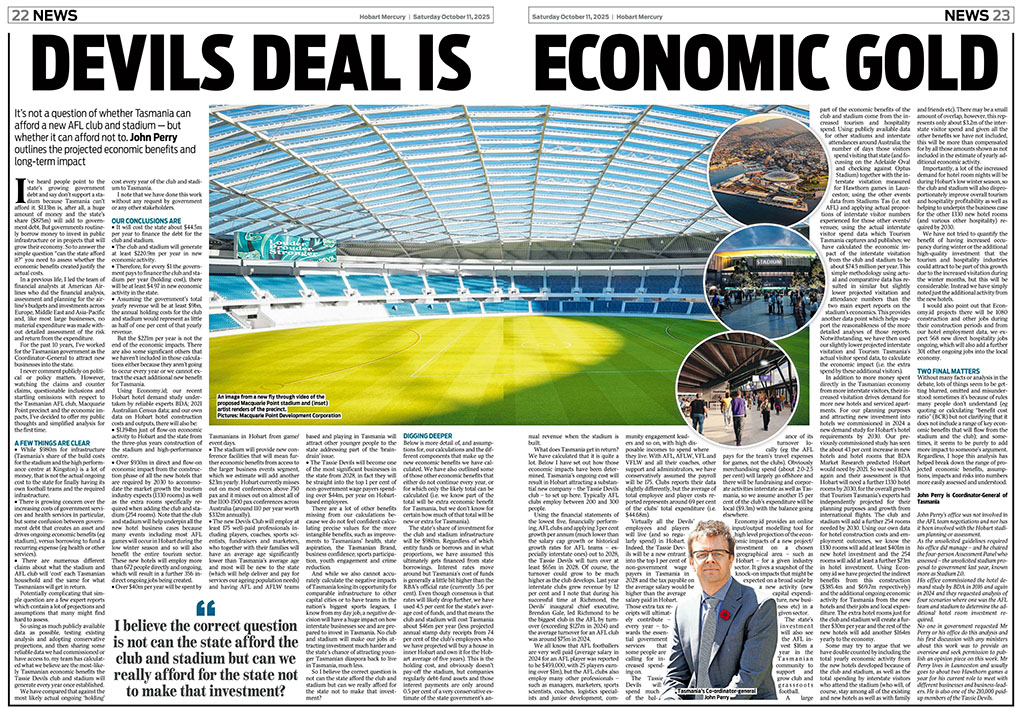
Screenshot of John Perry’s opinion piece as published in the Mercury 11 October 2025
Tasmanian Times failed to find any reference to this opinion piece article on the websites of the Office of the Governor General’s or the Tasmanian Planning Commission.

Media release – Vica Bayley MHA, Greens Acting Leader, 11 October 2025
Fantasy Island Economics Just More Stadium PR
The Coordinator-General’s analysis of the supposed benefits of the stadium is little more than fantasy economics, designed to build on the Rockliff Government’s propaganda and win votes in the Upper House.
All objective analysis released has found the stadium is an economic loser. The only argument is just how much of a loser it will be. The proponent’s own analysis completed by KPMG, Dr Nicholas Gruen and the experts at the Planning Commission all found the stadium will cost Tasmanians.
Since the independent experts at the Planning Commission found that the project would return less than 50c for every dollar spent, the costs of the stadium have blown out by hundreds of millions of dollars – and few expect it to stop there. It’s why they comprehensively rejected the stadium.
Yet the Rockliff Government’s own agent, the Coordinator-General, has concocted a fantastic new figure. This is fantasy island economics and nothing more than clutching at straws as part of the Liberal Government’s desperate public relations blitz.
If this was a credible analysis, why wasn’t it submitted to the Tasmanian Planning Commission for scrutiny in the formal assessment process? Why has it be left to a few days after the Rockliff Government’s formal response to push ahead, despite the Commission’s recommendation the project should not proceed? Why was it released selectively to a few media outlets?
Legislative Councillors and members of the public genuinely still trying to make up their mind on the stadium should feel insulted by the Liberal Government’s response to the Planning Commission’s rejection of the stadium, and the PR from their agent.

Media release – Our Place Hobart, 11 October 2025
Our Place responds to the Coordinator-General’s claims about the Mac Point Stadium
Our Place Hobart has described the Coordinator-General’s belated intervention in the stadium debate as a sign the government is struggling to both stem the growing panic in the broader Tasmanian community that the stadium may bankrupt the state and to gain the votes it needs in the Upper House.
The Coordinator-General has asserted, like the government, there will be seemingly unlimited economic benefits that flow from a $2billion stadium. Using the Co-ordinator General’s logic, the government would do even better to spend $4 billion—or even $6 billion of money it does not have. Not even the government’s own economists, KPMG, nor the Treasury, have ever suggested anything remotely like such voodoo economics in justification of the stadium.
In fact, in June 2025 Treasury was sounding alarm bells about the uncontrolled and unfunded infrastructure proposals.
The Co-ordinator General’s spin is full of doom and false assumptions, heroic predictions and avoids too many critical facts to take seriously. And he ignores the lack of information about cost.
If the Co-ordinator General was sincere in his claims why did he not submit them to the Tasmanian Planning Commission for rigorous independent analysis?
It is deeply concerning that when a debate of this gravity about Tasmania’s future is under way, the Hobart Mercury has avoided running many articles or points of view questioning the stadium and has instead become a promotional unit for Jeremy Rockliff.
The government has no idea of the size of the blank cheque it is asking parliament to sign, but we know, thanks to the Planning Commission, the true cost is already at the $2 billion mark over 10 years, when major additional works are factored in. There should be a serious discussion about what this means for Tasmania’s sick, homeless, and young.

Media statement – Tasmanian Chapter of the Australian Institute of Architect, 10 October 2025
Macquarie Point Multipurpose Stadium Integrated Assessment
The Tasmanian Chapter of the Australian Institute of Architects (the Institute) acknowledges the release of the Tasmanian Planning Commission’s Integrated Assessment Report for the Macquarie Point Multipurpose Stadium Integrated Assessment.
The Institute is pleased that this independent assessment process has been undertaken. The Tasmanian parliament can now give thorough consideration, provide a response and make a determination with rigour and accountability, as befits a project of this scale and impact.
We value the expertise of architects in contributing to the assessment and the broader public discussion on this issue. Good design is central to achieving the best outcomes for places, people and communities. On a site of this location, scale and complexity, design quality is not an added benefit but a necessity—ensuring that development responds appropriately, responsibly and with lasting value.
The Institute recognises that the proposed Macquarie Point Multipurpose Stadium, along with the associated planning processes, has generated significant public debate. We welcome the continued conversation around the broader urban context and its implications. The Institute remains committed to fostering informed and respectful dialogue on issues that impact Tasmania and its communities. The Institute continues to advocate for an approach that achieves the best possible legacy for Tasmania and Tasmanians.
Tasmanian Times (TT) is a community-based news and current affairs service covering the island state of Tasmania. It exists to provide a diverse presentation of Tasmanian issues. TT creates and supports independent media content utilising the best of modern technologies and tried-and-true practices of public-interest journalism.
Support us in expanding our coverage and developing new content by and for Tasmanians.
New initiatives on the way include … what our contributors and readers suggest! Please get in touch with your suggestions.