Earlier this year UNICEF Australia announced its Young Ambassador to represent Tasmania in an 18-month program for aspiring young advocates. Reede Adams-Beckett, 22, from Launceston was selected to form the group of 11 new UNICEF Australia Young Ambassadors, aged 16-23 years old.
UNICEF Australia CEO Tony Stuart said to effectively advocate for the rights of children and to ensure their needs are met, we must first listen to what they have to say.
“From all corners of the country and each with unique life experiences, we want to know what is important to Australia’s young people and how we can address the issues that impact them. That is why our Young Ambassador program is central to our mission, and to our ability to reach the young people who don’t feel heard.
“We congratulate each member of this group and welcome them to our UNICEF Australia family, where we will work to raise their voices, and give them a platform to encourage their peers to also get involved and share their perspectives,” Stuart said.
The 11 successful Young Ambassadors were selected from 350 applicants around the country, through a lengthy application process that included both individual and group interviews.
UNICEF Australia Young Ambassador Reede Adams-Beckett is a Palawa man with experience working in youth advocacy and who is committed to making a positive and lasting impact within youth policy.
“To me, First Nations social justice means taking action in creating real equality; having a voice as a community, being engaged when decisions need to be made and making an effort to keep the culture of the oldest peoples in the world alive – this means reinvigorating the vast languages, telling our stories and learning from our elders,” Reede said.
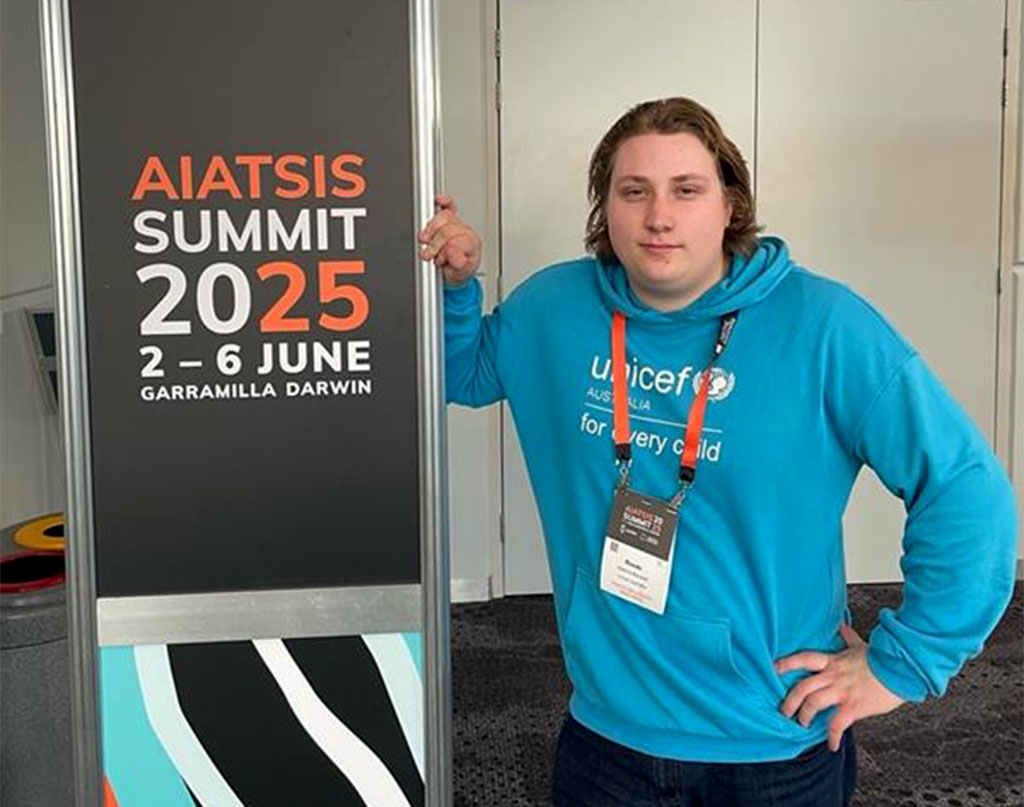
Adams-Beckett’s journey, as detailed in his article “Just on the other side: A journey to First Nations identity,” began at the Australian Institute of Aboriginal and Torres Strait Islander Studies (AIATSIS) Summit which he attended in June 2025. His commitment was to listening and learning and his experience was profoundly shaped by the question, ‘What kind of ancestor do you want to be?’, which he has summarised in the following article.
Just on the other side: A journey to First Nations identity
Reede Adams-Beckett, UNICEF Australia Young Ambassador representing Tasmania
“What kind of ancestor do you want to be?”
Over three days and 26 sessions, it was this question that truly shaped my experience at the Australian Institute of Aboriginal and Torres Strait Islander Studies (AIATSIS) Summit in Darwin.
As a proud descendant of the Trawlwoolway people in Lutruwita, Tasmania, I have not had the privilege of growing up on country or with a connection to culture as my family’s ties were lost generations ago. This has only fuelled my curiosity and motivation to take the steps towards discovery and to find the people who can teach me more about my ancestors.
The AIATSIS Summit 2025 proved to be one of these steps in my story. Dubbed as one of the largest conferences of its kind, it brings together Aboriginal and Torres Strait Islander Elders, leaders, and youth, as well as academics, experts and government officials to discuss the issues that matter most to First Nations peoples.
My strategy for the Summit? Listen. And I mean really listen. As someone without a deep background of community, I believe I should be the ears and not the voice to questions about the experiences of First Nations peoples. I would listen and I would learn.
Through speeches, workshops, cultural spaces and presentations we explored many themes – youth empowerment, leadership and advocacy. But one question posed by an Elder really stood out: “What kind of ancestor do you want to be?”
As an advocate for youth voices, I was reminded that this is a full community priority and not just a youth concern, and of the ripple effect young leaders can have on creating future young leaders and empowering a better community.
After all, what is the purpose of advocacy if not to make the next generation’s experience better than our own?
I saw how a community led by young people is central to the strength of First Nations communities across the country, with motivations to become “ancestors who show young people the right way”.
And with a voice, comes language. I was so inspired by Gudjal Elder, William Santo, who spent 30 dedicated years working to reclaim a seemingly lost language and created a milestone dictionary. Gudjal may not be the language spoken by my ancestors, but his story of determination and commitment to sharing his culture will stay with me throughout my life. It left me with a drive to continue my own journey to culture and community, and the desire to learn my local language.
These sessions made a lasting impact, but in between the formalities, there was a deeper lesson. At an event like the AIATSIS Summit, the real learnings can also happen outside in the shared spaces – through the people you meet and the stories they share. You may sit next to someone and share a few words that can lead to insights and even friendships you didn’t know you could make.
So here are my real learnings: Be a listener – our privilege is being young, and being able to learn from those who came before us; Learn your local language – this is how we can keep the oldest continuing culture alive and healthy; Get involved with community – it might just guide you the way you need to go; and keep asking yourself what kind of ancestor you want to be – this is grounding and it helps you reflect.
And for me, as I continue this journey, I’ll be working on connecting with members of my community, but from all of this, I’ve come to realise that with each of these new experiences, connection is just on the other side.
Tasmanian Times (TT) is a community-based news and current affairs service covering the island state of Tasmania. It exists to provide a diverse presentation of Tasmanian issues. TT creates and supports independent media content utilising the best of modern technologies and tried-and-true practices of public-interest journalism.
Support us in expanding our coverage and developing new content by and for Tasmanians.
New initiatives on the way include … what our contributors and readers suggest! Please get in touch with your suggestions.