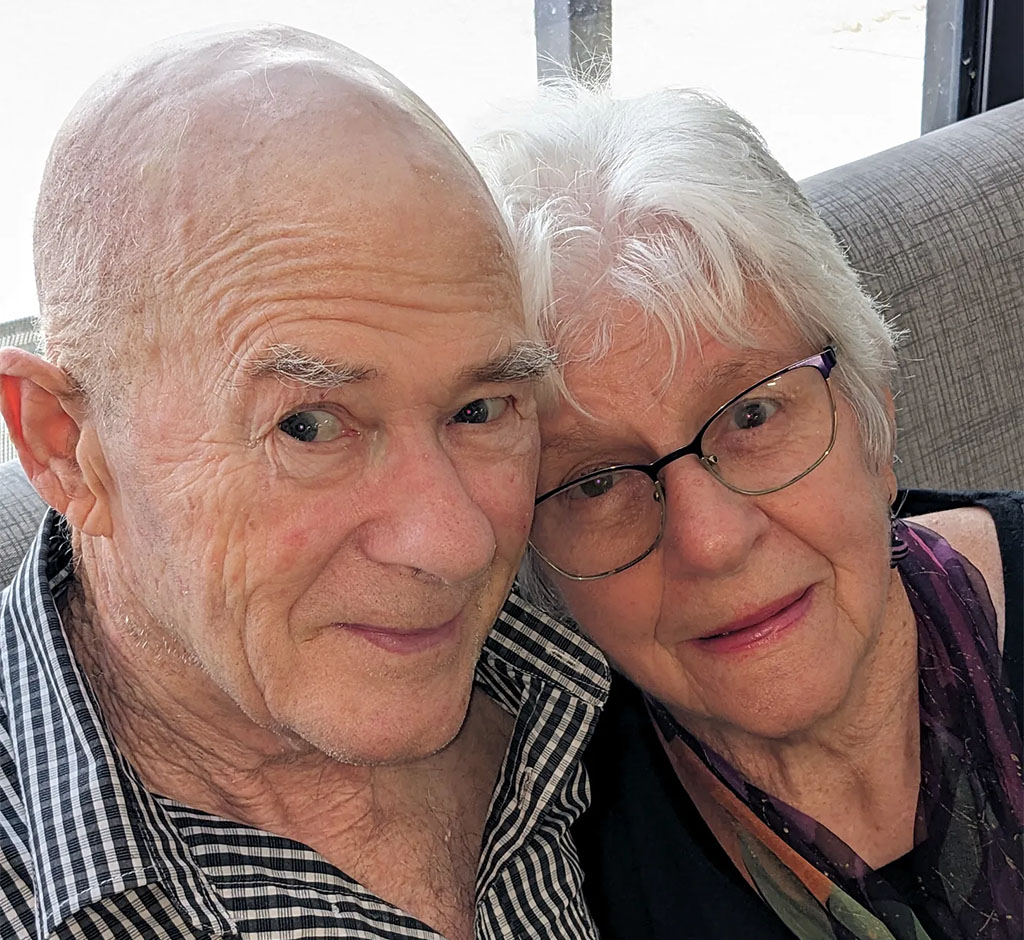
Author Linda Cockburn shares a very intimate essay. Vale Robert Cockburn.
My father died two weeks ago. The story is a blend of fact and fiction. Our relationship is very real. As is the forgiveness.
‘He wants to go,’ Mum tells me, ‘He’s eighty-six, he’s had enough.’
He’s in pain but refuses pain relief. Despite wanting to die, he won’t do anything to reduce the dwindling gap between still here and not. All my life he’s insisted there’s nothing and no one waiting beyond the grave. He faces death believing with his final breath, with his last heartbeat, he will be delivered unto a state of meat.
They have a beach side apartment. They’ve accumulated kilos of sand in their shoes walking down to bask on it or wade along its wave-frilled edges. Now, he sits in his chair and faces a view of distant waves and wheeling gulls with his eyes closed, his dog Tebor by his side. He waits.
A while back he started writing lists, trying to retain order in his increasingly disordered world. But still, things go missing. Their loss is sometimes mourned, most times soon forgotten. His handwriting is small, cramped, and barely legible. Mum tells me it frustrates him to re-read what he’s written. Attempts to pin the disappearing world to the page are soon dismissed.
He doesn’t like to speak on the phone. He doesn’t much like to speak. One day I call and catch him at a weak moment. He picks up. I query him about his health, but he isn’t interested in answering. He mumbles something and then says clearly, ‘I’m turning into a black hole.’
I laugh, waiting for the punch line, but he doesn’t deliver.
‘Why do you think that?’ I ask.
‘There was an apple on the bench, it disappeared.’
‘Before your eyes?’
‘No, I turned around, turned back and it was gone.’
He sounds old. I’m quiet, not sure how to handle this. He has dementia, it’s the nature of the disease, things will ‘disappear.’ But he’s not going to want to hear that.
‘Remember when grandma was alive and she answered the door, wild-eyed, and yelled at us to leave, there were bad spirits in the house, they’d stolen her shoulder pads? She ran off down the hall and they were stuck to her bum.’ he remembers, and we laugh.
‘It’s not like that,’ he says, and we talk about other things till Mum gets home.
My father and I have not been able to maintain a conversation longer than a minute without arguing for most of our lives. Our views are poles apart.
But now he can no longer sustain the need to dominate, occasionally we have a laugh.
Since his licence was revoked, he enjoys taking the car out of the garage and parking it in the driveway for mum, who’s expert at jumping gutters and taking off the side mirrors of other people’s cars. For a while, every time she left the house he’d be sitting in his chair, eyes closed, and she’d arrive home to find him with the chainsaw, or hanging from a ladder cleaning gutters, doing things he should not, precisely because he’d been told not to. The chainsaw mysteriously disappeared some time ago.
Mum had hand rails installed, but he refuses to use them. He has a walker he’s never touched. Instead, he walks unaided. One night he spent an hour trapped behind the toilet, another time he put his head through a wall, and a week later, still recuperating, he cracked his ribs against a dresser. Getting out of a chair is a herculean effort he will not be helped with.
I find myself reflecting on the conversation for the rest of the day. Perhaps, somewhere along the line, he’s snagged on a fact about black holes. He watches a lot of documentaries. Or used to. Maybe he’s integrated his memory loss with becoming a black hole. Everything in his life is being drawn down a dark tunnel of forgetfulness. Being a black hole is a better diagnosis than a disease that takes one of his faculties. He’s maintaining his pride with a strange quirk of reasoning for their loss.
‘Would you like me to talk to someone about it? Perhaps there’s something that can be done?’
He maintains silence long enough to make me wonder if he’s still there before he changes the subject. Later he comes back to it. Maybe it’s time to take the valuables out of the house. Your mother should leave. In his darkness he senses his illness is sucking her in too.
She rings in tears, saying, ‘I think there’s only a couple of days left.’
I explain it’s not how dementia works, he has a long way to go. She’s torn. She feels, now, at the end of her life, she deserves a rest, to not be the cleaner, the carer, to finally put herself first and not shape herself around his needs or be subjected to his anger. A few months back she’d playfully squirted him with the garden hose and he’d tried to strangle her with it. But his death is a two-edged sword. After sixty-eight years of marriage, she cannot imagine life without him. If memories could be weighed, then he’s been the bulk of hers. Phone calls with her are a repetition of the last, an endless parade of names of people I don’t know, of friends who’ve died, of being lonely. They’d been very social, now the room is full of empty chairs and they wonder when they will no longer fill their own.
Maybe now he’s losing his memories, I can let some go too. Be selective about what remains. Our past is painful, one he selectively edited out years ago but which sometimes runs a scorching path through my midnight brain. We remember my childhood very differently. He adopted the strict father-conservative ideology; spare the rod and spoil the child. His instrument of control was humiliation. I grew up knowing I was not only not enough, I could never be, I was irredeemably wrong. My parent’s ambitions for me were of the get-married-and-have-children kind, put the needs of men first, be quiet, subservient, ‘nice’. My mother brags about how other people’s children misbehaved, and how we never grizzled or complained, we only ever sat quietly and said nothing. We learnt early on sympathy was in short supply and only ever doled out to other people. We learnt by osmosis that our role in life was to come last. I’ve been shaking myself free of that lesson all my life. Perhaps this is a story of me climbing out of a black hole as much as it is of my father disappearing into one.
Memory is strange magic, how they’re made, how they’re kept, stored in chemicals, electrical signals exchanged by neurons that leap synaptic gaps. They smell of scents long gone, or sticky tight around uncomfortable emotions. They’re the integration of our everything. My father’s ability to make new memories is wearing out, those remaining are increasingly difficult to sift through to find the one he’s looking for. If I live long enough it’s likely I’ll share his fate. It terrifies me. He’s a message from a future I do not want.
The future is an insubstantial place with no memories to pin it down. It’s our past that makes substantial beings of us. For my father, the weight of his are lifting, or perhaps being sucked down a black hole.
My father had a difficult childhood. Whenever he sees the Salvos he pulls out his wallet and empties it. If he could pay to keep his memory, he wouldn’t haggle, he’d pay the asking price. But there are some he’d pay to forget.
One day my father believes he’ll be meat. But what he’ll be is memories, mine, my brothers and sisters, the people who survive him. We’ll hold the shape of him until we too are gone.
When I was young I took boughs of flowering trees to the cemetery in spring. I liked to walk the oldest parts, placing posies on the graves of people no one grieves for, their stories inscribed in crumbling stone. It was comforting to think people were finally at rest when all living memory of them is lost.
One day no one will remember my father. One day no one will remember my own small parcel of flesh, the way I walk, talk, think, the things I did, the things I didn’t.
I was seven and standing behind my father while he chopped wood, when a voice told me to, Get out of the way! I looked around, saw no one, but obediently moved to one side just as the axe head parted with the handle and sailed through where I’d stood. I told him. He said nothing. I assumed, as was so often the case, that he’d taken no notice. As an adult I started to retell the story at a family dinner, only to have him interrupt with a brusque, ‘I remember.’ Perhaps there’s more to being dead than just a transition from living animal to meat. Perhaps he wonders this too.
He has a stroke. I do what I said I never would. I go ‘home.’ When I arrive at the hospital he’s as my siblings have described, trapped in an ailing body the size of a childs. Even his voice is thin, a whisper. Over the few days I’ve allocated to say goodbye I visit often with food he fails to eat. I never stay long.
It’s when I take him for an x-ray and we’re sitting in an empty waiting room, and he’s staring at a blank wall that he says, so quietly I have to lean forward to catch the words as the stroke trips them off his tongue, ‘I wasn’t always kind.’ It’s a moment so huge it blooms, an eruption of adrenaline and emotions I cannot name.
‘No,’ I say just as quietly, ‘You weren’t.’ For I cannot lie and negate those hellish years he’s summed up in four benign words.
I push it, ‘Is this an apology?’
His head swivels, eyes snapping, ‘No!’ he barks, it’s the loudest I’ve heard him speak.
I laugh, ‘Too late, I’ve already accepted it as one.’ I’m surprised to find I have.
When I say a final goodbye he’s lying awkwardly on top of his hospital bed, his shirt askew. He watches me walk across the room with recognition, a smile. This will be the last time we’ll be in the same room, the last time I’ll hug him. I won’t return. I’ll never see this man, my father, alive again. I hold on to his frail body. A body that once towered over mine, once swung me in its arms.
‘It must be frightening, to be at the end of things,’ I whisper in his ear, and he nods.
‘I wasn’t a good father,’ he breathes into my hair. I can hear the regret. I sob against him and we hold on tight. I can feel all his sharp edges, not just the ensemble of bones pressed into the bed, but life’s lost opportunities.
‘I forgive you,’ I say. But he shakes his head. I cannot bear knowing he’s holding on to those old memories. I’ve held on to them for too long too.
‘It’s not easy to forgive yourself.’ I hold tighter and he agrees.
‘I love you,’ I say, and I surprise myself by meaning it. I haven’t forgotten the past, but I can finally put aside the casual cruelties, his attempts to control, to humiliate. It’s taken a toll not just on me, but in the constant effort required to maintain it and in the damaged relationships around him. I will miss him when he’s gone.
It’s several months before he’s released from hospital. He arrives home on the walking frame he’s finally conceded to using. He’s restless during the day, agitated at night. Mum tells me she finds him counting things, checking they’re still there.
The phone calls with my mother detailing his decline resume, the speed and size of disappearing increase.
Dad finds the garage empty and has difficulty remembering the colour, make and model of his car when he calls the police. When mum arrives home, driving it, he doesn’t recognise it, instead referring to a car he’d driven forty years earlier. For a moment Mum’s not sure he recognises her either.
Tebor is an old dog, and no one’s surprised when he’s diagnosed with cancer.
My father’s there to watch the needle slide into the shaved patch on his leg. Days later Mum finds him calling at the back door for him. She reminds him why Tebor doesn’t answer. And he nods his understanding. But on the phone he says,
‘Don’t tell your mother, but the dog’s gone.’ He thinks it’s his fault, that the whirling constellation of infinite darkness within him sucked in Tebor. The amount of dog hair that remains confuses him.
I tell him, ‘Dad, you might be a black hole, but you’re not a vacuum cleaner.’ And we laugh.
Mum’s doing the shopping when he takes himself to the beach. It’s not far, but for a sick old man on a walker, it’s sheer persistence that gets him there. When Mum discovers he’s gone she follows the dragged lines of his walker and his shuffling feet. The coroner’s report describes how the gaps between resting and walking decrease till each effort lasts less than a metre. High above the tide line Mum finds his shoes. Socks pushed deep into the toes so they’ll not blow away. Underneath his shoes, like a trapped animal, is his tired toupee and beneath that a letter he’d begun and lost interest in, perhaps aware of the fragmented sense of what he’d written. He’d crossed out the words, Must protect her. It’s bigger than. And in capital letters that lift off the faint blue line and float like alphabetic balloons, SORRY.
His walker lists, lopsided in the waves, pushed deep enough into the sand to know he’d sat on it for a while as the waves rushed against his feet. Recovering? Willing himself forward?
Or saying his last goodbye to a world outlived, before he disappeared into a black hole of his own making
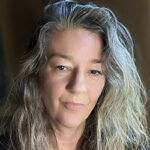
Linda Cockburn lives the life of a Quiet Revolutionary in the Huon Valley, Tasmania where she writes full time, recently releasing Book II, Button Up Buttercup in the Tasmanian post collapse/cosy dystopian, Eat My Shadow series.
Tasmanian Times (TT) is a community-based news and current affairs service covering the island state of Tasmania. It exists to provide a diverse view of Tasmanian issues. TT creates and supports independent media content utilising the best of modern technologies and tried-and-true practices of public-interest journalism.
Support us in expanding our coverage and developing new content by and for Tasmanians.
New initiatives on the way include:
- a weekly podcast covering current affairs
- a revamped website
- a monthly cartoon competition
- a user-friendly app for both Android and Apple devices
- a weekly roundup of key stories