

Report – Knight Frank, 28 July 2023
Global Residential Cities Index
House price inflation slows in the world’s leading cities 2023 Q1
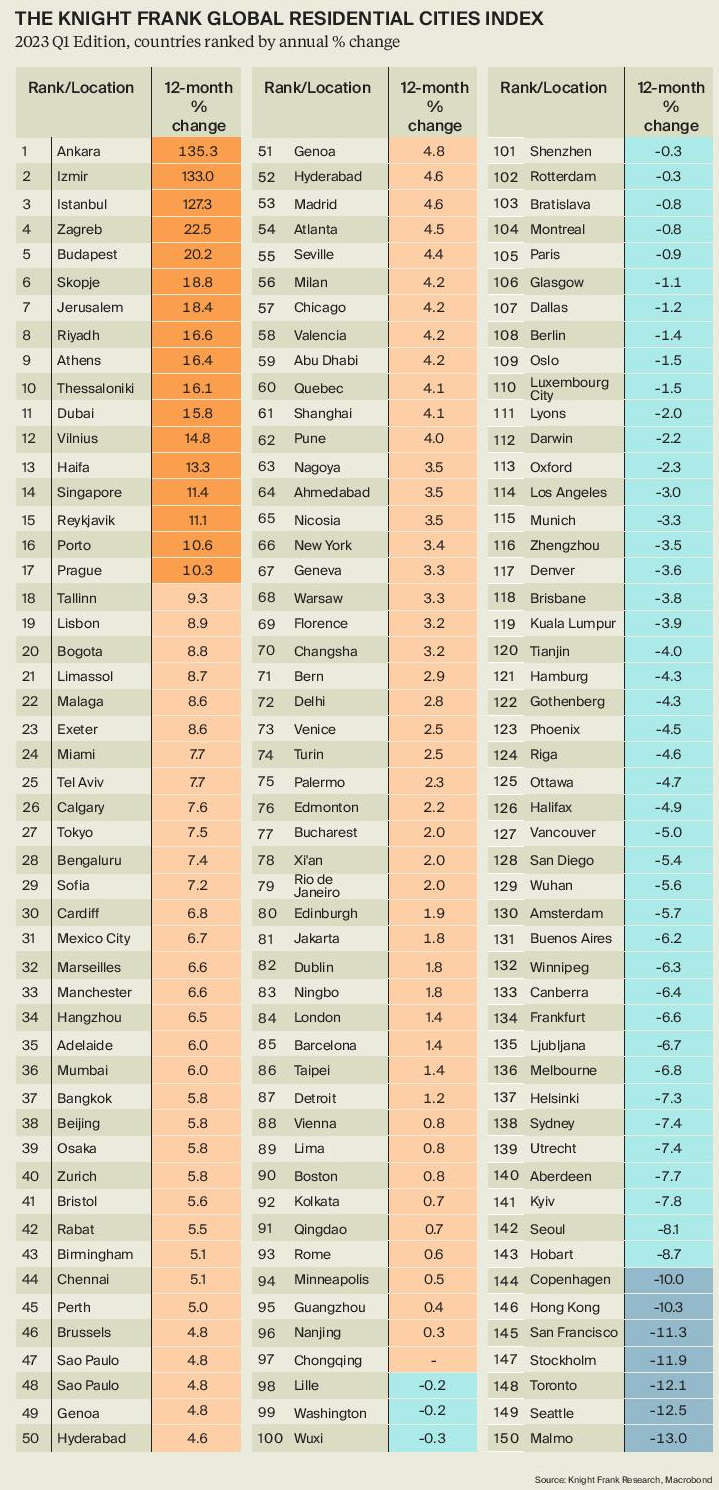
Key cities globally have seen price growth slow in response to rising interest rates and a more uncertain economic outlook. Average annual growth across the 150 cities included in the Knight Frank Global Residential Cities Index averaged 3.1% in Q1 2023, down from the 6.6% recorded in the previous quarter, and well below the recent peak of 11.6%, achieved in Q1 2022.
Annualised price growth across the Knight Frank Global Residential Cities Index has fallen sharply in recent quarters, from a high of nearly 12% at the beginning of 2022, when cities around the globe were experiencing a bounce in demand for accommodation following pandemic lockdowns. The latest reading confirms that across our basket of 150 cities prices rose on average by 3.1% in the 12-months to March 2023.
Behind this headline the slowdown in price growth is accelerating. Fully 51% of the cities in our index saw prices fall over the most recent three month period, with seven markets seeing prices fall by more than 5% – including two (Glasgow and Aberdeen) in Scotland and two in Sweden (Malmo and Stockholm).
The correction in prices which began in late 2021, has seen peak to trough falls of up to 24% in Wellington, New Zealand, closely followed by 22% in Buenos Aires. Another 14 cities across Europe, North America and New Zealand have seen double digit price falls from their recent post-pandemic highs.
Some markets have avoided price corrections so far, led by key Turkish markets, which are experiencing unique inflationary conditions in their wider economy. Several eastern and south-eastern European markets have also continued to see strong price acceleration in recent months: Zagreb (22.5%), Budapest (20.2%), Skopje (18.8%) and Athens (16.4%), for example.
The key issue for all markets remains the outlook for inflation, interest rates and economic activity. The Federal Reserve in the US seems to be closing in on peak rates in the current cycle, as inflation across the US slows rapidly. Other central banks will likely follow through 2023, with falls in Eurozone and UK inflation lagging the US by between three and six months.
While 2023 is likely to see slower economic growth than experienced in 2022, recent forecasts have pointed towards an improvement in expectations, with potential upsides for housing markets. The global economy will expand 3% this year, down from 3.5% last year, the IMF said in its latest World Economic Outlook on the 24 July. That’s a 0.2% upgrade from its April projection.
The IMF noted that global economic activity in the first quarter of the year proved resilient. Energy and food prices have come down sharply from their war-induced peaks, allowing global inflation pressures to ease faster than expected. Financial instability following the March banking turmoil also remains contained.
The balance of risks remain tilted to the downside, however. Interest rates are now in contractionary territory, weighing on activity, slowing the growth of credit to the non-financial sector, increasing households’ and firms’ interest payments, and putting pressure on real estate markets. Core inflation, meanwhile, remains well above target and is declining only gradually. Nevertheless, “stronger growth and lower inflation than expected are welcome news, suggesting the global economy is headed in the right direction,” the IMF concludes.
The takeaway for global housing markets points to ongoing price pressures in the near-term while values adjust to higher debt costs. Fundamentals however, wage growth and economic expansion, should permit a return to growth from the second half of 2024 for most markets.
“The slowdown in housing markets is unsurprising given the shock of higher interest rates in developed economies. Our latest results confirm that more than half of key global city markets saw prices fall in the most recent three-month period. We need to expect further price falls through 2023 as markets adjust to higher debt costs – however the downward shift in inflation in the US and other economies points to improving economic conditions. Economic fundamentals – wage growth and economic expansion should permit a return to growth for most markets from 2024.” – Liam Bailey, Knight Frank’s global head of research