Media release – Huon Valley Ratepayers Association, 19 June 2023
Huon Valley Council rates rise 12% despite finding an extra $6 million
Huon Valley Council (HVC) appears to have $6 million more than forecast. This unexpected $6m represents about a third of council’s annual income from rates but it is a bit of a mystery. The budget papers give no clear indication where it comes from.
In May this year – less than a month ago – the Financial Report stated that HVC was just $185,000 better off than the year’s budget had forecast. And now, in June, the forecast is that it will be $5,933,595 better off at the end of this month. The figure was in the ‘Estimates and Annual Budget’ document on Page 33 in the Statement of Cash Flow table. No detail or explanation was given but the forecast figure was just over $12m and over $18m is the amount carried forward into next year’s budget. So it appears council is $6m better off than forecast.
So the Huon Valley Residents and Ratepayers Association (HVRRA) is asking:
- Where did this extra money come from?
- Why put rates up by 12% if council has just made an extra $6m?
- Did councillors know about this $6m before they voted to put rates up by a hefty 12%?
The HVC Director of People and Corporate Services, David Spinks, has since confirmed this unexpected figure and explained that it is made up of “grants, capex spending and a range of other factors” but did not explain further. He did acknowledge that some of the figures are in the wrong places which only adds to the confusing picture.
HVRRA’s public officer, Pat Synge, says that: “Given the far better than expected cash positions at the end of June 2023 and the lack of detailed information about this extra $6m it would seem appropriate that councillors reconsider the 12% rates increase.”
He asked, “Why are Huon Valley Council’s budgets not informed by ‘year to date’ performance like most other businesses in Australia?” Recent HVC budgets have consistently forecast well below the actual outcomes. The actual result for 2021/22 was $4,856,908 more than the budget forecast. The year before that it was $2,784,000 more. And again this year the budget uses the budgeted result for 2022/23 as its starting point – not the actual result for 2022/23 which is some $6m more than forecast. This appears to be a consistent pattern. Ending the year with a better than forecast result but still increasing rates. Most businesses and organisations in Australia commence work on annual budgets for the next year in about April, and finalise them in June. The budget considerations for the next year are normally informed by the actual results for the year in progress bearing in mind any ‘one off’ events which caused the budget projection to vary from the actual results to date.”
Mr Synge acknowledged that “Ratepayers expect sound financial management and they expect council to maintain strong cash reserves. HVC already does this. But what is the justification for a proposed doubling in cash holdings, from $18 million to $39 million, over the next 10 years? We also ask, what will happen to this very significant cash reserve – that we ratepayers in the Huon Valley community have built up over the years – if HVC is then forced to amalgamate?”
The relevant documents can be found on the HVRRA website at www.huonvalley.org.au
_____________________________________________________________________________
Background
Most businesses and organisations in Australia commence work on annual budgets for each forthcoming year in about April, and finalise them in June. The budget for any forthcoming year is normally informed by the actual results for the year in progress, as at April (that is, 10 months out of the full year), tempered by the knowledge of any “one off” events. Any gains in one year are locked into the next.
The HVC budget document for 2022/23, dated 15 June 2022, uses the budgeted result for 2021/22 as its starting point, not informed by the actual year to date result. The actual result for 2021/22 was $4,856,908 better than budget.
A similar situation occurred in 2021/22, as shown in the table below.
Statement of Profit or Loss and Other Comprehensive Income
| Year | Budget | Actual | Variance |
| 2020-21 | 233,000 | 3,017,000 | 2,784,000 |
| 2021-22 | 291,092 | 5,148,000 | 4,856,908 |
| 2022-23 | (2,271,256) | $6m improvement? | $6 million? |
Relevant to the 2023/24 budget
The Estimates and Annual Budget (budget) document for 2023/24, dated 7 June 2023, as per previous practice, uses the budgeted result for 2022/23 as its starting point, not the actual result for 2022/23. The actual result for the full 2022/23 year is not yet known, but the result to the end of March 2023 as reported at the May 2023 Council meeting was $184,568 better than budget.
By 7 June 2023 however (the date of finalising the 2023/24 budget), the actual result for the year to June 2023 was forecast to be significantly better. The closing cash position to the end of June 2023 was budgeted to be $12,076,484, but as at 7 June 2023 was forecast to be $18,070,079, an improvement of $5,993,595.
As at the time of writing, 15 June 2023, it is not clear what exactly has driven the $5,933,595 improvement. That is, what was the contribution from the operating result from continuing operations (profit or loss and other comprehensive income), and what was from more ‘one off’ outcomes.
On page 33 of the Estimates and Annual Budget in the Statement of Cash Flows this figure of $18,070,079 is introduced as the estimated closing balance for the year – with no explanation, almost $6m more than budgeted. This sum is carried forward into the next year and is budgeted to remain in Cash and Cash Equivalents (see below) as can be seen in the 10 year LTFP.
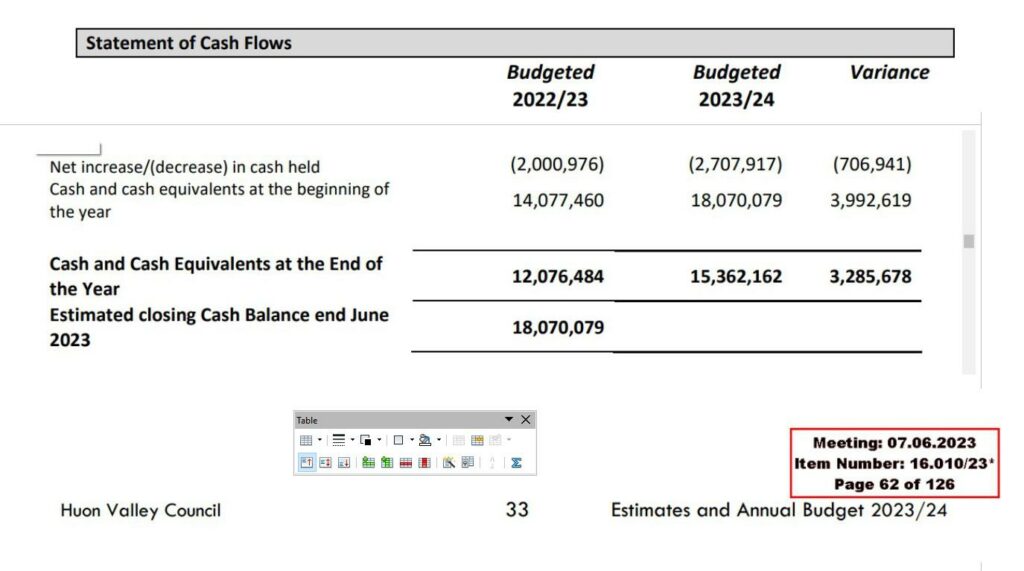
There was however no change to the Statement of Profit or Loss and Other Comprehensive Income component of the budget (page 11) to reflect the better than expected result for 2022/23.
This far from transparent.
10 year cash flow projections
The estimated long term financial position is projected in the Long Term Financial Plan. The projected cash position at the end of June 2023 of $18,070,079 is also inserted into the cash flow projections in that document (page 28). Note that the expected cash position at the end of the 10 year projection, to June 2033, is $39,112,305, an increase of more than 100%.
Conclusion
The size of the better than expected cash position at the end of June 2023 of $5,933,595 which is included in the Estimates and Annual Budget (budget) document for 2023/24 is a surprise.
That surprise is highlighted by the financial position reported at the May 2023 Council meeting, being $184,568 better than budget.
It is something of a challenge to accept that the expected annual outcome of almost $6 million better than budget (cash position) was not known before 7 June 2023, when the 2023/24 budget document was approved.
Given the size of this nearly $6m better than expected cash position at the end of June 2023 and the lack of detailed information about what comprises that amount (is it part of normal operating results, or is it ‘one off’?), coupled with the understatement of operating performance reflected in the most recent budgets, it is appropriate that the need for a 12% increase in rates for 2023/24 be reconsidered by councillors.
Questions for HVC councillors and senior management
- Noting that recent budgets have consistently forecast much worse than actual outcomes, why are budgets not informed by year to date performance, and any gains locked in?
- What is the detailed basis of the $6m better than expected result for 2022/23?
- The 2023/24 budget document includes, at page 3, the statement that:
‘The 2022/23 budget was a budget of response – responding to community feedback by allocating additional resources into areas such as roads, strategic land use planning, governance and communications. These inclusions gave rise to a significant operating deficit.’
This statement correctly reflects the 2022/23 budget forecast, but is it appropriate given the $6m better than expected 2022/23 actual result?
- $6m represents around one third of annual rates income. What is the impact of the current and previous under-estimates of operating performance on the need for the programmed 12% and 8% rate increases?
- Ratepayers expect sound financial management, but what is the justification for a proposed increase in cash holdings, from $18 million to $39 million, over the next 10 years, noting that such an increase is a key driver for rate increases?