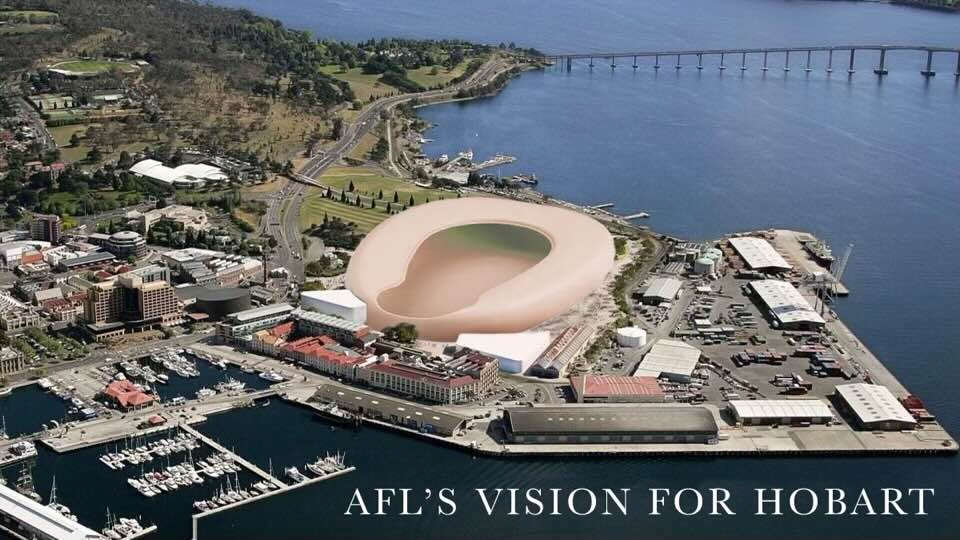
The Hobart stadium might, or might not be a done deal. It might, or might not, be an issue at the next state election. It might, or might not, cost more than budgeted – well, it probably will, and perhaps it should. But what is certain, however, is that the stadium debate raises very important questions about how we make decisions on big issues which affect many in the community.
Making good choices is hard work. In the great scheme of things (climate change; the rise of authoritarianism; AI; increasing inequality; the fragmentation of the polity by the different sources of our news) we have lots of hard work to do. We could use the stadium brouhaha as an opportunity to reflect on how we go about reaching decisions on matters of community controversy. That might increase our capacity to face the harder choices coming at us ready or not.
It is not simply a matter of putting forward our personal preferences. It is not like deciding which of the twenty flavours of ice-cream I will choose at the sweets bar. Of course I have a firm view on this. Always a double of coffee and chocolate in a waffle cone for me – unless there is pink grapefruit like I once tasted in Tuscany. I find it inexplicable that the person next to me in the queue goes for a tub of bubble-gum.
I’d say ‘I don’t like it’ to bubble-gum, but ‘I don’t like it’ is not a reason to oppose something which affects many people apart from me. Just as ‘I do like it’ is no good reason for something to happen regardless of others’ views.
So how should we come to a decision on a community issue like whether a stadium should be built for sports and entertainment, if we are not to choose on the basis of which ‘flavour‘ we like best?
Many philosophers would argue that, as a starting point, we should do whatever will maximise human happiness. This is the basis of the moral philosophy of utilitarianism, which goes at least back to the 18th century social reformer Jeremey Bentham. I expect most would then immediately want to add that there are some things that we should not do even if they would make most people happy. Causing other people pain simply for the sake of our own pleasure, for example, would be out for me. So if we were debating whether we should build the Roman Colosseum to stage Christians being eaten by lions, or gladiators battling to the death, then I would definitely be in the ‘No’ camp.
And we need to think of the happiness not just of the people now, but future generations as well. Borrowing so much to build the stadium that it will leave the next generation of Tasmanians short of money for even the housing, health care or education we now enjoy, that would be out for me too. I would also say that we need somehow to include nature in the happiness calculation. It might make most people happy now to burn fossil fuels with no regard for the impact on the climate, but we should not do so as this will cause widespread pain and suffering to animals and destruction of ecosystems, even if avoiding that damage makes humans a little less happy now, say by reducing speed limits or limiting the consumption coal-generated electricity.
All of which suggests that good decisions are made considering the widest context and the longest time span that we can. So we should consider the stadium’s contribution – positive and negative – at least to Tasmania’s environment and to Tasmanians’ happiness in relation to a wide range of things that we need money to do, and over a longish period of time.
So how have so many people come to a firm view on the merits or otherwise of the stadium without, it seems, careful consideration of the ‘happiness calculus’? That is the thing that troubles me most. But let’s try to work through the issues and see if there are obvious answers to the questions we must ask – which would explain why so many people are sure that building the stadium is obviously a good – no wait! – a really bad thing – to do.
Let’s first get clear that, with one important exception I will come back to below, the reasons for and against the stadium are wholly claims of fact. The values question has already been decided in accepting – if you have – that we should make the decision for or against the stadium based on our assessment of what will maximise Tasmanian happiness in the longish term. (Ignoring the caveats above about causing pain to others and protecting the environment for the moment, for the sake of keeping the argument simple.)
You might not accept this. But how will you argue that some people’s preferences are more important than others? You might, for example, say in an offhand way that the stadium is only of interest to ‘football bogans’ as a friend of mine recently put it. But even if this were true, how will you argue that the satisfaction of the desires of ‘bogans’ is less valuable than the satisfaction of the desires of – who? ‘People like me’?
You can see there is a slippery slope opening up before you once you reject Bentham’s radical equality of desires, which is the foundation of utilitarianism, and democracy. Best not to set foot on it lest you discover that, far from occupying the high ground from where you can look down on the ‘bogans’, there are many flying high above you in their private jets fondling their new Hermes bag on the way back from their distant relative’s coronation who consider you, and me, a colonial hick whose interests do not deserve consideration.
Perhaps Macquarie Point should be a gentleman’s polo pitch?
The same argument would apply in the other direction, as it were, if you were wholly committed to the stadium and dismissed those that say that Macquarie Point should be reserved for other suggested uses such as reconciliation park, or to give appropriate space for the Cenotaph, as ‘elitists’.
My personal interests certainly incline me to the ‘elitist’ vision of Macquarie point, but not so far down that path as to support a polo pitch. You would never find me there even if they would let me in. But you won’t find me at the stadium either if it is ever built. I’ve never been to an AFL game, never even watched one siren to siren on the TV, and don’t enjoy huge concerts. And to fess up, before moving to Tasmania from SA I thought the addition of lights to Adelaide Oval to allow day/night cricket was an uglification of the world’s reputedly most beautiful ground. Likewise I thought building a new footbridge across the Torrens and bringing AFL to Adelaide Oval had little to recommend it, arguing the point with my two sons – both avid Crows fans – until I was back in Adelaide one afternoon when a game was finishing at the Adelaide Oval and seeing the city come alive as the crowd of all ages and interests streamed out of the oval, across the bridge and into the city to cafes, restaurants and bars. As lively as Hobart during Dark Mofo.
At that point I had to admit I had prejudiced views about football. I’d never really taken it very seriously. It should have been obvious to me from years before that AFL has a hold on the Australian psyche that is as undeniable as it is – to me – inexplicable. If my own PhD qualified sons (one a biologist, the other a sociologist) had not made it clear to me that football was a sport for people of all kinds, I should have learned from a strange experience years before. I arrived at the annual meeting of the Australian Deans of Arts, Social Sciences and Humanities, and seeing two colleagues in animated discussion over morning coffee I decided to join them. One was the Professor of History and Dean of Arts at the University of Melbourne, and if I recall correctly the other was the Professor of Law and Dean of Arts at Monash. It turns out that they were dissecting Saturday’s game of Collingwood vs Carlton, I think. I drifted away to join the Dean of Arts from the University of New South Wales interested in how they were planning to manage quality control at their proposed Singapore campus. But we were soon laughing about the latest episode of the Vicar of Dibley. Lesson should have been learned.
So I accept that Tassie getting its own AFT team is a big deal for lots and lots of people, even if it means naught to me. And many Tasmanians will become members of the club. Believe it or not, fifteen of the current eighteen AFL clubs have more than 50,000 members, about 1.2m in total for all the clubs. That’s about 4% of Australia’s population including the two ‘non-AFL states of NSW and QLD.’ If Tassie follows the pattern, well over 22,000 of our friends and neighbours will join up.
That is impressive, though without polling the populace, I cannot put a figure on how many people would be made how much happier by Tassie having its own AFL team. But from my experience of living in Adelaide when SA got its first and then second license, and observing the recent Tasmanian press coverage of the matter, I’d hazard the guess that if you put a list before Tasmanians of things that might happen next year, like a new building for the TMAG, our own opera house, a new network of bicycle trails, or even major build of new social housing or decrease in hospital waiting lists, Tassie in the AFL would come out tops. That would not be my choice, and it may not be Jeremy Rockliff’s either, but that is not the point. Governments who do not do what most voters want need to be awfully good at explaining why not, if they want to hold office.
So much for facts about football. What about all the other factors relevant to our consideration of whether the stadium should be built?
There are three big questions: why does the AFL say we need to build a new stadium to have a team?; why should we agree to their demand?; and if we are going to have new stadium, why should it be built at Macquarie Point? And again, to reflect on how we make decisions about big issues in the community, if you have already made up your mind about the stadium, for or against, where did you get the information to answer these questions, or how did you decide that these are not the questions that need to be answered?
The AFL says we need a new stadium to be granted a licence for a team. I am not privy to their case for this, but from my quick research (on which I stand to be corrected) it is not hard to see how it would go. The AFL is made up of 18 clubs, which are effectively owned by their members and run by member elected boards, headed by elected club presidents. The 18 clubs elect the AFL Commissioners, and it is this body that offers AFL licences. For Tasmania to be granted a licence, the AFL Commission needs to recommend this to the club presidents, and two thirds of the presidents of the 18 clubs would need to disagree for it not to go ahead. The AFL Commission is not likely to offer a licence to Tasmania unless members of the Commission are persuaded the team will be successful, and the club presidents are not likely to acquiesce to the Commission granting a licence unless they too think the Tassie team will be viable.
Viable means attendance at games. The AFL says – we are yet to see their sums on this – that something like 23,000 seats are required to accommodate the crowds that would be needed to pay the money needed to meet the Tasmanian team’s bills without the Tassie team being a loss-making drag on the finances of the other clubs. If their sums are correct, that explains why the UTAS stadium in Launceston – seating capacity of 19,500? – and Blundstone Arena at Bellerive – less than this? – are not considered adequate for the Tasmanian games to be profitable, without considering other issues like the grounds’ capacities for corporate and other higher paying seats and facilities.
Perhaps when the sums are made public we will see that a new stadium is not needed for the team to be financially viable. But what won’t see is the AFL grant Tasmania a licence if the sums do not make it pretty certain that the games in Tasmania will pay our team’s way.
It seems obvious to me that a Tasmanian team would need to need to pay its way for the 18 club presidents to support our joining the league. But not everyone agrees. According to an ABC story, 10 Tasmanian Federal MPs including Liberal, Green and an Independent say that the AFL should ‘do the right thing by Tasmania’ and ‘give Tasmania the team without making us build a stadium’.
But wouldn’t this mean that the existing AFL clubs would have to give to the Tasmanian team money they have earned which might otherwise be spent on their own teams? If so, I don’t see them agreeing, nor even on what moral basis we could make such a claim. Especially when many in Tasmania – including one of the recently turned independent former Liberal members of the House of Assembly – argue that we should not build the Basslink power cable because we don’t want to have to share Tasmania’s cheaper electricity with the mainland – that is, with the members and supporters of the AFL clubs that supposedly ‘owe us a team’.
So I expect the ‘no stadium no team’ demand will stick, unless the AFL can be persuaded that one or other of the existing stadiums can be expanded to provide the seating required to make the crowds at the Tasmanian games large enough for a Tassie team to increase the income of the AFL by more than the cost of adding a Tasmanian team. That would pose the question ‘Why Macquarie Point?’
I doubt that the Tasmanian government would want to redevelop one of the other stadiums rather than build a new one at Macquarie Point. Like the AFL, our government needs to be persuaded that the economics of the stadium make sense over time. Clearly the initial contributions from the feds and the AFL help with that, but the heavy lifting will have to be done by the increase in economic activity in Tasmania produced initially by the stadium’s construction and then over time by people attending AFL and other events at the stadium.
The economic boost from construction is probably the same wherever the stadium is built. But perhaps not the continuing economic activity associated with people attending events there. The question, simply, is what location for the stadium will maximise the numbers of people who before or after AFL games, or whatever else they are attending at the stadium, spend money on accommodation, eating out, entertainment and whatever else the people who go to football games and large concerts do pre- and post event.
Again, the government has presumably done some sums on this – or they should have – and decided Macquarie Point gives the biggest bang for the buck. If so, that is a good reason to choose that location as it would make the stadium the least costly to Tasmanians. But how can we be persuaded to accept – or reject – that claim without seeing the sums?
Now let’s consider the question of whether we can afford a stadium at all, putting aside the question of whether it would be a financial asset for Tasmania in the long term, on the basis that at present there are higher priorities for expenditure.
This might be so. Perhaps Tasmania just cannot afford a stadium, even if it is an arguably reasonable condition of being allocated an AFL licence. In that case we would be saying Tasmania cannot afford an AFL team. But before we reach that conclusion, shouldn’t we consider the desire to see our own team playing AFL in Tasmania in the context of all the interests of Tasmanians that might be supported by government expenditure? And equally, shouldn’t we consider the money that building the stadium will need in the context of the whole government budget, not pit the stadium head-to-head against money for housing, or health, or education, or the arts or whatever?
I don’t have crystal ball to see the future, so I can’t say with any great certainty whether building the stadium or spending more money on housing or national parks or improved public transport or reducing government debt will maximise Tasmanians’ happiness and better protect our environment in the long run. But that is what we need to consider if we are to come to the best decision about the stadium. No doubt that is the financial/ political consideration that is occupying the time of senior members of the government and opposition at the moment. And just as the government makes all other decisions on the allocation of funds from the budget, they will make this too. And then enjoy the support of the voters if we like it, or suffer the consequences if we don’t.
For my own preferences, I have just one firm view, and it is once more a matter of values, rather than the factual questions we have been considering. If we are to build a stadium, make it a building we can be proud of, like Paris is – now – proud of the Eiffel Tower, and Sydney is proud of the Opera House, having forgotten what it cost. Enough of the uglification of our city! Make it a building we are pleased to look at, like the Opera House, rather than mourn the loss of the view that used to be had beyond, as no one when walking around Bennelong Point thinks ‘There used to be a beautiful view of the harbour from here before that bloody white monstrosity was put in the way.’ And if we build it at all do so in a way that shows architecture gets climate change, making it a model for others to follow.
At least then when I am walking on the mountain – unspoiled by a cable car – or sailing past to enjoy the pristine waters of the Channel – once the fish farms are banished to the deeper seas or land – and spy the stadium, I won’t think it a blight on the landscape. Then should I hear a faint ‘Come on the Quolls’ in the distance I won’t be at all catty about it, happy that you are enjoying your pleasures, while I am enjoying mine.
Dr Michael Rowan is an Emeritus Professor of the University of South Australia who now lives in Kingborough.
Editor’s note: Since publishing this I have done some calculations on the ‘economy of seats’ that supposedly is the basis for a new stadium being essential.
The equation is pretty straightforward.
The proposed Macquarie Point facility will have 3,000 more seats than Bellerive Oval. Those seats will be used for 7 AFL games a year. The capacity will depend on team form, weather, popularity of opposition, etc. but we can suggest a plausible 80% usage based on AFL attendances around the country. Average ticket price – considering a mix of premium, general admission, junior and concession tickets – might be around $30 at best; ticket prices at Bellerive Oval currently start from $15 for adults, $12 concession and $5 junior, but a local team at Macquarie Point might be able to command higher prices. Remember that a local at Bellerive might also command higher prices, but anyway…
Hence our equation resolves:
3000 seats x 7 games x 0.8 capacity x 30 per ticket = $504,000 per year extra revenue for playing at Macquarie Point as opposed to Bellerive. At best.
It is possible that Clarence Council would chip in this amount to lock in the benefits of AFL games on their side of the river, so there is plausibly no net financial benefit at all to a Tasmanian team playing at a new stadium at Macquarie Point.
And all of this, of course, is without even taking into account an upgrade of Bellerive Oval. At any costing, it would be a fraction of the cost of a new facility for almost all of the benefit.