Media release – Tasmanian Economic Regulator, 10 June 2022
2020-21 REPORT ON THE STATE OF THE TASMANIAN WATER AND SEWERAGE INDUSTRY
Today the Tasmanian Economic Regulator released its latest annual report on Tasmania’s water and sewerage industry.
The main objectives of the report are to provide an overview of the performance of the industry in 2020-21 and identify key priorities for improved performance by TasWater.
Mr Joe Dimasi, the Tasmanian Economic Regulator, said “TasWater continued to improve its performance in 2020-21, despite the continued challenges presented by the COVID-19 pandemic in that year. However, several challenges remain, including reducing the volume of water that cannot be accounted for, which remains an ongoing concern.”
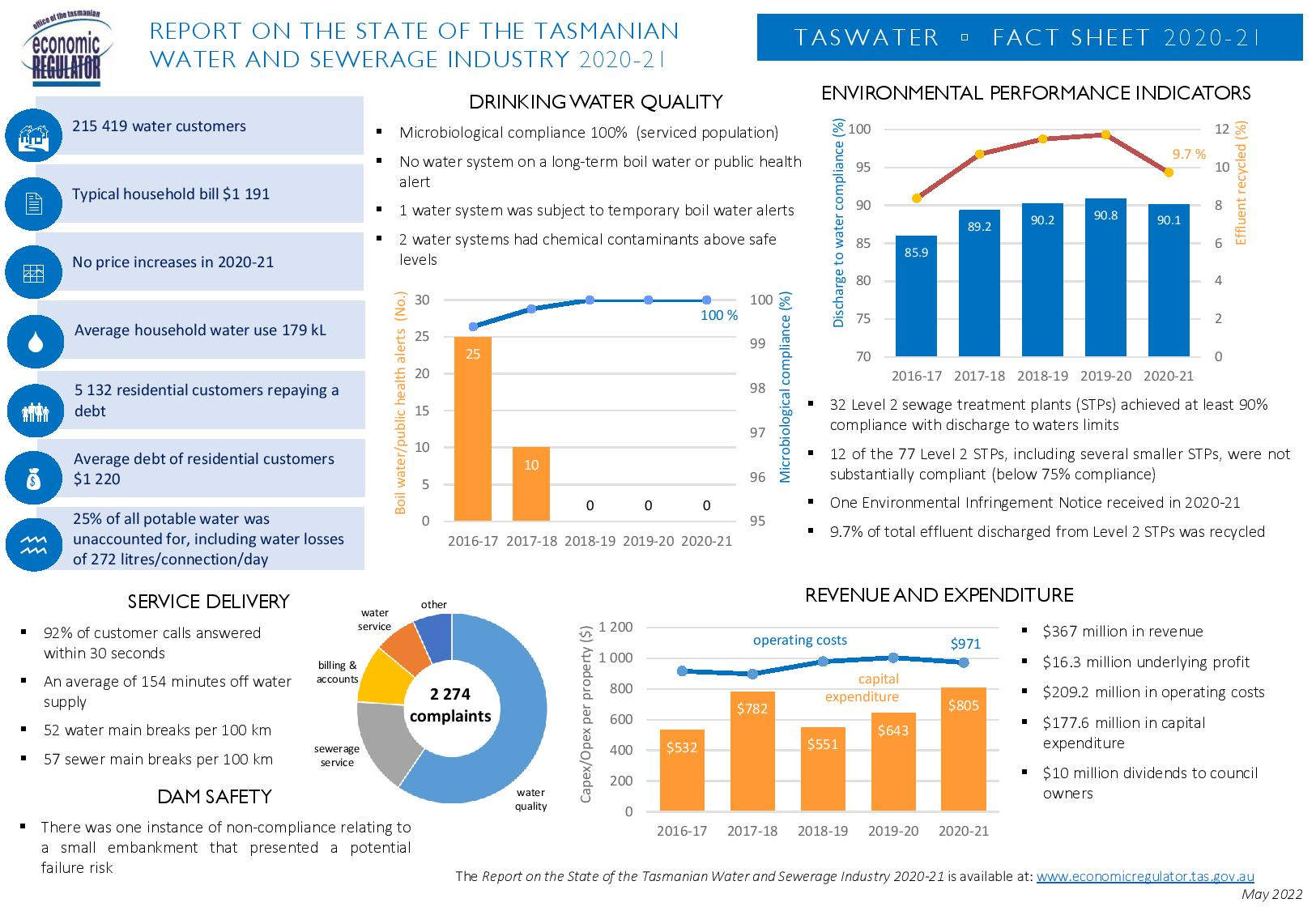
TasWater continued to meet safe drinking water targets in 2020-21. No water systems operated under long-term boil water alerts or had a public health alert (do not consume) in place. This is a significant improvement on four years ago, where there were 25 long-term boil water or public health alerts across the State.
TasWater has also maintained its improved compliance regarding treated sewerage, with over 90 per cent of the volume of sewerage discharged from its sewerage treatment plants meeting the required standards. Eight of the 13 largest plants achieved more than 90 per cent compliance in 2020-21. Twelve of the 77 sewerage treatment plants, several of which were smaller plants, were assessed as underperforming as they did not achieve 75 per cent compliance in 2020-21. However this is an improvement on the 13 sewerage treatment plants that did not achieve 75 per cent compliance the previous year.
No price increases were imposed for water and sewerage services in 2020-21, reflecting the TasWater Board’s decision to support its customers in dealing with the impacts of the COVID-19 pandemic. The typical annual water and sewerage bill for residential customers using the average of 179 kilolitres of water per year was $1 191, as in 2019-20. Tasmanian households paid similar annual bills to the national average, based on an illustrative consumption of 200 kilolitres water per year.
The number of residential and business customers on TasWater’s hardship program decreased from 603 customers in 2019-20 to 459 customers in 2020-21. However, the average level of debt when customers entered the hardship program increased from $1 806 in 2019-20 to $2 209 in 2020-21. No customers had their water supply restricted for non-payment in 2020-21.
The volume of calls received by TasWater’s customer service centre decreased by approximately 18 per cent in 2020-21, with 92 per cent of those calls answered within 30 seconds. However, customer complaints increased by 22.5 per cent in 2020-21 and exceeded the customer service standard set by the Tasmanian Economic Regulator. Ninety-six per cent of complaints were resolved within 10 days, or within an agreed timeframe. As in previous years, the majority of complaints related to water quality, including taste, colour and odour.
TasWater’s underlying profit in 2020-21 was $16.3 million, compared to a loss of $15.8 million in 2019-20 which was due, in part, to the COVID-19 pandemic. Capital expenditure increased by 37.9 per cent to $177.6 million, compared to the previous year, though it fell short of the $193.3 million in its 2021-25 Corporate Plan. TasWater reported that this was largely due to delays in commencing the Bryn Estyn water treatment plant upgrade (which provides water to greater Hobart), design challenges on two major dam projects and COVID-19 related travel restrictions.
The Tasmanian Economic Regulator continues to be concerned at the very high share of treated water that is not supplied to its customers in 2020-21, as estimated by TasWater. The Tasmanian Economic Regulator notes that TasWater’s estimate that 25 per cent of the water it treats is unaccounted for may be due, in part, to TasWater not having accurate information on the volume of water supplied by some of its water treatment plants.
The Tasmanian Economic Regulator said that “improving the quality of data on water supplied by its water treatment plants and reducing the volume of unaccounted for water is a key priority”. The Tasmanian Economic Regulator also places a high priority on TasWater achieving its ambitious capital investment program over the next four years. Other priorities include securing long-term efficiency gains, improving the quality of its information collection and management and ensuring that TasWater has adequate water supplies to prevent water restrictions, unless they are due to factors outside TasWater’s control.
Read the full report here: https://www.economicregulator.tas.gov.au/Documents/22%201292%20%20Report%20on%20the%20State%20of%20the%20Tasmanian%20Water%20and%20Sewerage%20Industry%202020-21.pdf.
Media release – TasWater, 10 June 2022
State of the Industry Report 2020-2021 released
TasWater welcomes the Tasmanian Economic Regulator’s State of the Industry Report (2020-21) which recognises continued improved performance across the business despite the impacts of COVID-19. The independent report provides both an overview and identifies key priorities to improve the performance of the water and sewerage industry in Tasmania.
TasWater CEO George Theo said highlights from the State of the Industry Report include the 100 per cent microbiological compliance for our drinking water for the third year in a row and improved treated sewerage compliance.
“In the 2020-21 period no water systems operated under a long-term boil water alert or a do-not-consume notice,” he said. “We are proud of this, as just four years ago there were 25 permanent public health alerts across Tasmania. These were removed through the 24glasses Regional Towns Water Supply Program and we are still seeing these great benefits across the state to this day.”
“In the same reporting period, we also had over 90 per cent compliance with discharge to water limits for the third year in a row.” The report also noted that there was a price freeze during the 2020-21 period, to support customers through the impacts of COVID-19.
“The Economic Regulator also pointed out areas where we still have work to do, for instance, unaccounted for water remains an issue,” Mr Theo said. “We are investing more in the renewal of our infrastructure such as water mains and pipelines across the state, including the recently completed 1.3-kilometre Lake Fenton pipeline in New Norfolk delivered by TasWater’s Capital Delivery Office (CDO).
“We have also been implementing active leakage management, featuring technology that listens for leaks that may not be visible. “Overall, the results from the report are pleasing, although we acknowledge there is more to do and are committed to improving services to our communities.”