
South Korean company, Korea Zinc, has taken a major stride towards exporting green hydrogen from Australia to South Korea after it snapped up renewable energy developer Epuron in a deal that will give it access to wind and solar generation in Australia. It plans to build own and operate Epuron’s portfolio of proposed wind and solar farms throughout Queensland, New South Wales and Tasmania.
But not everyone is happy. Representing less than 0.5% of Epuron’s potential Australian projects is the proposal for Western Plains Wind Farm on the tiny Stanley Peninsula in Tasmania. Locals fear the proposal from wind developer Epuron, will destroy the iconic tourism, historic, landscape and amenity of the Stanley Peninsula.
It involves twelve massive wind turbines on the peninsula which will tower over four-stories taller than the iconic Stanley Nut- the dramatic volcanic plug which rises 143 metres above sea level.
As the Stanley Peninsula is so small at 17km2 it simply cannot host these huge turbines without destroying the iconic landscape and ruining the dramatic skyline and the vistas from the peak.
The Stanley Peninsula in north-west Tasmania bears an uncanny resemblance to Seongsan Ilchulbong on JeJu Island in South Korea, famous for its stunning volcanic landscape. The UNESCO listed Seongsan Ilchulbong has long been considered one of the best scenic destinations in South Korea and attracts over a million South Korean tourists each year.
Like Seongsan Ilchulbong Peak, the Stanley Nut is a cooled lava pond at the end of a peninsula and fully exposed at sea level. It is famous for its spectacular landscape and sunrise views. It is a geological monument and the picturesque historic 1800s fishing village of Stanley lies at the base.
Just as Seongsan Ilchulbong is beloved in South Korea, its twin in Stanley is beloved in Australia. This small Tasmanian town took out gold in the Tasmanian Top Small Tourist Town in 2021 and won bronze for Australia. Tourists travel to the stunning Stanley peninsula to marvel at the dramatic landscape, to walk or chairlift up the Stanley Nut to enjoy the stunning views of the coast and gentle rolling green hills.
The community does not have a good relationship with Epuron, whose model was to gain development approvals and then on-sell them. Stanley folk have staged protests, lodged complaints and gained significant media exposure in their fight against the windfarm, engaging legal and other experts to assist in the fight.
The community understands that the proposed wind farm in Stanley is on a site that was not specifically chosen by Korea Zinc, and is part of a larger portfolio Korea Zinc is acquiring with the Epuron purchase.
Representatives of the Stanley community are seeking to start dialogue with Korea Zinc.
Their message is simple – they support green energy; however, it needs to be in the right place.
The Stanley community understand South Koreans respect sites of significance and are asking Korea Zinc to respect Stanley Peninsula and to walk away from Seongsan Ilchulbong’s twin in Stanley. They see Korea Zinc’s potential opportunity to play a part in preserving Stanley, Tasmania in the same way South Koreans respect and preserve Seongsan Ilchulbong on Jeju Island.
Kerry Houston is Secretary of Respect Stanley Peninsula – No Wind Turbines Inc.
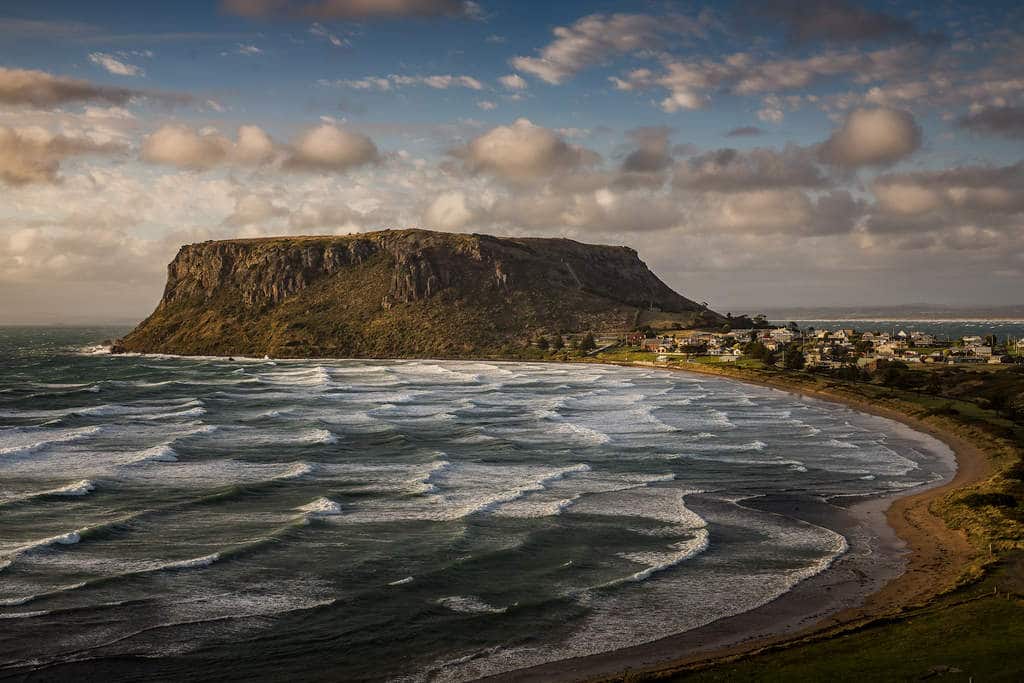
The Nut, Stanley.