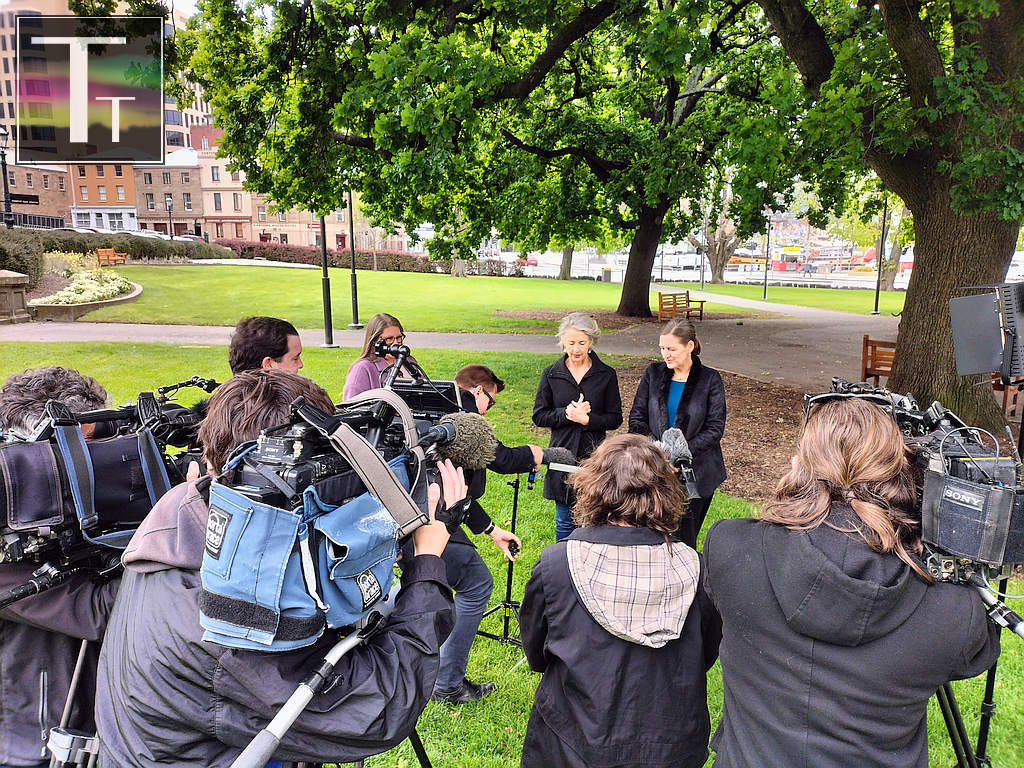
Transcript of media conference with Tasmanian Greens Leader Cassy O’Connor at Parliament Lawns, Hobart, Monday 25 October 2021.
Cassy O’Connor
In Greens private members time this week we’ll be moving to repeal the legislated minimum saw-log quota. This legislated forest destruction quota requires Forestry Tasmania to make available to the industry 137,000 cubic metres of native forest timber every year. It’s a quota which is holding Forestry Tasmania back from achieving Forest Stewardship Certification because they have to cut harder and harder in order to meet their legislative quota. But it’s also an issue of carbon sequestration habitat. And the fact that this legislated quota comes at enormous public cost because of the subsidies that are embedded in the contracts for forestry Tasmania industry customers until 2027. The West Australian premier Mark McGowan has announced an end to native forests logging within three years. We know Victoria is moving to when native forests logging it is well past time that Tasmania the Tasmanian government got real about the facts here are legislated for us destruction quota is anti science and we don’t believe it’s in line with community expectations. We have a responsibility in a time of climate and biodiversity crisis to keep the carbon that’s in the ground in the ground. Removing that mandated forest destruction target is an important first step.
Tasmanian Times
You mentioned Mark McGowan’s timeline. What’s the timeline for Tasmania?
Cassy O’Connor
Well, of course, we believe most Tasmanians don’t support logging of high conservation value forests. They’d like to see it in tomorrow, as would we. But the first step is a legislative step where you amend the Forest Management Act of 2013, section 16. And you remove that mandated quota. That 137,000 cubic metres is what is stopping Forestry Tasmania from achieving FSC certification because they have a legal obligation to supply this timber to industry, they have to cut those coupes harder and harder. That’s leading to massive carbon loss, massive biodiversity loss, and all of it publicly subsidised Well, according to forestry, Tasmania, his own board, in a letter that they sent to the minister in 2016, it’s very difficult for forestry Tasmania to meet that minimum quota. The industry needs to have the guidance and the leadership to get out of native forest logging and into onto a sustainable footing and a plantation based industry. That’s the way the world is moving. The world is looking for plantation product, the world is looking for FSC certified product. It’s only markets like China, which don’t care if there’s sustainable harvesting that are taking non FSC native forest wood chips from places like Tasmania, and it brings shame on us all. We need to make sure that Tasmania becomes truly a world leader in forest protection and management in a time of climate and biodiversity crisis.
Journalist – John Hunt
What … are you expecting this law to get up? Or you expect it to face opposition from Labor and the Liberals?
Cassy O’Connor
The Greens are all about iterative legislative reform. We take steps one step at a time to push for change. Of course we know that the Liberals are locked into native forest logging, and partly because of people like Shane Broad in the parliamentary Labor Party, Labor’s right locked in there, too. We believe that most Tasmanians want to see an end to native forest logging. The industry’s own polling says that native forest logging is becoming increasingly unpopular in the community. It’s also happening at huge cost environmentally and economically. We know this is the right thing to do. In their heart of hearts we believe the Liberal and Labor parties know that this is the right thing to do. This is what science is saying we need to do and this is what young people particularly are crying out for.
Journalist – Adam Langenberg
What’s the rationale around the target existing if it’s hard for Sustainable Timber to make?
Cassy O’Connor
This is a historical fact. The minimum quota used to be more than 300,000 cubic metres before the Tasmanian Forest Agreement. Through negotiations between environmentalists and industry, the minimum quota was more than halved. That’s now some eight years ago, and certainly the climate has moved on. Since then we’re in a code red for humanity, and Tasmania has these carbon banks, and it needs to protect the carbon that’s in those carbon banks. So the legislated forest destruction target is a historical anomaly, has no foundation in science, and we don’t believe it has community support.
Journalist – Adam Langenberg
When it was legislated was there any sort of time frame around what it will be reviewed?
Cassy O’Connor
No, it’s a locked-in, mandated, minimum quota of 137,000 cubic metres of timber that comes out of our beautiful forests, which contain plants and animals you won’t find anywhere else in the world. The native forest logging industry in Tasmania has been on the public teat for decades, and it’s time they got off. And we need real leadership in government, a government that says to native forest logging companies, we’re going to transition out of destroying Tasmania’s beautiful old forests and help you move into the plantation sector. That’s what the scientists and the young people are telling us needs to be done.
Tasmanian Times
Have you modelled the financial implications of this?
Cassy O’Connor
It’s incredibly hard to model financial costs of this sort of thing when you don’t know what the actual subsidies are to Forestry Tasmania. So we know they get a community service payment in the state budget, but the subsidies are hidden in the contracts. You can’t get any information on what the deal is in the contracts with industry until 2027. But what we can all be 100% sure of is that Forestry Tasmania is providing that timber at a loss and that is a fact that’s been made clear to the Minister by Forestry Tasmania’s own board.
Journalist – Imogen Elliott
The government may argue ”well we do care about native forest, we recently rezoned some permanent timber production forest” … what was it for, a national park? … (inaudible) would you buy that argument?
Cassy O’Connor
No, we don’t buy that argument. Those forests that went into that are going into national park are contained inside the Tasmanian Wilderness World Heritage Area. You couldn’t log them anyway. So it’s no skin off the government’s nose to include those patches of forests in the formal reserve estate. If the Liberals are serious about sustainability, looking after the environment and giving young people hope for the future, they’ll start moving this industry out of native forest logging and into plantations.
Journalist – Adam Langenberg
Can we go to racing? There’s a report out today showing that the industry is going great guns, $195 million contribution to the economy. Quite a lot of jobs, particularly in the regional areas, What’s your take on on the racing industry and how it’s going?
Cassy O’Connor
This is a report that’s been commissioned by Tasracing in order to justify its existence and the $30 million it receives from Tasmanians in public subsidies every year, I would urge everyone to take this report with a grain of salt because it’s commissioned by Tasracing, and we’ve had a bit of a look at the methodology. And I just I don’t think that those claims can hold up. But it’s very hard to prove or disprove this. So this is an industry that requires $30 million every year in public subsidies, just to keep going at the same time as it’s responsible for the breeding of animals for profit, and in many cases, early death.
Journalist – John Hunt
So what is your issue … you said the methodology … you say you don’t buy it … can you explain that?
Cassy O’Connor
So this is very similar to a report that Tasracing released in 2013, that use the same consultants, it it pulls very big numbers out of somewhere, in order to justify the industry’s publicly subsidised existence. It’s very hard to see how the racing industry can be contributing, for example, $195 million a year to the Tasmanian economy. But it’s really hard also to take that apart, I’d simply say this. It’s a report commissioned by Tasracing, which receives $30 million every year from taxpayers in subsidies. So this is Tasracing, trying to make a case for its viability and contribution to the Tasmanian economy. This is not news. It’s propaganda.
Journalist – John Hunt
And just moving on to the whip issue. Peter’s obviously challenging the decision of the court, and then the Racing Minister today said that they’re working with the authorities at national level but stopped short of saying that they’d ban it. What would you like to see happen?
Cassy O’Connor
Well, that’s weasel words. We could here change the rules of racing, so that Tasmania can go it alone on a whips ban. There’s no place for whips in the industry, whips are basically cruel. And you’ve got some rules of racing, where it’s a requirement, for example in the pacing sector, to have a whip. The minister knows that whipping of horses is out of line with community expectations. She knows Tasmania could go alone, but obviously she doesn’t have the courage to take on the industry.
Journalist – Adam Langenberg
There’s an open letter on lifting the age of criminal responsibility at 14 and the government says that it’d like to see a national approach and sticking to its lines there but given the ACT has gone it alone in lifting it should Tasmania follow their lead?
Cassy O’Connor
Tasmania can lift the age of criminal responsibility. We have state criminal laws, the Greens have been pushing for children not to be locked up and for the age of criminal responsibility to be raised in Tasmania for a very long time and around the country. And in fact, it is a Green Minister in the ACT who has driven the change there to raise the age of criminal responsibility. Attorney General Elise Archer should stop making excuses and saying we need to have a nationally coordinated approach and just get on with it. There is no justification whatsoever for putting 10, 11, 12 and 13 year olds in prisons.
Journalist – Imogen Elliott
Back to the Tasracing report. It said that about 650 animals were bred for the industry. Is that a concerning number and … (inaudible)
Cassy O’Connor
Again, it’s quite difficult to understand how many of the horses or the greyhounds that take part in the industry live for the term of their natural life, but we’re quite sure many, many don’t. And we’ve seen national stories about beautiful race horses thoroughbreds being sent off to the knackery. We know that greyhounds and horses are bred for profit. Again, this is state-sponsored cruelty. There are plenty of terrific people in the industry. Plenty of trainers and owners who absolutely love these animals. But broadly speaking, the industry is about state-sponsored cruelty, where animals are brought into this world simply to turn a dollar and when they can’t any more, they’re disposed of.

Media release – Bob Brown Foundation, 25 October 2021
Dump antiquated mandatory logging quotas
Bob Brown Foundation has urged the Tasmanian Parliament to vote for the Greens bill to abolish section 16 of the Forest Management Act 2013, which sets a mandatory minimum sawlog quota of 137,000 cubic metres of category 1 and 3 sawlog per annum, regardless of whether there is a market.
“This anachronistic law forces regulators to ignore science, ignore economics and ignore community concerns and instead forces them to meet an arbitrary quota. It is one of the biggest legislative impediments to the transition to a sustainable plantation-based forestry sector,” said Bob Brown Foundation’s takayna / Tarkine Campaigner Scott Jordan.
“Under section 16, we have seen Tasmania lag behind on the transition out of native forests with Tasmania’s native forest harvest almost double the national rate, and yet we score lowest on our financial returns per cubic metre of native forest logged of any state. Section 16 forces us to log beyond our environmental capacity, and then sell beyond the market’s capacity. It’s a fool’s paradigm.”
“The long term market trend is to move to plantations, and the climate emergency we face means there is no time to waste. Section 16 should go, and it should be followed by an end to all native forest logging.”

Media release – Wilderness Society Tasmania, 25 October 2021
Will Tasmania’s Parliament Vote To Keep Enforced Soviet-Style Logging Quota For More Forest Destruction?
As Victoria and Western Australia transition away from native forest logging, a key part of Tasmania’s native forest logging regime will be tested in State Parliament this week.
On Wednesday, the Tasmanian Greens will table an amendment that would remove Section 16 of the Forestry Act 2013.
This section of the Act equates to a Government-mandated logging quota, and forces Forestry Tasmania (trading as ‘Sustainable Timber Tasmania’) to make 137,000 cubic metres of forest timber available each year, regardless of what the markets actually want or don’t want.
“Removing this Government-mandated quota is important to reduce the amount of High Conservation Value forests destroyed by Forestry Tasmania, for example, all swift parrot habitat, which should be protected from logging.
“The Liberal Government claims that private enterprise and ‘free markets’ are the best forms of economic management but this Government-enforced logging quota is Soviet-style economics.
“The Government says it prefers privatisation but is using taxpayer funds to interfere in the market, enforcing a mindlessly-destructive logging quota that destroys this island’s remaining High Conservation Value forests for commercial loss.