As we wait for the Northern Midlands Council ad to appear calling for representations on their decision to sell the Campbell Town Hall, a new appeal has been lodged against the decision.
There are two key reasons for this happening.
One reason is the detail that there is a hole the size of an elephant in the legislation that the Resource Management and Planning Appeal Tribunal works under. This flaw is that a council decision to sell public land – with or without a town hall sitting on it – is considered in the same way as a development application.
A development application is a single decision event for a council, where all the relevant information is on the table and in the agenda attachments for that decision.
A council decision to sell public land is a two part decision, but the RMPAT, under current legislation, can only consider what happened at part two of the council decision.
Any documents lodged in part one of the council decision, cannot be referred to in part two of the decision in a tribunal appeal.
In addition, the decision to sell public land runs over many years, but none of what happened before part two of the council decision can be considered.
This legal situation in the tribunal hands over a massive advantage to the council, and leaves the community at a huge disadvantage, denied years of evidence that cannot be presented in support of an appeal.
We have called on the Tasmanian Government to fix this hole in the legislation, so that an appeal from the community can be on a level playing field with the council, but we are yet to hear back on whether the quirk in the law will be fixed.
By appealing part one of the two part decision, we are hoping that the whole story of the council decision to sell the Campbell Town Hall will be considered, a historic episode that runs from 2012, and in its progress saw the demolition of the grandstand at the sports ground, for no good reason, and with no replacement.
The new facility at the sports ground, described by councillors as a replacement for the Town Hall, is in reality a venue for the council business plan with functions and meetings.
The grandstand appears to have been demolished, as it spoiled the grand entrance to the council function centre. With no grandstand to watch a game at the sports ground, there is no proper place for patrons to shelter from the sun and the rain. Patrons now sit in their cars parked around the sports field.
The second reason is the undue haste with which the council placed the sale of the Town Hall back on the agenda, after they discovered that their first decision was illegal.
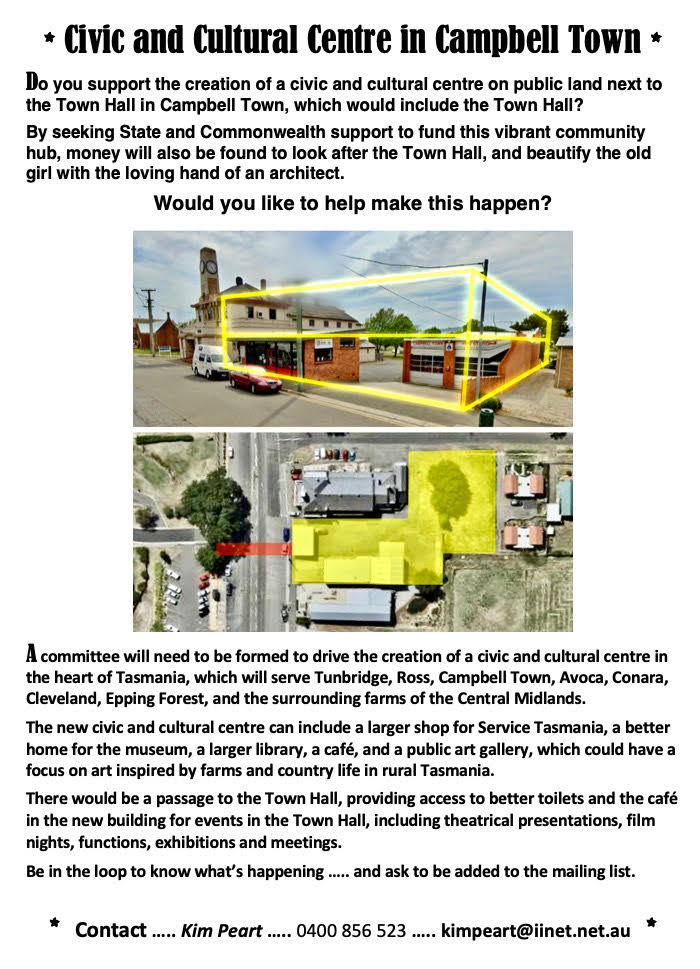
There was a new concept on the table, which I presented at the council meeting of 19 July, with a civic and cultural centre being located on land next to the Town Hall, and including the Town Hall.
Despite calling on the council to discuss the alternative approach, the council will not talk to the community.
Mayor Mary Knowles is quoted as saying: “the Town Hall sale had first been mooted in 2014” … “We went to the community and had two well attended community meetings.” (Northern Midlands Courier, 22 July 2021, page 4)
The context of 2014 needs to be understood.
The council had just spent over $100,000 putting in new rooms in the Town Hall for the Campbell Town Museum, so how could anyone believe seven years ago that the council actually planned to sell the Town Hall. It doesn’t add up.
I would like more information on those two meetings, and what was actually presented.
A 2014 consultant’s report mentions that due to the internal changes, the Town Hall could no longer be used for large functions.
Is that the real reason the council decided to build a new function and meeting venue at the sports ground?
The Campbell Town Museum in the Town Hall is now located in three unconnected rooms, which is quite disconcerting.
Did the council break the Town Hall? Did the council undermine the viability of the museum? Have the council been seeking to sell the Town Hall out of a sense of shame at what they did to the building?
If the council take responsibility for moving the museum, where will it go, and at what cost to the ratepayers?
Is it a council feeling of guilt over what they did to the Town Hall in 2013, at great expense, that keeps them from talking to the community about a solid way to keep the Town Hall in public hands, or working with the community to develop an events program at the Town Hall?
A murkier revelation is that: “the aging Town Hall needed hundreds of thousands of dollars worth of maintenance done, which the council simply cannot afford.” (Northern Midlands Courier, 22 July 2021, page 4)
Has the council been neglecting the maintenance of the Town Hall to the tune of hundreds of thousands of dollars?
Do we need to wonder if the Northern Midlands Council is a real council? The northern parts of the municipality are more like a suburb of Launceston, where people go to work, access civic services and cultural places.
Is the Northern Midlands Council bludging off Launceston’s investment in civic life, history and the arts?
Is this why the Northern Midlands Council has no perception of the benefits of developing a civic and cultural centre in the Central Midlands? They have no arts policy, nor arts officer, nor even heritage officer, despite having two World Heritage sites.
Would the Central Midlands be better off cutting loose from the northern carpet baggers in the council, and forming a new municipality to serve the best interests of the region?
That would save the Town Hall.
Kim Peart is a long-time resident of Ross, a writer, a keen aficionado of Second Life, and the founder of Space Pioneers.