Media release – Jeremy Rockliff, Minister for Mental Health and Wellbeing, 21 July 2021
We must work together to prevent suicide
Every death by suicide is a devastating loss – for families, for friends, work mates, and for communities.
It is important to recognise the reasons people take their own life are complex, and not always connected to mental illness.
The Tasmanian Government is working hard with our health service, community partners, and all levels of government to ensure Tasmanians know where to go to receive the support they need, in line with Tasmania’s Suicide Prevention Strategy.
We need to know as much as we can about the stressors that people who die by suicide are experiencing, and use this knowledge to inform more targeted suicide prevention initiatives. It is also absolutely vital we listen to and work with health professionals and experts in this area, and that is exactly what we are doing.
The Tasmanian Suicide Register, established in 2017, is one of the most powerful tools we have to give us greater understanding, and along with other new and evolving analysis, is putting us in a much stronger position to target assistance for people at risk of suicide, and make sure that the services we fund are the right mix and are available at the right place and at the right time.
The Way Back Support Service, jointly funded by the Tasmanian and Australian Governments, will commence in coming months, and be delivered by Anglicare Tasmania to provide intensive support for Tasmanians aged 15 to 65 plus for up to three months following a suicide attempt or suicidal crisis.
As part of the Government’s Tasmanian Mental Health Reform Program, we are developing an integrated suicide response that connects after care support functions with a community based crisis response.
The updated Rethink 2020 Plan also includes suicide prevention as a priority area, and an implementation plan is currently being finalised for release in coming weeks.
The Tasmanian Government is also working with the Australian Government, and other jurisdictions, to finalise the National Mental Health and Suicide Prevention Agreement later this year.
All Tasmanians can play a role in suicide prevention by:
- Giving people a sense of belonging or a feeling of connectedness;
- Reducing stigma;
- Listening without judgment, showing compassion, and instilling hope;
- And importantly, developing their skills to recognise and support someone in crisis – including to encourage the seeking of professional help if required.
We can each make a difference by regularly checking in with the people around us and encouraging discussion.
I encourage all elected representatives, irrespective of political views to work together alongside people with the relevant expertise and stakeholders to do all that is possible to prevent the tragedy of suicide.
Assistance is available 24/7 by calling Lifeline on 13 11 14, or the Suicide Call Back Service on 1300 659 467.
Importantly, if anyone is in immediate danger, they should call triple zero immediately.
Media release – Dr Bastian Seidel MLC, Shadow Health Minister, 21 July 2021
Rockliff must act and establish independent Suicide Prevention Commission
After two years of failing Tasmanians as the Minister responsible for Mental Health, Jeremy Rockliff must immediately act after the release of confronting new data on suicide rates.
Shadow Health Minister Dr Bastian Seidel said as the new statistics reveal Tasmania’s age-standardised suicide rates are now the country’s second highest, Mr Rockliff must finally work with mental health organisations and, as a matter of urgency, fund the establishment of an independent Suicide Prevention Commission in the Liberal’s next budget.
Dr Seidel said the report released by the Australian Institute of Health and Welfare showed 108 Tasmanians took their lives in 2019.
“It is tragic that suicide remains the number one cause of death for younger Australians aged between 18-24 and up to nine suicides each month in Tasmania is just devastating,” Dr Seidel said.
“Suicide has an overwhelming effect on families and communities but it’s unacceptable that there has been such inaction and failure to address critical mental health issues on Mr Rockliff’s watch as the Minister responsible for Mental Health for the past two years.
“Tasmanians do not need more reviews or discussion papers or more tokenistic words of comfort from this Minister – they need action and they need a genuine effort to address mental health and suicide prevention.
“That includes a whole-of-community approach.
“It’s not good enough that the Liberal Government continues to talk up an economy they claim is booming but at the same time continues to neglect Tasmania’s most vulnerable.”
Viewing the monitoring data
Caution: Some people may find parts of this content confronting or distressing.
Please carefully consider your needs when reading the following information about suicide and self-harm. If this material raises concerns for you contact Lifeline on 13 11 14, or see other ways you can seek help.
The information included here places an emphasis on data, and as such, can appear to depersonalise the pain and loss behind the statistics. The AIHW acknowledges the individuals, families and communities affected by suicide each year in Australia.
Aboriginal and Torres Strait Islander readers are advised that information relating to Indigenous suicide and self-harm is included.
The AIHW supports the use of the Mindframe guidelines on responsible, accurate and safe suicide and self-harm reporting. Please consider these guidelines when reporting on statistics on the monitoring of suicide and self-harm.
To continue, scroll down…
Deaths by suicide, by states and territories
Patterns of deaths by suicide between states and territories can reveal insights that may be masked by results for the whole of Australia. Variations in the rates of deaths by suicide across states and territories may help to highlight different risk factors and assist in better targeting of suicide prevention activities. For example, differences in the ratio of urban to regional and remote areas may explain some of the differences across states and territories given that the rates of suicide tend to be higher in regional and remote areas, see Suicide by remoteness areas.
Information based on the deceased’s usual state or territory of residence is available for deaths registered after 1979. Deaths by suicide may be presented by either year of death or by year of registration. Reporting by year of death can provide more reliable information on trends in occurrence than reporting by year of registration; however, the latest data available underestimates the occurrence of recent deaths due to a lag in registration, for more information, see Technical notes. Here, statistics based on both year of registration of death and year of occurrence of death are presented.
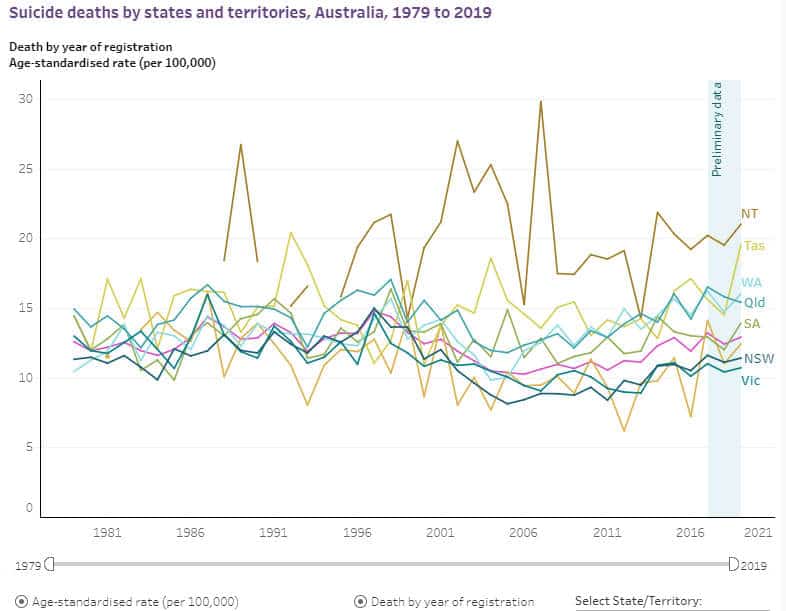
How do suicide rates vary across states and territories?
From 1979 to 2019, age-standardised suicide rates based on death registrations:
- tended to be lower for New South Wales, Victoria and the Australian Capital Territory than the overall Australian suicide rate while rates for all other jurisdictions tended to be higher
- tended to be highest in the Northern Territory (14.2 to 29.8 deaths per 100,000 population); however, it was one of the jurisdictions with the lowest number of deaths by suicide (from a high of 56 in 2014 to a low of 7 in 1982).
In 2019:
- the age-standardised suicide rate ranged from 10.7 per 100,000 population in Victoria to 21.0 per 100,000 in the Northern Territory.
Age-standardised suicide rates allow for comparisons between states and territories by adjusting for differences in age structures and population size. Rates fluctuate over time—particularly in the smaller jurisdictions—due to the small number of deaths by suicide that are registered each year. Caution is advised when comparing state and territory data. Differences in coronial processes, data processing or coding practices should also be taken into consideration when comparing data across jurisdictions and over time.
In 1979, the highest number of deaths by suicide was in:
- New South Wales (539 deaths), followed by Victoria (462), Queensland (296), South Australia (178) and Western Australia (116).
By 2019, the highest number of deaths by suicide was in:
- New South Wales (937), followed by Queensland (784), Victoria (717), Western Australia (418) and South Australia (251).
However, it should be noted that New South Wales and Victoria have the largest populations in Australia and the populations of both Queensland and Western Australia increased considerably from 1979 to 2019.
What is the effect of reporting deaths by suicide by year of occurrence?
The data for age-standardised rates and number of suicide deaths are broadly similar when analysed by year of death or year of registration. Minor differences arise due to the elapsed time prior to registration with recent years showing some differences due to incomplete coronial processes and registrations.