The recent Long Term Financial Management Plan (LTFMP) of the Glamorgan Spring Bay (Council) is raising some eyebrows on the east coast after it flagged ‘annual rate increases in the order of 15% in the short term’.
Executive Summary
The Long Term Financial Management Plan (LTFMP) seeks to inform the reader about how the Glamorgan Spring Bay (Council) intends to govern the financial aspects of its Strategic Framework. Underpinning this is Council’s goal of managing its operations in a financially sustainable manner now and into the future.
With the advent of the COVID-19 health crisis Council experienced financial challenges as it quickly responded to protect the health and wellbeing of our community and sought to support residents, local business and community organisations while maintaining essential services.
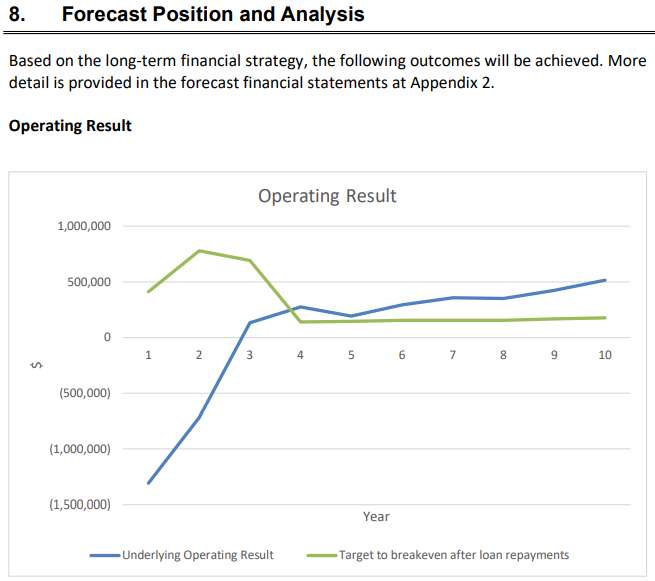
This LTFMP, in the short term, has been shaped by the economic impacts of the COVID-19 pandemic. While difficult to estimate the financial impacts and therefore how quickly the municipality will recover, this plan forecasts a recovery to a financially sustainable position over the next four years.
This plan has been developed with Council’s key financial strategies at its core: moderate underlying surpluses, sufficient liquidity and cash flow, minimise debt, and asset renewal requirements being satisfactorily funded.
Council recently considered its long term asset management plans, acknowledging the need to focus capital spending on asset renewals over the next ten years. Both the long term financial plan and the long term asset management plans are to be reviewed annually.
The forecasts contained within this LTFMP and which are necessarily based upon certain assumptions, produce the following outcomes over the 10-year horizon of this plan: –
• The achievement of modest underlying operating surpluses. Over the next 10 year period, Council is forecast to achieve underlying surpluses in the range -9.08% to 2.3% of revenue, and averaging -1.57%. Surpluses should then increase beyond this 10 year period. It is important that Council generates sufficient revenue to cover all of its cash and non-cash costs, with a small buffer.
• Long borrowings are currently at maximum capacity and these will decrease by more than 50% over the 10 year period.
• Cash balances in the short term are very low. Balances should steadily increase to a more acceptable level over the 10 year period with a near three fold increase in the cash balance by the end of the 10 year period. Balances and cash flow requirements will need to be closely monitored and further refined to ensure adequate liquidity.
• 100% funding of forecast asset renewal requirements will be achieved by year 4, which is a key financial sustainability indicator. An appropriate benchmark is considered to be 90-100%. Renewal forecasts are continually being refined and the funding level monitored.
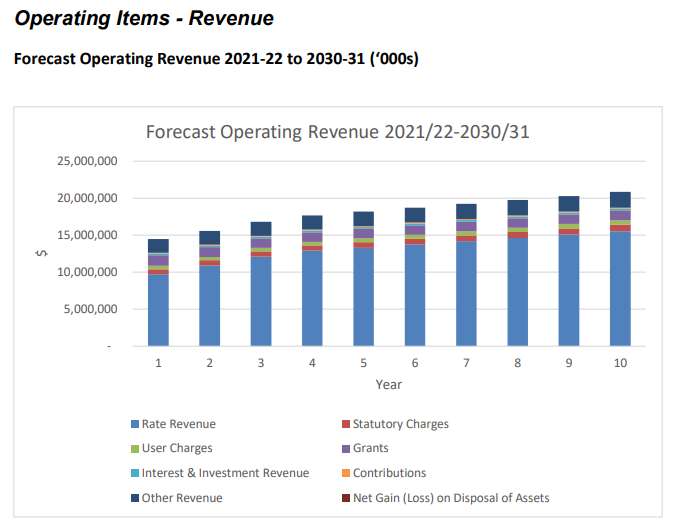
These outcomes, together with the underpinning assumptions of revenue and cost growth indicate annual rate increases in the order of 15% in the short term, and then decreasing to 3.25%. This is exclusive of the State Government fire levy, any redistributive effects of revaluations, Assessed Annual Value (AAV) indexation or changes to council rating policy.
These outcomes ensure a return to a financially sustainable position for the Council, thus ensuring the ability to deliver services into the future. It will ensure an equitable distribution of costs between current and future generations.
Featured image above (from report) courtesy J Lovell.
Tasmanian Times exists to amplify your voice
Please support our crowdfunding campaign to
rejuvenate independent media in Tasmania!