
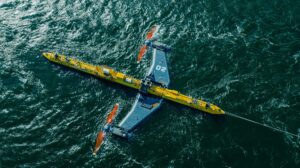
Scotland’s Orbital Marine Power (formerly Scotrenewables) has completed the build on what it claims will be the world’s most powerful operational tidal turbine. It’s now on its way to the Orkney Islands in the country’s far north, where it’ll have a chance to prove its worth connected to the grid.
Orbital successfully launched its 2MW tidal turbine, the Orbital O2, from the Port of Dundee on Thursday 22 April.
After commissioning at Orkney it will be connected to the European Marine Energy Centre (EMEC) where it will become the world’s most powerful operational tidal turbine.
Speaking of the launch, Orbital’s CEO, Andrew Scott, said: “This is a huge milestone for Orbital; the O2 is a remarkable example of British cleantech innovation and the build we have completed here is an inspiring display of what a UK supply chain can achieve if given the opportunity – even under the extraordinary pressures of a pandemic.”
The O2 turbine started construction in the second half of 2019 and reflects approximately 80% UK supply content. From Scottish steel work and main manufacturing through to anchors from Wales and blades from the south of England; the build of the O2 is estimated to have supported over 80 jobs within the UK economy.
O2 has the ability to generate enough clean, predictable electricity to meet the demand of around 2,000 UK homes and offset approximately 2,200 tonnes of CO2 production per year.
Projects of this type are effectively harvesting ‘lunar energy’. As the moon’s gravity pulls at the Earth’s surface, it heaves vast quantities of ocean water around the globe in predictable patterns. Where this water is forced through narrow gaps or around headlands, it speeds up, and it’s possible to harvest the kinetic energy of that mass of water using turbines under the ocean’s surface. This is called tidal power.
Other large tidal energy projects include Korea’s Sihwa Lake Tidal Power Plant and the Rance Tidal Power Station in France. They have both been built using large and extremely expensive undersea walls, or barrages. These barrage systems close sluice gates at low tide, then open them up at high tide to take advantage of the height differential to run turbines. They work well, but the installation cost is very high and the stifling of natural water flow has had some negative environmental consequences.
The floating approach is targeted at keeping costs as low as possible. The floating turbines are installed in channels that accelerate tidal flows. These turbine platforms are then moored to the ocean floor at four points using extremely strong chains, meaning the undersea work to install them is fast, minimal and less expensive.
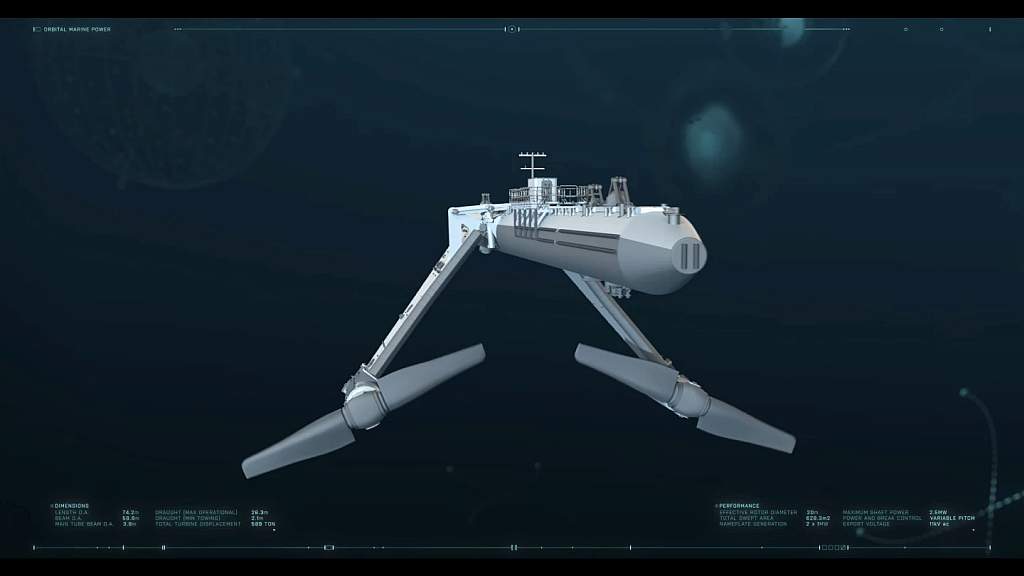
The turbines are joined to the main platform with giant arms, and their blades can be reversed in pitch between tide cycles to generate power whichever way the water’s moving. Energy is sent back to shore through thick undersea cables, and the platform’s arms can articulate to bring the turbines up out of the water for simple inspection and maintenance without any scuba gear required.
The most important numbers for Orbital will be how much power the O2 generates annually, how much it costs to build and run, how much it can sell that power for in a given market, and how long it’ll last in the corrosive undersea environment.
Energy markets will likely be very enthusiastic about predictable renewable power sources that can operate when the sun’s not shining and the wind’s not blowing, to accompany to firming capabilities of battery systems.
Chris Smith, MD of TEXO Group commented: “The O2 programme has given us a significant opportunity to demonstrate our multi-disciplinary capabilities, and our proactive approach to working collaboratively with clients. We firmly believe that the transition to a net zero environment will deliver a range of opportunities to the UK’s engineering and fabrication sectors and we are very proud to see Orbital’s O2 turbine launched today.”
Also speaking of the launch, John Alexander, Leader of Dundee City Council said: “I’m very proud of the role that Dundee has played in helping to deliver this pioneering tidal turbine and congratulate the team at Orbital Marine and TEXO for their incredible efforts during the hardest year in recent memory. Orbital Marine’s incredible piece of engineering will play a pivotal role in showcasing this technology and helping Scotland to achieve its ambition in tackling the climate emergency, further propelling Dundee into a city which is transforming itself into a hub for renewables and innovation.”