The Invasive Species Council has today released major new economic modelling showing feral deer could cost Tasmania up to $1.4 billion over the next 30 years unless governments dramatically scale up control efforts.
The report, prepared by Frontier Economics, found:
- Feral deer just in the Midlands and eastern regions are currently costing Tasmania more than $53 million per year.
- Under the current management setting, over the next 30 years, these costs could accumulate to almost $1.4 billion, assuming impacts escalate linearly alongside population growth.
- This means the yearly costs of deer in the Midlands and eastern regions could blow out from $53 million to as high as $298.3 million per year.
- The biggest economic impacts include lost agricultural productivity, forestry damage and deer-related vehicle crashes.
- Cost estimates reported here are conservative as the report only covers deer and their impacts in the Midlands and the eastern regions, not the whole state, and does not monetise all cultural, biodiversity, disease-risk and other impacts.
‘Tasmania is sleepwalking into the same feral deer disaster we’re already seeing on the mainland. If things don’t change significantly, the costs of deer to the Tasmanian community could accumulate to almost $1.4 billion,’ Invasive Species Council Conservation Officer
Tiana Pirtle said.
‘But even these staggering figures only tell part of the story. This report does not quantify the enormous environmental damage feral deer are causing to Tasmania’s bushland, threatened species habitat, waterways and culturally significant landscapes.
‘This billion-dollar warning is actually an underestimate, given the modelling was only for part of the state and did not quantify all impacts.
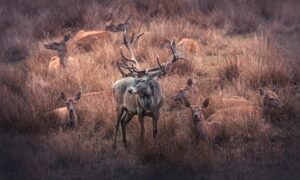
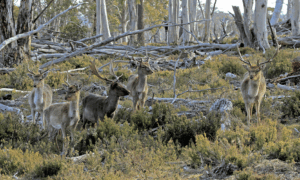
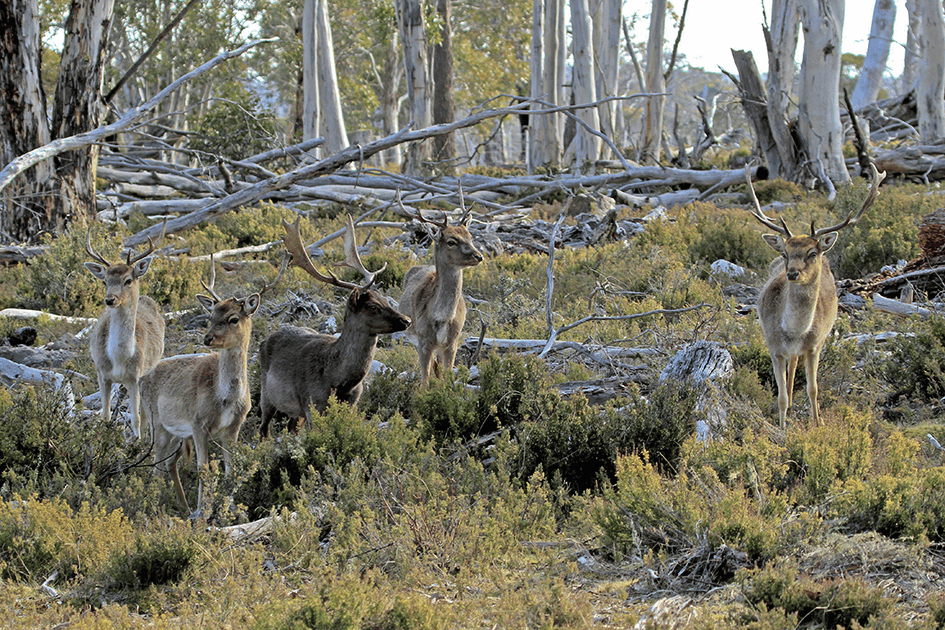
‘Feral deer are exploding across the landscape – trashing and trampling bushland and crops, smashing fences and causing dangerous road crashes.
‘Feral deer numbers just in Tasmania’s Midlands and eastern regions alone could surge from around 71,000 today to more than 667,000 by 2054.
‘At some point we need to stop pretending the current approach is working. It’s not. And our unique landscapes, bush and wildlife, as well as the livelihood of farmers, are paying the price.
‘You cannot solve a landscape-scale invasive species problem with fragmented, ad hoc control and a few recreational hunters.
‘In fact, the Tasmanian government’s own economic analysis previously found that the economic benefits generated by recreational deer hunting pale in comparison to the economic impact of feral deer reported here.
‘The current approach is failing because governments are still trying to manage deer as a hunting resource instead of treating them like the invasive species they are.
‘That means properly funding coordinated, long-term deer control across public and private land, removing outdated protections and game management settings that continue to entrench deer populations, tightening deer farm regulations to reduce escapes and releases, and treating feral deer as the serious invasive species threat they are.
‘The longer governments delay decisive action, the harder – and vastly more expensive – this becomes.
‘The scale of this crisis and the failure to reduce numbers is shredding the agricultural and environmental legacy of the Rockcliff Government.
‘The state government has only spent $5 million since 2022 on managing deer, or $1.25 million per year. This is vastly outweighed by the current annual costs imposed by deer, and given that the recent state budget does not show ongoing funding beyond 2026–27 for deer management, these costs of deer will continue to escalate.
‘Premier Rockliff and Primary Industries Minister Gavin Pearce now face a choice – continue with the failed status quo or finally give Tasmania the resources and reforms needed to bring this escalating deer crisis under control.’
Dr Kerry Bridle, an ecologist based in the Tasmanian Midlands, said: ‘The Tasmanian Midlands region has suffered from dramatic biodiversity decline, and this decline is ongoing, with feral deer one of the main factors.
‘Feral deer are increasing the cost of regeneration. It now costs about $30 to protect a single sapling from feral deer. This is almost 10 times higher than the amount allocated in grants awarded using public funds for biodiversity protection.
‘This means that landholders must pay the shortfall to ensure our forests will persist into the future, providing habitat for native wildlife and shade and shelter for livestock.’
‘We can see damage that deer are doing to crops, pastures and restoration plantings, but less visible is the damage that they are doing in native forests and woodlands. Many forests and woodlands are missing teenager and ‘young adult’ trees. The few seedlings and young saplings present are the prime targets for deer damage, affecting the recruitment process and the long-term viability of our native woody ecosystems.’
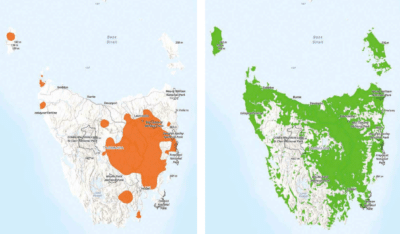
Main feral deer concentration (orange)
Nathan Calman, CEO of Tas Farmers, said
‘The growing feral deer population in Tasmania is a significant and unfair burden for the state’s primary producers.
‘The current deer management plan has not slowed the population growth or spread of population in the state and without meaningful change threatens the sustainability of the states agricultural sector.
‘Recent changes announced by the Minister are meaningful in cutting red tape, however without further reform will not put downward pressure on the population.
‘Deer must have their partially protected status removed as a first logical step in targeting meaning population reduction.’
The Invasive Species Council is calling on the Rockliff Government to:
- remove the legal protection of feral deer under the Wildlife Act
- commit at least $3 million per year over the next 5 years to reduce the deer population in the Midlands through targeted, coordinated professional control operations
- commit at least $20 million over the next 10 years for key island eradications, including Bruny and King Island, with that funding frontloaded
- urgently expand and intensify peri-urban deer control programs, including the Tasman and Freycinet Peninsulas, and around Hobart and Launceston
- continue and expand the aerial control program on the Central Plateau to protect the World Heritage Area
- ban all new deer farms and increase enforcement of deer farm regulations to prevent deer from leaking back into the environment
- revise the zoning system in the Deer Management Plan from the 3 zones (sustainable hunting zone, mixed management zone and no deer zone) to 2: a deer management zone and a deer eradication zone
A copy of the report can be found here – Economic, social and environmental cost of deer in Tasmania report
Background:
- Feral deer numbers have exploded across Tasmania – Within the boundaries of the 2019 survey area only the report finds “the population increased from 53,660 +/- 19% deer in 2019 to 71,655 +/- 19.6% deer in 2024, a multiplication factor of 1.3357, and thus a rise of 33.57% in 5 years (equivalent to a ~6% rise per annum).
- The majority of feral deer are in the Midlands, but satellite populations have spread to the Tasman and Freycinet Peninsulas, Bruny and King Islands, around Hobart, Launceston and in the northwest.
- Feral deer cause damage to native vegetation and ecologically fragile areas through over-browsing, over-grazing and trampling, with negative impacts on biodiversity and the Aboriginal cultural landscape.
- Feral deer remain legally protected in Tasmania as a game resource under the Wildlife (General) Regulations 2010. Tasmania and Victoria are the only states that continue to treat feral deer as a hunting resource instead of managing them as an invasive species.
If you’re interested in this article, please join our Free Newsletter for Part 3 of 5
If you have any comments you’d like to add to this article, please contribute via this form. We’re trialling this while we work through replacing our comments section.
A strong truly independent media is a cornerstone of democracy and the only shield against autocracy. What value do you put on democracy and living in a free country?
Remember, after the power grab the first action of every despot in modern history is to take control of the media, so please consider supporting us so we can grow stronger and be a better shield!
Your kids will thank you and so will your Granny, but the aspiring despots won’t…and you never know when one will pop up.