Data Centres
Firmus is Biggering & Biggering – Part 2

The American Railroad Bubble in the 1880s was fuelled by unprecedented access to capital, infrastructure overbuilding, and speculation to capture lucrative future markets.
When supply quickly outstripped demand and the returns didn’t materialise, the result was a banking crisis and the Panic of 1893. Major investment banks collapsed, which triggered bank runs across the country and resulted in widespread bankruptcies. The unsustainable debt and plunging share prices eventually triggered a historic financial depression.
This bubble was created by two varieties of so-called ‘Robber Barons’; ‘The Speculators’, who duplicated existing systems and initiated aggressive price wars, and ‘The Monopolists’, who controlled the major established routes and engaged in corporate warfare. When the bubble popped, J. P. Morgan stepped in and made immense wealth and gained historic power by consolidating, restructuring, and taking control of the financially ruined railroad companies.
“History doesn’t repeat itself, but it often rhymes.” – Mark Twain
To understand the prospects, risks and opportunities for Firmus Technologies, and any other AI company coming to Tasmania we need to have a good grasp of the context in which these companies are spending vast amounts of money. The coverage in the Tasmanian media don’t tell the real story.
The race to build artificial intelligence has been described as having parallels with the American Railroad Bubble. To understand where we are in the story, we need to understand the backdrop and then investigate the flow of capital. In the AI race the flow of capital has moved through three distinct chapters with each one being riskier than the last.
The backdrop, according to Bank of America, is that the ten largest AI names now account for around 40% of US market value, which is on par with the Nifty Fifty blue chips of the early 1970s, Japan at the peak of its 1980s bubble, and the dot-com peak of 2000. Only the railroad mania of the 1880s was more concentrated. When the IPOs of SpaceX, OpenAI and Anthropic are added, this figure rises to closer to 48% of total US market value.
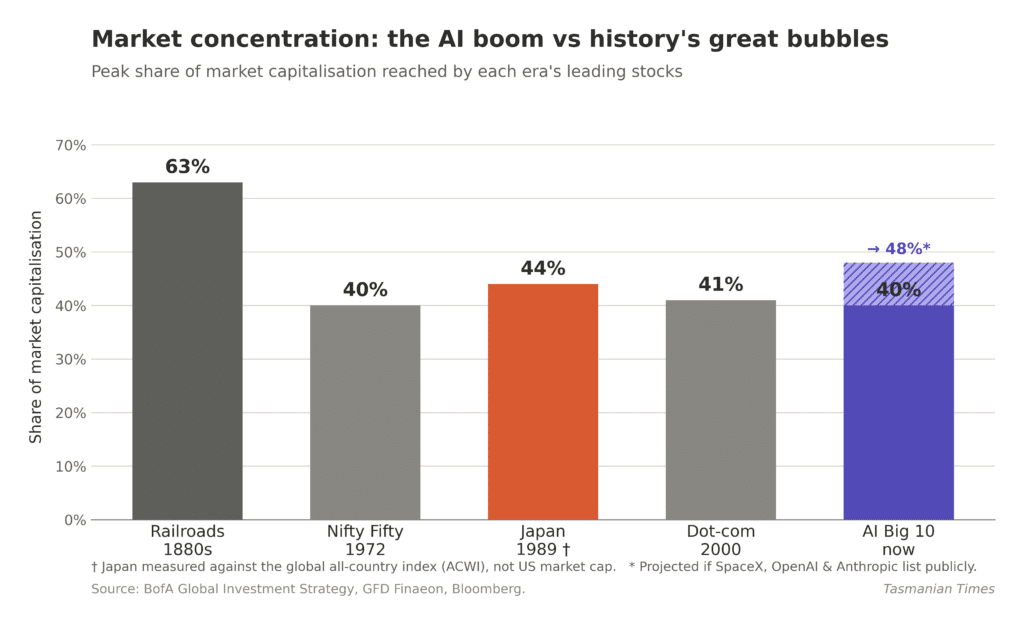

Peak market concentration across history’s great bubbles. Recreation of a Bank of America chart. Japan is measured against the global market; the others against the US market.
The flow of capital is best split into three chapters.
The first chapter (2023-2024) was the equity era. This is when investors simply wrote cheques to own a slice of the company. The cheque sizes and super-fast valuation increases have been staggering. OpenAI’s $40 billion round in early 2025 valued it at $300 billion, which was nearly three times the largest amount ever raised by a private technology company. Anthropic’s value climbed from about $4 billion in 2023 to $183 billion by September 2025.
The defining feature of this era is that the money comes in from people betting on the future. If the bet goes wrong, those investors lose money, but nobody must be repaid. That makes equity capital the safest kind of fuel for these companies and the supply of capital seemed endless.
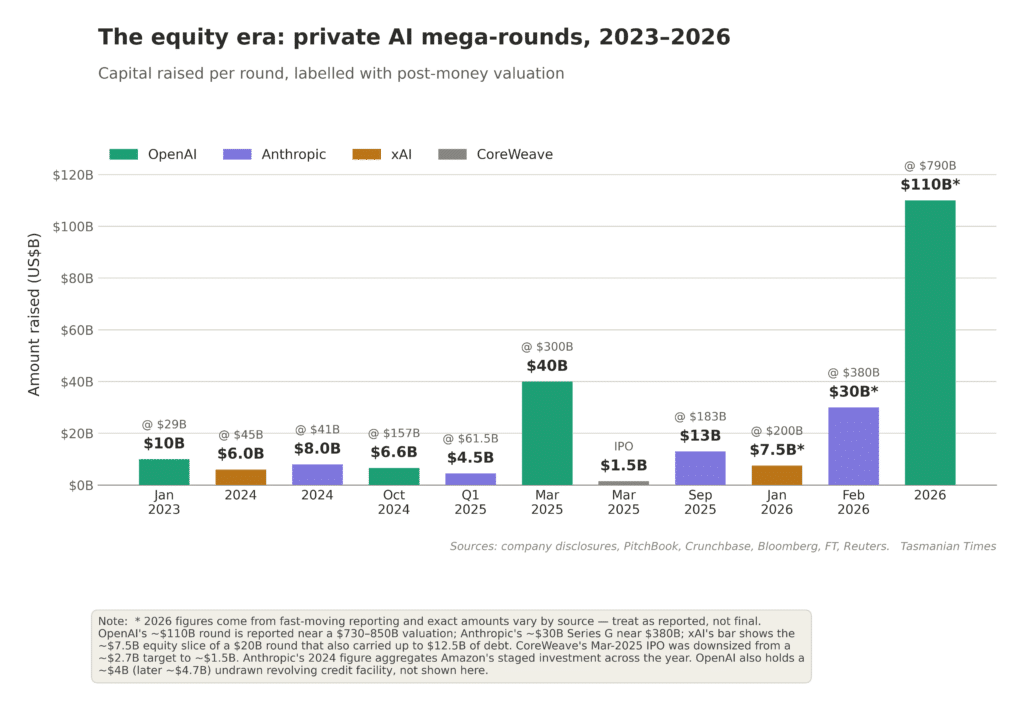

Private AI mega-rounds, 2023–2026: capital raised per round, labelled with post-money valuation.The second chapter starts in late 2025, when the AI industry entered the debt era. Spending on developing AI had outgrown what fresh equity capital could cover, so the companies moved into bonds and loans that must be repaid with interest. Even the giants started borrowing, and they moved super-fast and at scale. The five biggest AI cloud players issued about $121 billion of bonds in 2025, roughly three times the $40 billion they raised in 2020. Meta’s $30 billion bond sale was the largest corporate bond deal ever that was not funding a takeover.
The second chapter starts in late 2025, when the AI industry entered the debt era. Spending on developing AI had outgrown what fresh equity capital could cover, so the companies moved into bonds and loans that must be repaid with interest. Even the giants started borrowing, and they moved super-fast and at scale. The five biggest AI cloud players issued about $121 billion of bonds in 2025, roughly three times the $40 billion they raised in 2020. Meta’s $30 billion bond sale was the largest corporate bond deal ever that was not funding a takeover.
The crucial element is quality of the debt. Lenders grade borrowers much like a credit score. The safest bonds are “investment grade” and borrow cheaply, at roughly 4% to 5%. The riskiest bonds are “high yield” (or “junk bonds”) and pay much more in interest. That gap is where the AI story starts to get uncomfortable. Oracle still holds an investment-grade rating on paper, but after a borrowing spree its bonds began trading like junk. Analysts warned Oracles’ rating could fall to just above junk. Further down the pecking order, the picture is starker. CoreWeave, a company often compared to Firmus, is clearly junk-rated and has borrowed $12.9 billion privately at 11% to 15%. Elon Musk’s X-AI has also raised $5 billion through a mix of bonds and loans at a 12.5% interest rate, without any credit rating at all.
In short, the money became more expensive, and the borrowers became riskier at the same time.
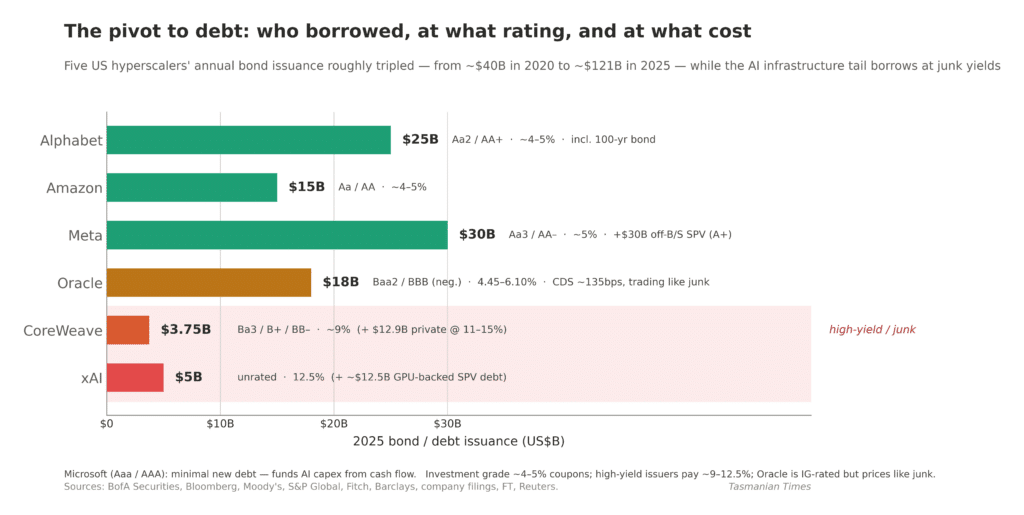

The pivot to debt: hyperscaler bond issuance tripled from 2020 to 2025, and the ratings ladder runs from AA-rated giants down into junk.
The final chapter in the flow of capital is when the money starts going around in circles. Increasingly, the chipmakers and cloud providers are also funding the companies that buy their products and services. The cash often loops straight back. Nvidia invests billions in OpenAI and xAI. Those firms then spend much of it on Nvidia chips. Amazon and Google pour tens of billions into Anthropic. Anthropic commits to spending a comparable fortune renting Amazon’s and Google’s cloud computing. In the local context, Nvidia invested $20 billion into CoreWeave, but only $30 million into Firmus. The question remains whether Nividias’ investment in Firmus is only the start or simply spreading its bets across the whole industry. We’ll dive into that question in a later part of this series.
The risk is easy to state. The same dollar can be counted three times which can make the whole group look healthier and faster growing than it really is. It also ties everyone’s fate together. Like a house of cards, if one big player folds, the loop can run in reverse, and the rest fall too.
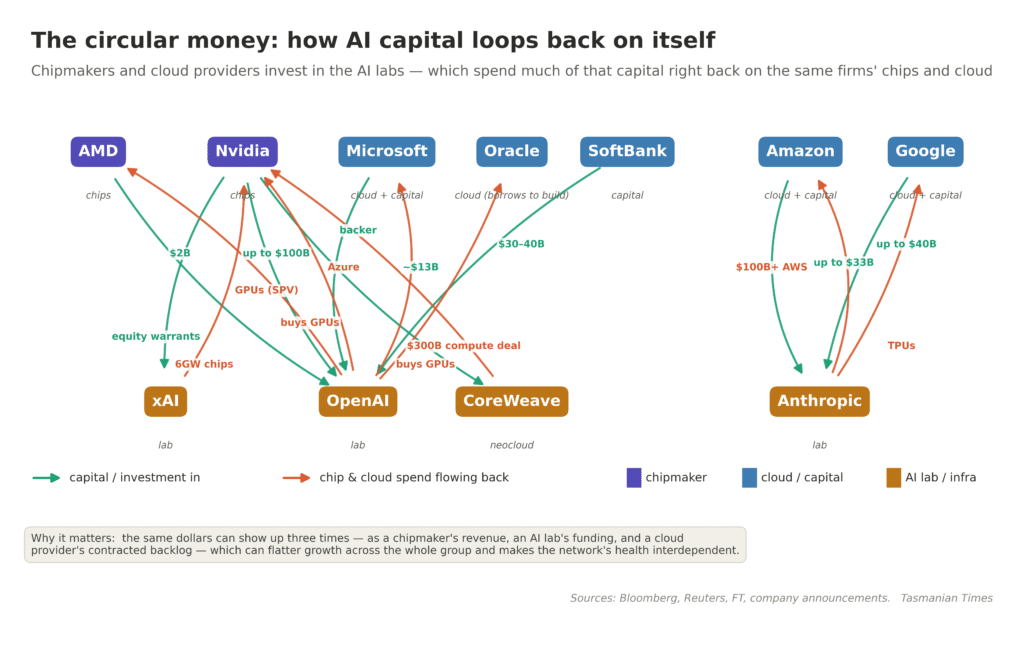

How AI capital loops back on itself: capital flows into the labs (green) and returns as chip and cloud spending (orange).
The key point is that the trajectory itself is the story. AI funding has moved from ownership, where losses fall on willing gamblers, to debt, which must be repaid no matter what, to circular arrangements, where the players increasingly prop one another up. None of this means a crash is coming and many of these firms have huge, real revenues. But the financing is becoming more fragile with each chapter. That is precisely why credit-rating agencies and strategists are now watching the bond market, not just the share price, for the first sign of trouble.
That’s the global landscape.
Looking closer to home, Firmus Technologies is squarely in the global mix and a substantial player in the Australian AI landscape. Although not fully exposed, Firmus’ plan for Tasmania is starting to emerge.
The deal with SUBCO to build a new subsea data fibre-optic cable connecting Tasmania to the mainland was announced on June 2. This week the public became aware that development applications for Bell Bay and Wesley Vale AI factories have been lodged with the Georgetown and Latrobe councils respectively.
In the next three parts of this series, Tasmanian Times will dive deep into Firmus’ plans for Tasmania, especially the questions of water and energy. That is only scratching the surface, as there are other elements at play in this story that are yet to be reported on in the media.
Feature graphic - The Bosses of the Senate" by Joseph Keppler, Puck, 23 January 1889 (J. Ottmann Lith. Co.). Source: Library of Congress.
Update – 22 June 2026 – From the AFR “The latest estimates from Goldman Sachs suggest hyperscalers will spend $US5.3 trillion ($7.6 trillion) on AI and data centres by 2030. Morgan Stanley last week estimated AI-related global debt issuance stood at nearly $US236 billion as of May 31, more than four times larger than the same time last year. That should hit $US500 billion by the end of the year….the tech giants are issuing debt in Switzerland, Canada, Japan and anywhere else they can think of to try to find more capital.”
Part 1 of this series looks at the Firmus corporate
Part 2 of this series gives global context.
Part 3 of this series delves into the Firmus strategy.
Part 4 of this series looks the each AI Factory
Part 5 of this series will look at the pros and cons for Tasmania
Notes:
- 2026 figures (the largest OpenAI and Anthropic rounds) come from fast-moving reporting and vary between sources.
- The ‘2020 vs 2025’ debt comparison is a before-and-after snapshot, not a continuous trend line.
- Dollar figures in the circular-financing map are largely committed or “up-to” amounts, staged and milestone-dependent rather than fully cash in hand. The map also shows the major reported links, not every relationship. There are many more.
- In the concentration chart, Japan’s figure represents its share of the global market, while the other three are based on shares of the US market. Bank of America uses each era’s full “bubble basket,” which produces a higher reading than a strict “top-10 stocks” measure.
- Sources: Bank of America Global Investment Strategy, Bloomberg, Reuters, Financial Times, Moody’s, S&P Global, Fitch, Barclays, Pitch Book, and company disclosures.
If you’re interested in this article, please join our Free Newsletter for Part 3 of 5
If you have any comments you’d like to add to this article, please contribute via this form. We’re trialling this while we work through replacing our comments section.
A strong truly independent media is a cornerstone of democracy and the only shield against autocracy. What value do you put on democracy and living in a free country?
Remember, after the power grab the first action of every despot in modern history is to take control of the media, so please consider supporting us so we can grow stronger and be a better shield!
Your kids will thank you and so will your Granny, but the aspiring despots won’t…and you never know when one will pop up.