Large copper deposits were discovered around Mount Lyell in western Tasmania during the late 19th century, triggering a wave of mining activity across the region. What had once been a remote, densely forested area became a landscape dotted with mines, settlements, and railways.
In 1897, an entrepreneur named James Crotty formed the North Mount Lyell Copper Company in direct competition with the Mount Mining and Railway Company. Crotty’s plan was to create an integrated industrial network linking mines at Linda with a dedicated port in Macquarie Harbour. It was a bold vision for an area that was not easy to access. The weather on Tasmania’s west coast has always been unforgiving, and the terrain is steep and heavily forested.
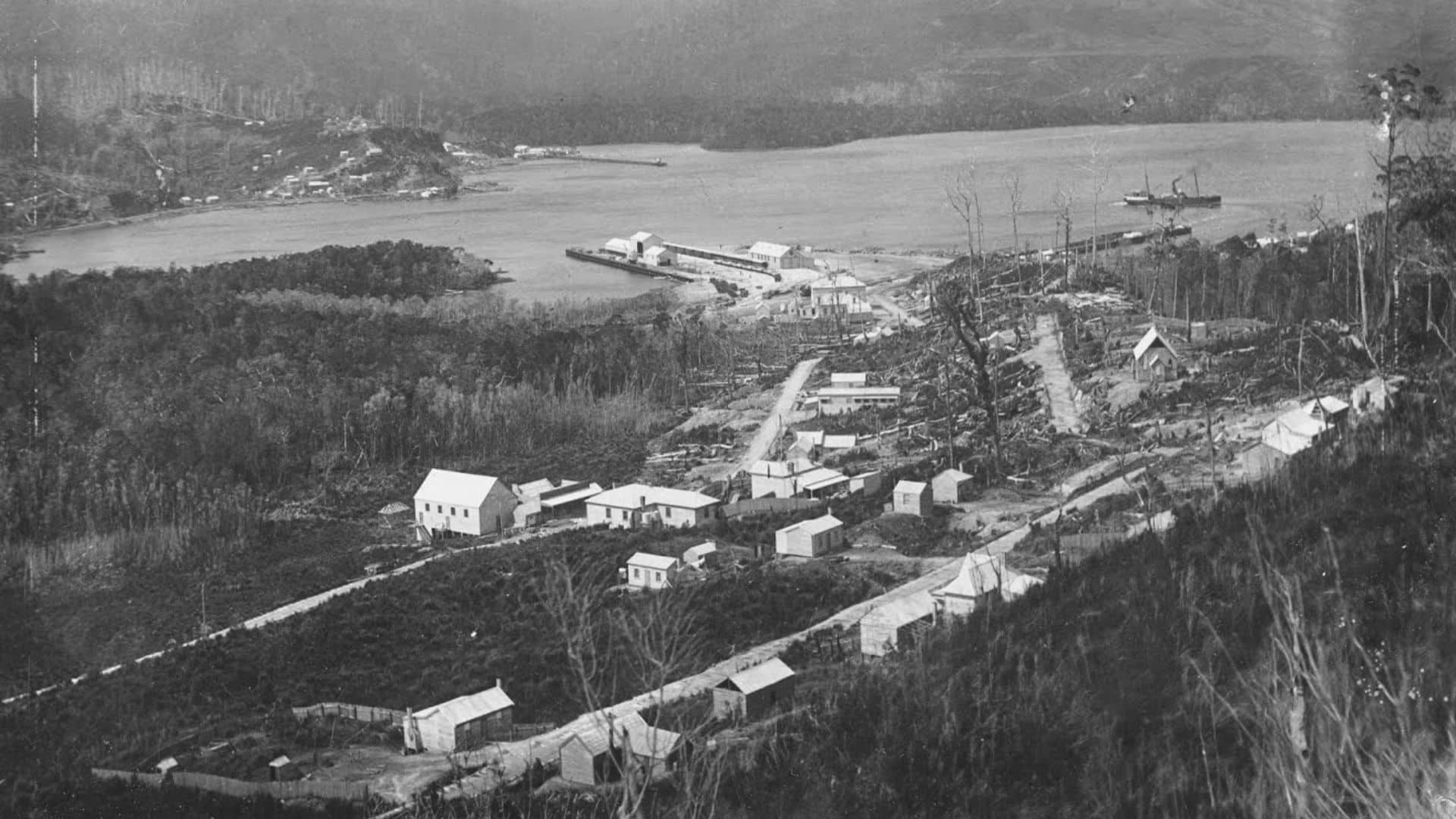
Despite this, East Pillinger was established as the North Mount Lyell Copper Company’s port in Macquarie Harbour. Built between 1897 and 1898, it featured wharves, workshops, offices, and other industrial facilities. At the same time, the nearby settlement of West Pillinger was developed as a residential township for the workers and families who kept the operation running.
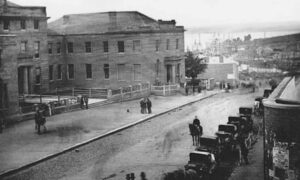
Between 1899 to 1902, East and West Pillinger had a combined population of between 600 and 1,000 residents. The settlements included around 80 dwellings, approximately 25 businesses, three hotels, a Catholic church, a school, a library, a coffee palace, sporting clubs, and shipping agencies.
James Crotty died in 1898, before fully realising his vision. Without his leadership and direction, the North Mount Lyell Copper Company struggled to sustain itself and soon merged with its competitor, the Mount Lyell Mining and Railway Company. The new company chose nearby Strahan as its primary port, rendering East Pillinger redundant. Much of the settlement’s infrastructure was subsequently dismantled, though some of it remained in use for timber harvesting, rail transport, and harbour operations.
The railway ceased operating in 1925, and the tracks were removed the following year. Although this marked the effective end of East Pillinger as a functioning industrial settlement, a small number of residents remained there until the early 1940s.
Once East and West Pillinger were finally abandoned, the surrounding forest gradually reclaimed what remained of them.
In the late 20th century, the Tasmanian authorities recognised East Pillinger as an important historic and archaeological site because of its connection to the state’s late 19th century mining boom, among other factors.
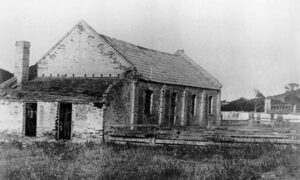
Today, East Pillinger is a ghost of its former self, accessible only by boat or by walking along the former railway alignment. Visible remnants of the settlement include brick kilns, boilers, the remains of jetties, and railway embarkments.
References & Bibliography
- East Pillinger: Historic Township (Parks and Wildlife Service Tasmania)
- East Pillinger (Parks and Wildlife Service Tasmania)
- Pillinger, Tasmania – Forgotten Towns (The Andy T Channel)
- No. 543 – East Pillinger – Sacred Heart Catholic Church – “The Children of St Patrick” (Churches of Tasmania)
- Reindeer Lodge @ Pillinger Town (Mountain Huts Australia)
- History & Heritage (Our Tasmania)
- The Peaks of Lyell (6th edition) by Geoffrey Blainey
- The Abt Railway and Railways of the Lyell Region by Lou Rae
Tas That Was is a column that includes:
- anecdotes of life in Tasmania in the past;
- historical photographs of locations in Tasmania; and/or
- documentaries about locations in Tasmania.
If you have an anecdote or photograph you’d like to share with us, please send it to [email protected].
Callum J. Jones is passionate about telling stories. He studied English, History, and Journalism at the University of Tasmania and lived in Western Sydney from 2022 to 2024 while working as a journalist for Professional Planner, a leading online publication for financial planners. Callum has written for Tasmanian Times since 2018 and has also been published in a range of other outlets, including Quadrant and the BAD Western Sydney anthologies.