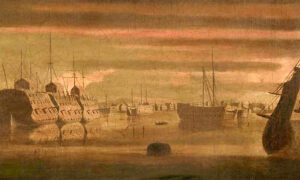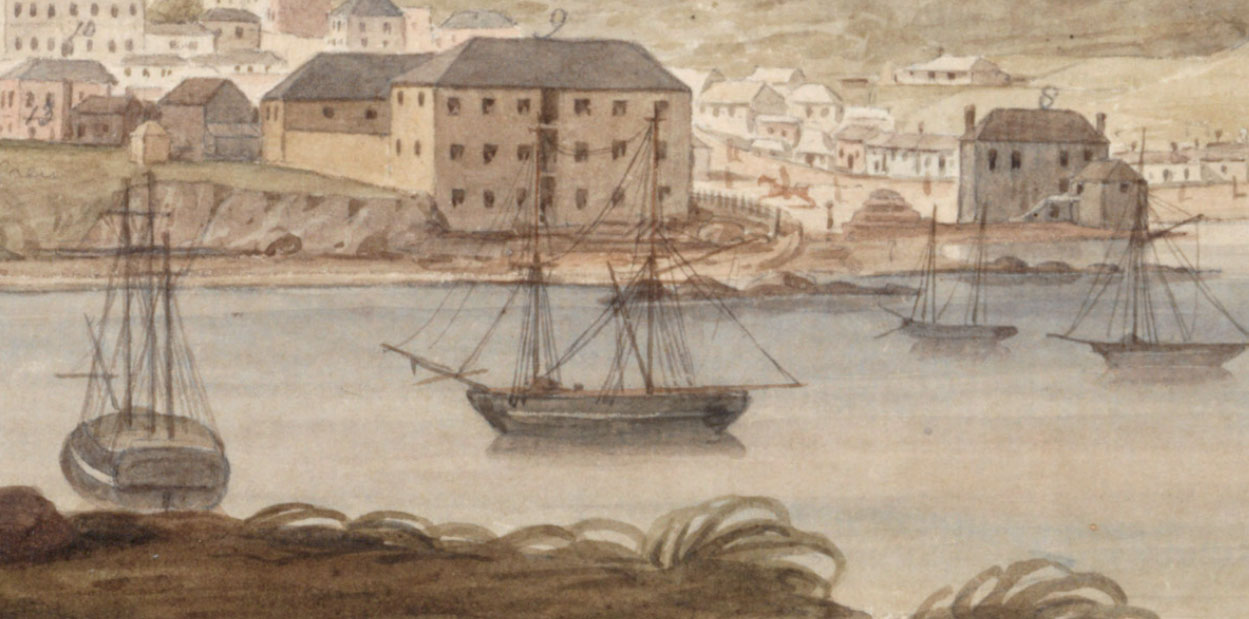
Detail reputedly showing the brig Cyprus (centre) from a panorama of Hobart 1828 – watercolour drawings by Augustus Earle, courtesy State Library of NSW.
The true story of William Swallow and the Cyprus mutiny isn’t as well-known as it should be, according to debut novelist Alexandria Burnham.
The Cyprus mutiny occurred in 1829 in Recherche Bay in Van Diemen’s Land (now Tasmania). A group of convicts led by William Swallow – a 37-year-old man transported in 1821 for housebreaking – seized control of the government-owned brig on 14 August 1829 during a routine voyage.
Once in command, they marooned the officers, guards and non-mutineer convicts ashore, then sailed the Cyprus across the Pacific, calling in at New Zealand, the Chatham Islands, the Pacific Islands and even Japan, before ultimately reaching China. There, they scuttled the vessel and claimed to be castaways.
Swallow and several of the mutineers were eventually captured and tried in London, where two – George James Davis and William Watts – were hanged in December 1830 as the last men executed for piracy in Britain. Swallow managed to convince the authorities that he’d been coerced into navigating the ship because he was a sailor by trade, and he was found not guilty. He was returned to Van Diemen’s Land to serve the remainder of his original life sentence.
Swallow’s account of the voyage was long doubted until Japanese records matched his story more than 180 years later.
Burnham, who has recently published an historical fiction novel about Swallow and the Cyprus, told Tasmanian Times that she first learned about the story when she stumbled across an ABC article online.
“What an insane story,” she said. “An Australian convict who sailed to Japan! I kept reading more and more about it. I [looked] to see if any fiction had been written about him [Swallow], and honestly, not really; no-one’s done anything substantial.”
This led Burnham to consider having a go at fictionalising Swallow’s life story.
“I’m sitting there asking myself, ‘How would I do it?’”
She ended up spending six years researching Swallow’s life and mapping it all out. She even visited all the locations.
“It’s been a blast,” she said. “I’ve really enjoyed writing [the novel].”
Because Swallow is a work of historical fiction, Burnham was guided by the principle: If it happened, it goes in the book.
“I didn’t want to omit things because they were tricky or didn’t fit,” she explained.
“It’s not like I set out with an idea of, ‘Oh, I want this to be the character arc, and I’ll just bend and change history to do it.’ It was the opposite process: I mapped out Swallow’s entire timeline and then followed it. There are gaps where we don’t know why he did certain things, and sometimes we don’t necessarily know how he got from A to C, so I used a lot of informed creative guessing to fill in the gaps.”
One of Burnham’s biggest inventions is one of the mutineers on the ship is completely fictional.
“The accurate number is 18 mutineers. I’ve made it 19,” she said.
“I snuck an extra mutineer onto the Cyprus, primarily because [there were] particularly interesting narrative things I wanted to do [and] it didn’t quite feel right to take one of the real people who would have real descendants and say, ‘Oh, I’ll just completely change him, but everyone else gets to be real.’”
Burnham hopes that people who read Swallow will come away with a sense that it is a story about freedom.
“I have a story of someone escaping a prison sentence. They’re escaping the literal shackles that have been put on them. This was just someone who, at his core, was always just going to rebel. He was clearly someone with such strong, core beliefs that made him say, ‘No, I refuse that. I’m going to do everything to get away from that.’ It informed a really strong character.
“I think that’s what will resonate with readers today. Because I think that’s a very universal thing to feel like we’re being trapped by outside expectations, and we want to push back.”
Historical Fiction Isn’t Just Escapism
Burnham told Tasmanian Times that historical fiction can sometimes get a bad rap from people.
“Some see it as, ‘Oh, it’s just escapism’, or ‘It’s just for people who want to learn about that time’,” she said.
“I think it’s much more than that.”
Burnham explains that historical fiction can tell us quite a lot about our contemporary selves, especially if the characters feel very human.
“I think we can learn quite a lot about ourselves, our modern context in historical fiction.
“I hope people see a lot of humanness in William. I hope they can celebrate his triumphs, suffer at his mistakes in equal measure, and go on that journey with him. At the end of the day, I hope readers learn about this really interesting part of Australian history that hasn’t had a major spotlight shown on it yet.”
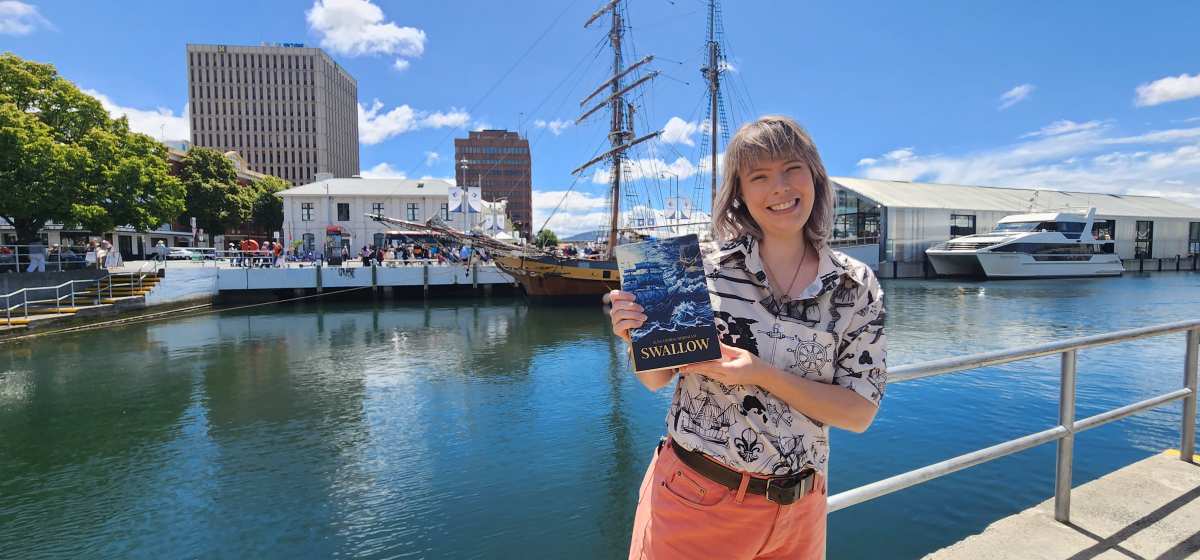
Prior to becoming a novelist, Burnham forged a career in screen and comic book writing. She is also the creative producer at WestWords, Western Sydney’s Centre for Writing.
Callum J. Jones is passionate about telling stories. He studied English, History, and Journalism at the University of Tasmania and lived in Western Sydney from 2022 to 2024 while working as a journalist for Professional Planner, a leading online publication for financial planners. Callum has written for Tasmanian Times since 2018 and has also been published in a range of other outlets, including Quadrant and the BAD Western Sydney anthologies.