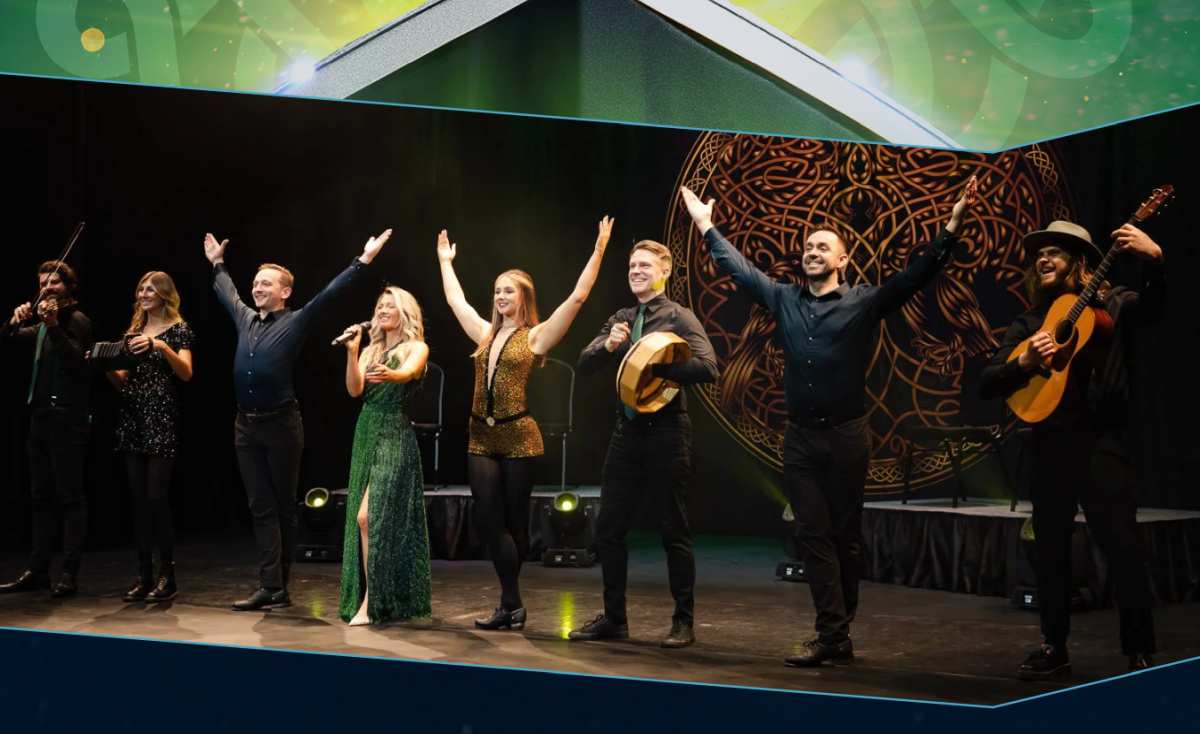
Ireland: The Voyage celebrates the heritage of Ireland through traditional music and dance with a modern spin. The show journeys through periods of the Celts, Vikings, Normans and St Patrick. Each era is presented cinematically with powerful song and dance reflecting on Ireland’s sadness and triumphs.
When we think about Ireland, its legends and myths come to mind. These legends and myths were once suppressed and stifled and the Irish held on to them tight.
Giselle O’Meara, the principal singer of the show, tells me that originally the Celts contained the myths and stories of Ireland in their music and dance.
“There are so many songs that deliver the myths and legends of Ireland. The Irish remained steadfast and didn’t allow their songs to be lost and neither did they let their dances be lost, they would hold secret gatherings.”
And this is where the Irish showed their ingenuity in standing behind windows and keeping their upper bodies still while their feet exploded in dance below. This act was the origin of traditional Irish dancing.
O’Meara reminds us that it took ‘River Dance’ – an interlude in The Eurovision Song Contest – to bring Irish dancing to the world.
But it should be remembered River Dance was Irish dancing evolved, dancing with their hands on their hips, not rigid to their sides and O’Meara as a traditional Irish dancer tells me even though River Dance “changed the presentation of Irish dance”, traditional Irish dance competitions still require arms held rigid to the sides. O’Meara jokes as she gets older and her feet are not so fast, she is slightly inclined to the singing! Although she also says her two loves are “divided equally down the middle.”
O’Meara tells me her all-time favourite traditional song to sing is ‘Caledonia’, a song her mum used to sing to the children. Caledonia is a song about love of individuals and family but also love for country and home. When she is away from home the song reminds O’Meara about her love for Ireland and gives her comfort. O’Meara is equally happy singing it on large stages or smaller gigs and sessions. O’Meara hints to me she will sing it in the show’s second half and there might also be a chance for her to do some dancing!
O’Meara, who is from west Cork – “As far west as you can go with the next village being New York” – has been in Australia touring for around three years and she loves Australia especially the weather and the fact you might meet your second cousin.
When it comes to myths or legends of Ireland O’Meara nominates as her favourite ‘The Children of Lir’, about children who were turned into swans for 900 years and then turned back to humans before they died. There is a statue to the children in Dublin village. Perhaps ‘The Children of Lir’ is a reminder of the sadness in struggle but also the capacity of the Irish to endure with their myths and legends that defined them.
I am reminded as we finish our conversation that O’Meara’s first name is in fact Giselle, the name of a swan.
You can see ‘Ireland the Voyage: The Journey of Ireland’ which features Tasmanian local Tim Gleeson, playing the bodhran as part of the band, on the following dates and venues.
Burnie
Burnie Arts Centre
Thursday 12 February 2026 · 19.30
Launceston
Albert Hall
Friday 13 February 2026 · 19.30
Devonport
Paranaple Arts Centre
Saturday 14 February 2026 · 19.30
Hobart
Theatre Royal
Sunday 15 February 2026 · 14:00