Article
Stadium Debate – Analysing the Government’s Response

The debate over the proposed Macquarie Point stadium has reached a critical juncture, moving from economic scrutiny to a battle over intangibles and aspirational claims.
In Part Two Our Place Hobart continues their detailed critique, examining the government’s rhetoric of “urban renewal” and “opportunity,” and dismantling their claims of “appropriate mitigation” for the catastrophic visual and cultural heritage impacts on Hobart’s unique waterfront.
Stadium Benefits – Unquantifiable Intangibles vs Economic Reality


“OUR OPPORTUNITY”
The second page of the summary is a reiteration of the points made thus far, in a slightly different order and phrased to justify the government’s position. More word-smithing with little substance.
The opportunities this project offers Tasmanians are significant – ones we cannot and should not give up on.
This is a value free statement. ‘Opportunities’ can result in positive or negative outcomes. A jewel thief sees a shop owner forgetting to turn on his alarm when he leaves for the night as an opportunity!
Note how the debate is being couched in terms of “not giving up” as if we’re engaged in some noble struggle. This is reminiscent of David O’Byrne likening himself to a little digger in the trenches.
How about the Premier doesn’t give up, and shows some courage in standing up for Tasmanians and facing down the AFL? That would take courage and a true ‘never give up’ attitude.
While these opportunities have been barely articulated throughout the Government’s response, which mostly concerns “the vibe” – unquantifiable intangibles – our analysis has shown that for every ‘opportunity’ the government has identified, implying that its outcome is advantageous, it has ignored other outcomes that are equally disadvantageous. In much the same way that the Co-ordinator General’s input-output modelling multiplied the outputs to achieve a fanciful 497% return, while limiting the inputs (costs) to the annual amount paid to service an interest-only loan, this Government’s ‘response’ to the TPC’s year of deep analysis has blithely ignored its conclusion that Macquarie Point is the wrong location for a roofed AFL playing field.
There really has been no attempt on the part of the government to address the planning concerns. It has found itself hard up against practical physics, and it can huff and puff all it wants, but it can’t blow down the facts. Realising that it has little option left but to find a ‘work-around’, it’s reduced to propagandising the debate with inane distractions, false analogies, fanciful economic modelling and plucking on heartstrings for arguments in favour of persisting with a dud deal.
We do not need a uncosted, unnecessary, incongruous, giant blimp dumped on our heritage waterfront and nothing in this document has proven that we do.
The Tasmanian Government remains committed to these opportunities, which is why we will continue to support the Macquarie Point Multipurpose Stadium project.
It remains committed to hype and puffery because it hasn’t prosecuted any case beyond fanciful ‘opportunities’. It hasn’t been able to prove any NET benefits, even intangible ones.
The Tasmanian Government’s position is that:
The economic and social benefits of this project, along with the broader opportunities that it will catalyse, are substantial and represent an opportunity not to be missed.
And also, apparently, not to be enumerated. See above. Just repeating something ad nauseum doesn’t make it so. Relying on directing the narrative with slogans and puff pieces will not actually make net benefits manifest.
The stadium will drive significant investment and economic growth, supporting new developments and a new sector in Tasmania surrounding professional sport.
On the contrary, the stadium will require significant investment aka donations of Tasmanian taxpayer largesse. Any economic activity that pumped $2Bn into the economy would result in economic growth. The question remains, is the development of a new professional sport sector worth that expense? And aren’t the Jack Jumpers, the Hobart Hurricanes, the Tas Open Golf, the International WTA 250 Tennis, and the Tassie Tigers Hockey team part of an existing ‘professional sports’ sector? Hardly “new”.
The fact that most of the costs borne by Tasmanians will pay for imports – materials, consultancy services, FIFO workers, transport and engineering costs etc – while most of the ‘profits’ will flow offshore – AFL/Media/Gambling conglomerate, International Airlines, corporate hotel and restaurant chains – has never been acknowledged. A tiny percentage may trickle down to local businesses, mainly in and around Hobart, but it’s the whole state that pays for their ‘economic growth’.
The project will transform the Hobart waterfront beyond what could have been anticipated over three decades ago. It is time to look beyond the 1991 Sullivans Cove Planning Scheme and bring to fruition the Government’s new vision of the site – a vibrant mixed-use precinct, anchored by a world-class stadium.
It will certainly do that, but not in a good way! The waterfront’s appeal, to locals and visitors alike, lies in its cogency which it owes to the Sullivan’s Cove Planning scheme that the government is so eager to denigrate. This statement shows a complete ignorance of proper planning processes.
It must be remembered that the Order will hand all planning controls over to the Minister with no further oversight, but there will be no vibrancy flowing from this Minister’s vision. In fact, all ‘visions’ have been carefully curated to disguise the scale and incongruity of a roofed cricket oval shoehorned into this heritage precinct. Scale and incongruity are two concepts that repeatedly emerge from the TPC’s assessment and underpin its major objections.
The stadium is the right development, at the right time, in the right place.
No, it’s not. It’s the wrong development, at the wrong time, in the wrong place, and saying otherwise without reference to fact is pure contrarianism, not an appropriate response from Government to what one of its instrumentalities, the Planning Commission, spent a year poring over thousands of pages of expert analysis to conclude.
The stadium will trigger broader activation and urban renewal at Macquarie Pont (sic) and beyond.
The stadium footprint is so large and the site so restricted, it leaves insufficient room around it for the “broader activation” of anything. Everything is shoved to the margins to make way for a structure that will sit idle for 96% of the time. The counterfactual to this is that any one of the alternative proposals for Mac Point [4] would achieve this goal more effectively and less expensively.
These opportunities are significant and the stadium, which is projected to host over 300 events a year, will attract hundreds of thousands of visitors to the area and contribute to it being a bustling, thriving precinct.
Another misrepresentation of the truth – the stadium will only be used 37 event days per year [15]. The rest are in the convention centre. This centre may be successful in attracting that number, although there has been no attempt to research whether Hobart actually needs additional conference facilities, nor whether a new centre, heavily promoted by taxpayer funds will create new business or simply poach events from existing venues. The events schedule includes 40 ‘major conferences’ with 450+ delegates [15]. There are at least 7 venues in Hobart at present that can service conferences of that size, three of whose capacity exceeds 1,500. There are another 8 smaller conference venues with a capacity between 80 and 500 delegates able to cater to the 260 “Minor non-event-day bookings”. Most existing venues are located in hotels with parking and permanent food and beverage facilities. It seems counter-intuitive for a Liberal Government to be proposing the establishment of a publicly funded business enterprise set up in competition with private providers.
Impacts on the cultural heritage of the surrounding sites, can be appropriately mitigated.
To ‘mitigate” means to reduce, alleviate, lessen, soften, or ease. There is no evidence that any effort has been made to mitigate the visual destruction this enormous edifice will inflict upon the Harbour precinct. No attempt has been made to mitigate the Cenotaph’s overshadowing or the erasure of its sight-lines. Mitigation is simply not possible because a roofed AFL playing field is, by definition, too tall, too wide and too voluminous to be reduced, or softened, or eased. No amount of lipstick will shrink a pig.
Planning is about trade-offs and the Government considers that the modest impacts on heritage can be justified by the positive transformation opportunities that the stadium and Macquarie Point Urban Renewal represents.
Seeing planning as being about ‘trade-offs’ is an uneducated opinion driven by an exploitative ‘development-at-any-cost perspective’, understandable when the rampantly pro-development political history of the Liberal Party is taken into account.
Describing the impacts as “modest” completely disregards expert opinion that saw them as so unjustifiable they made the whole proposal worthy of rejection.
Playing word games to control the narrative is all the government has left because it can’t argue the case for a stadium at Mac Point in planning terms. That the Stadium Order currently before the Legislative Council places all control of planning in the hands of one Minister who is ignorant of proper planning processes and blind to aesthetics, heritage, and landscape harmony, is of great concern to those in the industry and those who care about our urban environment.
The Cambridge Dictionary defines urban renewal as:
“the process of making a poor area of city attractive for people to live and work in again by building new houses, offices, schools, etc. and improving the existing ones.”
This is not about “Urban Renewal”, though. It’s entirely about building a stadium to satisfy the demands of the AFL. In order to use the term ‘urban renewal’, the proponents have scattered a few buildings around the margins of that largely empty space to the ultimate detriment of us all.
The stadium itself has the potential to become part of the fabric of Tasmania’s unique history.
Another value free statement. It may certainly become part of Tasmania’s unique history but not necessarily remembered with pride. For many Tasmanians, if it gets built, it will be looked upon with shame:
Shame for the way Indigenous Tasmanians have been treated once again as collateral damage in a colonial conflict except, this time the AFL are the new colonisers, their CEO swanning into town and pointing at a site declaring “build it there” while the Tasmanian government tug their forelocks and play troops on the ground, doing their masters’ bidding. But that’s hardly unique.
Shame for the way the concerns of other stakeholders – the TSO, the Heritage Council, The RSL, local residents, ratepayers and businesses – have been dismissed or ignored . . . not unique either.
Shame too for a premier who in a moment of hubris acted without social licence and in complete disregard for good governance and due process, to sign over his state, in secret, to corporate capture by a sports gambling media conglomerate. Is it that which is to become a part of our unique history? If so, should it be celebrated?
Shame also for the Government’s behaviour in trashing the Tasmanian brand and demeaning its citizenry with adolescent name calling, and thereby exposing many Tasmanians, many previously die-hard sports lovers, to just how sordid a money-making scheme the AFL has become. It may just have done equal harm to both brands. With its history of racism, sexism, homophobia, financial mismanagement, and inadequate responses to workplace injuries, can the AFL now afford to add extortion to its repertoire of sins?
Conclusion:
The glaringly obvious result of all this verbiage is that it proves the only reason for a stadium at Mac Point is because our hapless Premier signed a contract chaining this burden of debt to a Tasmanian AFL team. That’s its entire raison d’etre. All the other justifications can be shown for the furphies they are – which is why the government has gone into the business of manufacturing illusion after illusion in an attempt to justify it. A stadium at Mac Point will not be able to deliver a net benefit overall, and any benefits it does deliver would be done so less effectively and less economically than all the other development proposals for that site.
REFERENCE
[15] Annual Events Calendar. Macquarie Point Multipurpose Stadium Government Response Oct 2025 p.28
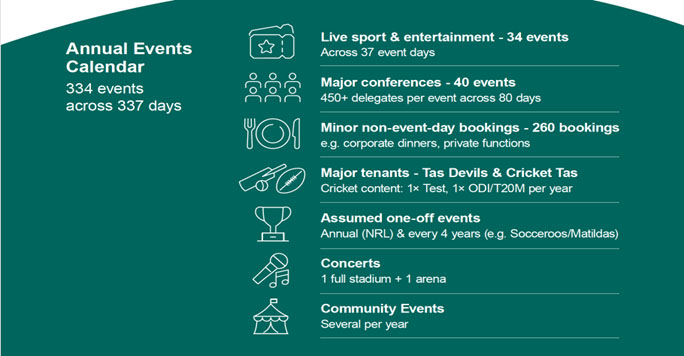

Re: Major Tenants – Cricket – The ICC have not sanctioned Test Cricket or ODIs be played under a fixed roof.
Tasmanian Times (TT) is a community-based news and current affairs service covering the island state of Tasmania. It exists to provide a diverse presentation of Tasmanian issues. TT creates and supports independent media content utilising the best of modern technologies and tried-and-true practices of public-interest journalism.
Support us in expanding our coverage and developing new content by and for Tasmanians.
New initiatives on the way include … what our contributors and readers suggest! Please get in touch with your suggestions.