The Short Term Accommodation Association Australia (STAAA) has voiced strong opposition to the Tasmanian Government’s proposed short stay levy, following the release of the Draft Short Stay Levy Bill 2025 and an accompanying Treasury discussion paper.
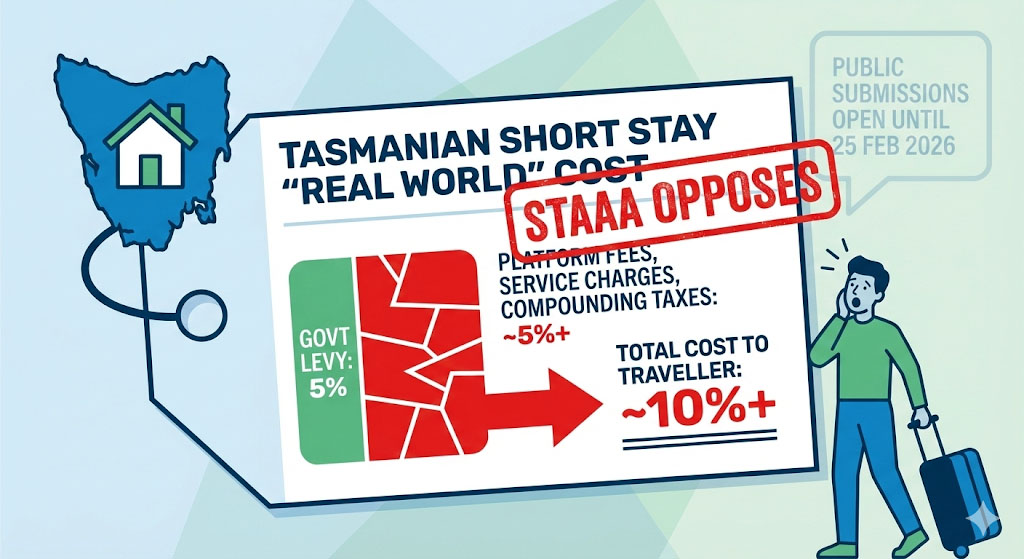
While the government has framed the levy as a 5 per cent charge, STAAA warns that the real world cost to travellers will likely hit 10 per cent once booking platform commissions, service fees and tax compounding are factored in.
Media release – The Short Term Accommodation Association Australia (STAAA), 19 December 2025
STAAA Strongly Opposes Tasmania’s Proposed 5% Short-Stay Levy
The Short Term Accommodation Association Australia (STAAA) today voiced its strong opposition to the Tasmanian Government’s proposed short stay levy, following the release yesterday of the Draft Short Stay Levy Bill 2025 and Discussion Paper by the Department of Treasury and Finance.
Public submissions on the proposal are open until 17:00 on Wednesday 25 February 2026.
STAAA warns that the levy, publicly framed as a 5 per cent charge, will in reality result in significantly higher costs to travellers, with the true impact likely to be closer to 10 per cent once booking platform commissions, service fees and tax compounding are factored in.
“This will not be a flat 5 per cent levy in the real world,” said Keiran Craig-Jones, STAAA Executive Director.
“When platform commissions, service fees and booking costs are added on top, travellers will pay considerably more, making Tasmania a more expensive destination.”
The Department of Treasury and Finance has stated that the draft Bill is the legal framework for the levy and has been drafted in accordance with Government policy parameters, including that 100 per cent of the levy revenue will go directly to assisting first home buyers, the levy will apply to short-term rental accommodation such as listings advertised on platforms including Airbnb and Stayz, the levy will not apply to accommodation operators such as hotels, pubs, bed and breakfasts and caravan parks and that the levy will be paid by those using short stay accommodation rather than property owners.
The STAAA says these assumptions demonstrate a lack of understanding of revenue management practices across the accommodation industry, not just short term rental accommodation. Pricing is demand driven and dynamic and costs are absorbed throughout the system, placing pressure on owners and operators and undermining accommodation supply rather than neatly falling on the traveller or guest.
The association is particularly concerned that hosted short-term rental accommodation, including Tasmanians renting out a bedroom in their own home, will also be captured by the levy, disproportionately impacting households who rely on this income to manage rising living and housing costs.
The STAAA has also highlighted a significant contradiction in the Government’s housing policy narrative. Tasmania is currently the only state in Australia that has not opted into the Federal Government’s Help to Buy scheme, which allows eligible low and middle income earners to purchase a home with as little as a two per cent deposit.
Without state legislation passed by 1 March 2026, hundreds of Tasmanians risk losing access to places allocated to the state this year, which will be redistributed to other states and territories across Australia.
“If the Tasmanian Government is serious about helping first home buyers, it is extraordinary that it has failed to opt into a nationally available scheme that could already be supporting hundreds of Tasmanians,” Craig-Jones said.
“Instead, it is pursuing a new levy that will increase costs and and risks damaging a sector that is critical to the state’s visitor economy.”
The association also pointed to recent statements from Minister for Tourism, Hospitality and Events, Jane Howlett celebrating record accommodation occupancy and strong visitor growth across Tasmania. According to Hospitality Tasmania data, statewide occupancy reached 79.05 per cent in October, near a decade high and more than 1.35 million visitors travelled to Tasmania in the year ending June 2025.
“The Government cannot celebrate record occupancy and a growing visitor economy while simultaneously introducing new taxes that undermine accommodation affordability and supply,” Craig-Jones said.
The STAAA further warned that the levy will have downstream cost impacts on major infrastructure projects, including the Macquarie Point stadium.
Short-term rental accommodation is expected to be the preferred accommodation choice for contractors and project workers and the proposed levy will add an estimated additional 10 per cent to accommodation related construction costs during the build period.
The association also raised concerns that international booking platforms will generate additional revenue by collecting the levy at the time of booking, earning commission on the tax itself and additional interest, while continuing to pay minimal local taxes in Australia.
The STAAA is encouraging all Tasmanian short term rental accommodation owners and operators, including hosted providers, to participate in the public consultation process and make their views known.
Additional information can be located here: https://www.treasury.tas.gov.au/economy/short-stay-levy-bill-2025-consultation
Tasmanian Times (TT) is a community-based news and current affairs service covering the island state of Tasmania. It exists to provide a diverse presentation of Tasmanian issues. TT creates and supports independent media content utilising the best of modern technologies and tried-and-true practices of public-interest journalism.
Support us in expanding our coverage and developing new content by and for Tasmanians.
New initiatives on the way include … what our contributors and readers suggest! Please get in touch with your suggestions.