Article
Premier Used Budget Funds For Secret Election Blitz

New documents obtained by Tasmanian Times reveal the Rockliff Government used taxpayer funds to finance a media domination strategy that extended well into the recent election campaign, contradicting earlier claims that the spending was merely for a “routine” Budget launch.
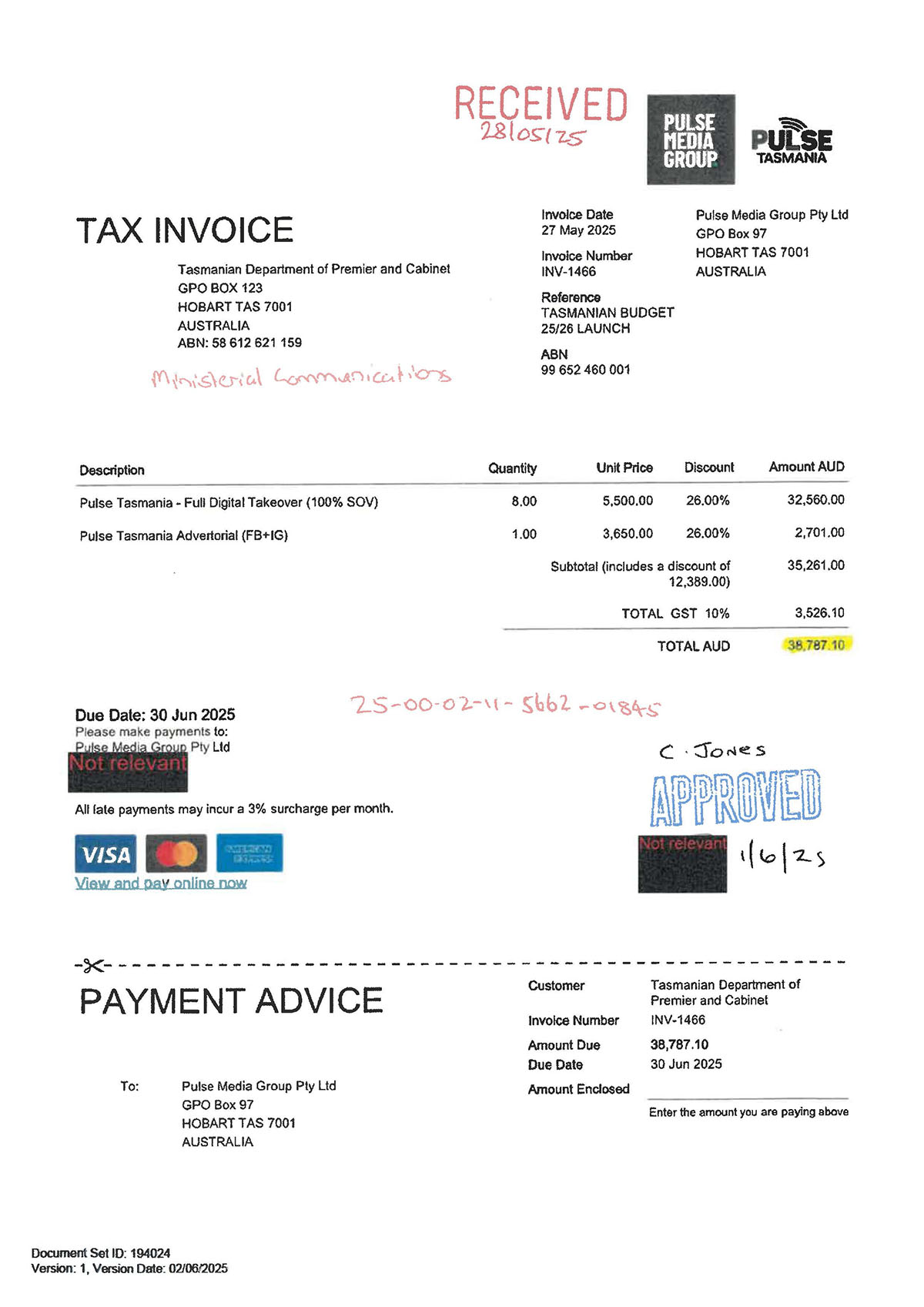
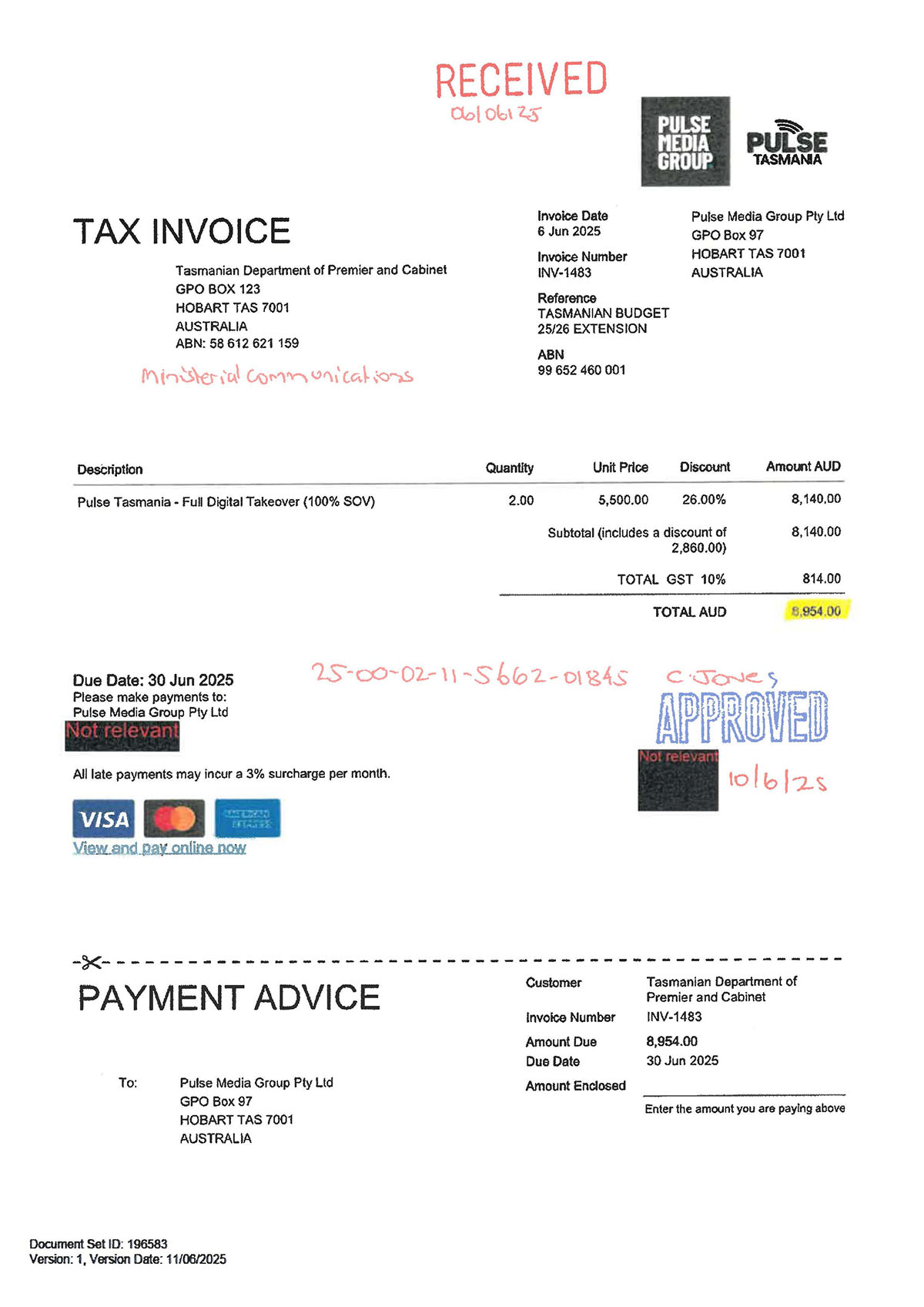
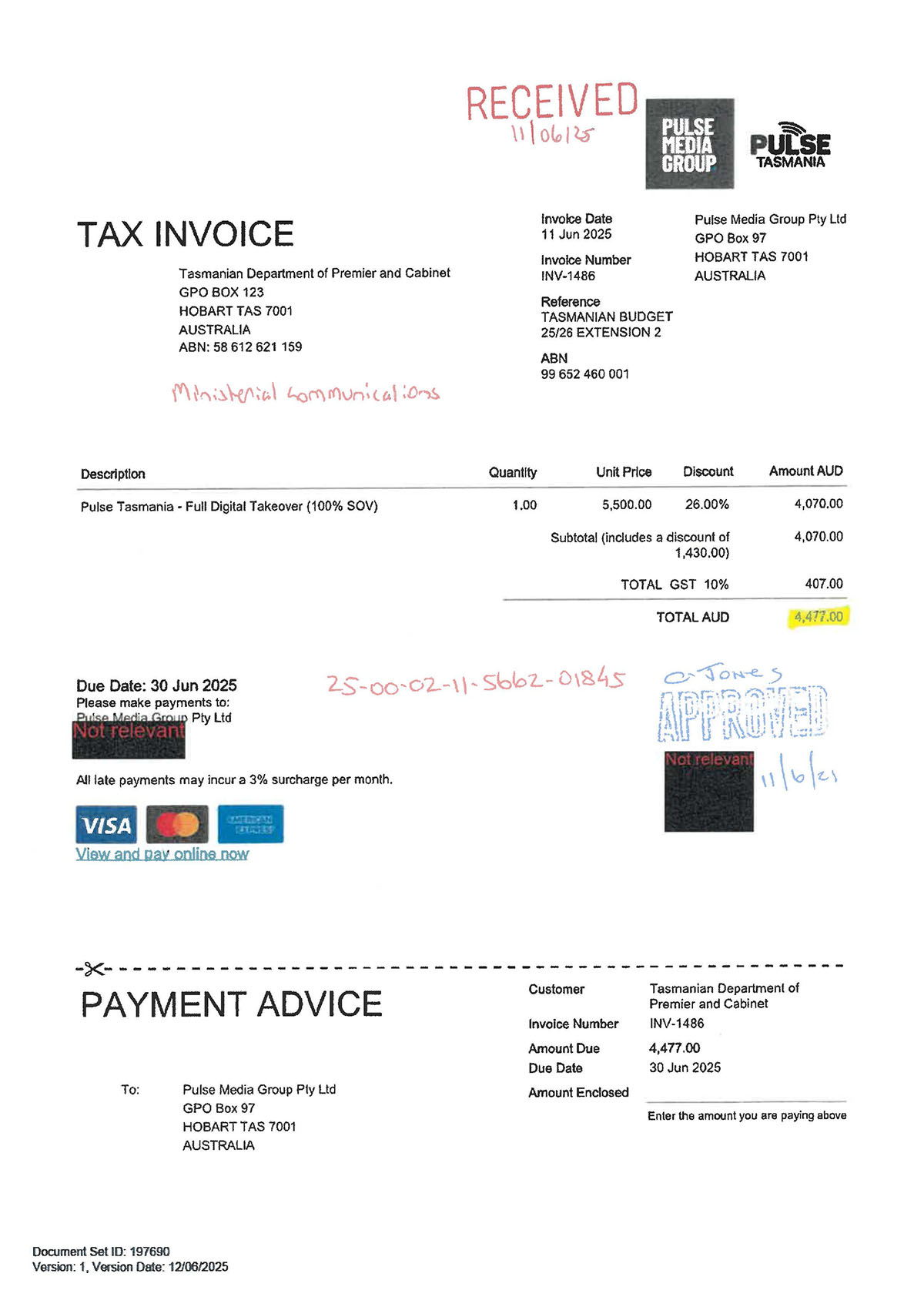
Invoices released under Right to Information (RTI) show the Department of Premier and Cabinet paid Pulse Media Group a total of $52,218.10 for a “100% Share of Voice” digital takeover.
This figure is nearly 50 per cent higher than the $35,000 cost previously defended by the Premier as “good value”.
While the invoices are labelled “Tasmanian Budget 25/26,” the timeline of the spending raises serious questions about whether departmental funds were repurposed to support the Liberal Party’s re-election bid during the collapse of parliament.
The “May RTI” – The Pitch for Dominance
The government’s intent was laid bare in an earlier RTI release, which contained internal emails from May 2025 as previously disclosed by independent publisher Thought Digest Media (TDMG). In these documents, Pulse Media Group pitched the government a “Full Digital Takeover,” promising the Premier “100% share-of-voice” on what they described as the state’s “#1 free news website.”
The pitch was explicit – the government would secure exclusive rights to the platform, effectively blocking all other advertisers—including political opponents—from appearing on the site.
The “New RTI” – The Election Timeline
While the initial “Budget” campaign launched on 27 May for a cost of $38,787.10, the new financial documents reveal that the government did not stop there. Instead, they authorised two “extensions” to the contract precisely as the political crisis deepened:
- 6 June ($8,954) – An extension was purchased immediately following the successful no-confidence motion against Premier Jeremy Rockliff.
- 11 June ($4,477) – A second extension was purchased after the election period had formally commenced.
By purchasing these extensions, the government ensured its “100% Share of Voice” monopoly continued during the critical first week of the snap election campaign.
The Stonewall – Missing Correspondence
Despite explicit requests for all correspondence and briefing notes detailing the negotiation of these costs, the government provided only three basic invoices and declined to release any internal documentation regarding the deal. Compounding this lack of transparency, the Premier’s office has confirmed that no internal review of its decision is legally possible.
The officer advised that while records relating to the June extensions likely exist, they were not captured in the initial search because the government interpreted the request as being limited strictly to cost breakdowns. The existence of these withheld documents is evidenced by Invoice INV-1466, which bears an “APPROVED” stamp signed by a “C. Jones” on 1 June 2025. Under standard government financial procedures, a payment of this magnitude cannot be approved without an accompanying authorisation minute or internal briefing note—records that were explicitly requested as “correspondence” and “briefing notes” but were not provided.
Adding to the tension, the government fast-tracked the public release of these documents. Despite departmental policy allowing up to 48 hours to publish released data on the public disclosure log, the Premier’s office made the invoices public less than 24 hours after they were sent to Tasmanian Times. This practice effectively eliminates any window for the media to conduct exclusive scrutiny of complex records before the government broadcasts them to the wider public.
When Tasmanian Times submitted another RTI request this afternoon, the same officer advised that because the information sought relates to the Premier’s office, the application must be treated as a request to the Premier directly, which carries no statutory right to internal review under the current legislative framework.
Questions of Legitimacy
The use of public funds to secure exclusive advertising space during an election period remains highly irregular.
The delegated officer confirmed today that a 26 per cent discount was applied to the booking as a special rate applied to government under the contracted Master Ordering Agency, Gray Matters Advertising. While described as a standard rate, the timing of these discounted extensions—authorised during a regulated election period—has been referred to the Integrity Commission and the Tasmanian Electoral Commission to determine if they constitute an undeclared gift in kind or a misuse of public resources.
By labelling the June extensions as Budget Promotion, the government effectively bypassed the usual restrictions on party-political advertising, using the public purse to drown out opposition messaging on a key platform during the critical first week of the campaign.
Pulse Media Group was contacted on 15 December regarding a formal compliance report from TDMG alleging the suppression of public scrutiny and the presentation of advertorials as news. At the time of publication, Pulse has provided no response or acknowledgement to those inquiries.
The Premier’s office and the Liberal Party also failed to respond to requests for comment before the publication deadline this afternoon.
Editor’s Note & Transparency Statement
Tasmanian Times has formally referred the matters detailed in this report to the Integrity Commission of Tasmania and the Tasmanian Electoral Commission for assessment. Our referrals specifically request investigation into whether the authorisation of departmental funds for advertising extensions after the dissolution of the House of Assembly constitutes a misuse of public resources, and whether the 26% discount applied constitutes an undeclared ‘gift in kind’ under the Electoral Act 2004.
The reporting above is based on official government documents released under Right to Information (Ref: 25/171515).

Tasmanian Times (TT) is a community-based news and current affairs service covering the island state of Tasmania. It exists to provide a diverse presentation of Tasmanian issues. TT creates and supports independent media content utilising the best of modern technologies and tried-and-true practices of public-interest journalism.
Support us in expanding our coverage and developing new content by and for Tasmanians.
New initiatives on the way include … what our contributors and readers suggest! Please get in touch with your suggestions.