
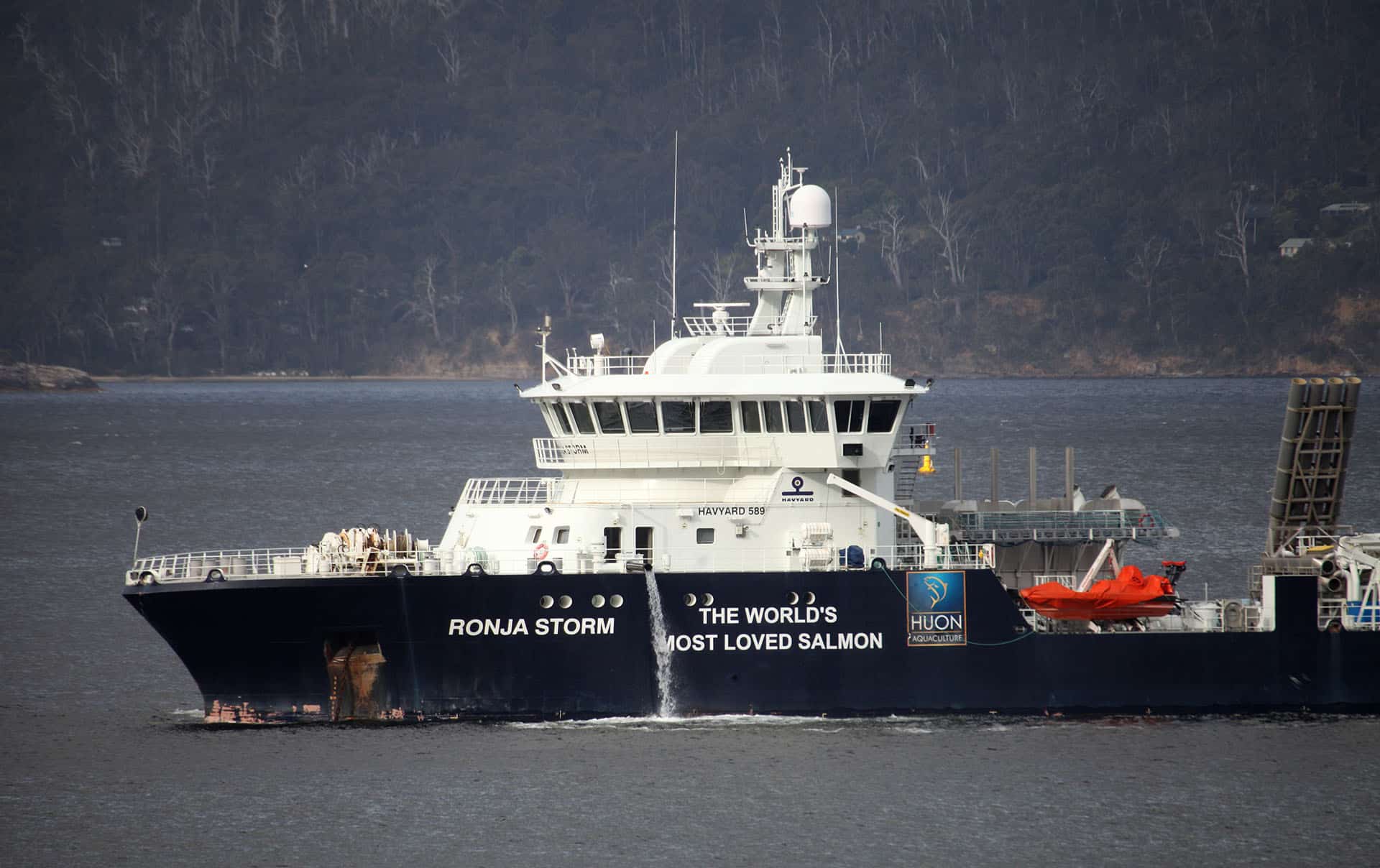
The Tasmanian Government’s claim of a sudden “emergency” to justify pouring pig antibiotics into public waterways has collapsed.
New Right to Information (RTI) documents released last week expose a calculated deception – there was no crisis, only a schedule.
When Huon Aquaculture demanded approval to use an unapproved drug within seven days, regulators didn’t enforce the law—they helped rewrite the narrative. We now have the proof that the government bypassed its own public consultation rules to fast-track a chemical treatment that industry had been planning for months.
The manufacturing of Tasmania’s salmon ’emergency’ is now irrefutable. New Right to Information documents released last week complete a devastating timeline that proves government officials did not regulate—they orchestrated deception to fast-track an unapproved antibiotic into public waterways.
In September, Tasmanian Times revealed the secret six-month coordination between government and industry to introduce florfenicol. We documented how Stuart Bowman, the government’s Agricultural and Veterinary Chemicals Programme Manager, confirmed in writing that industry could bypass federal oversight by using the antibiotic off-label.
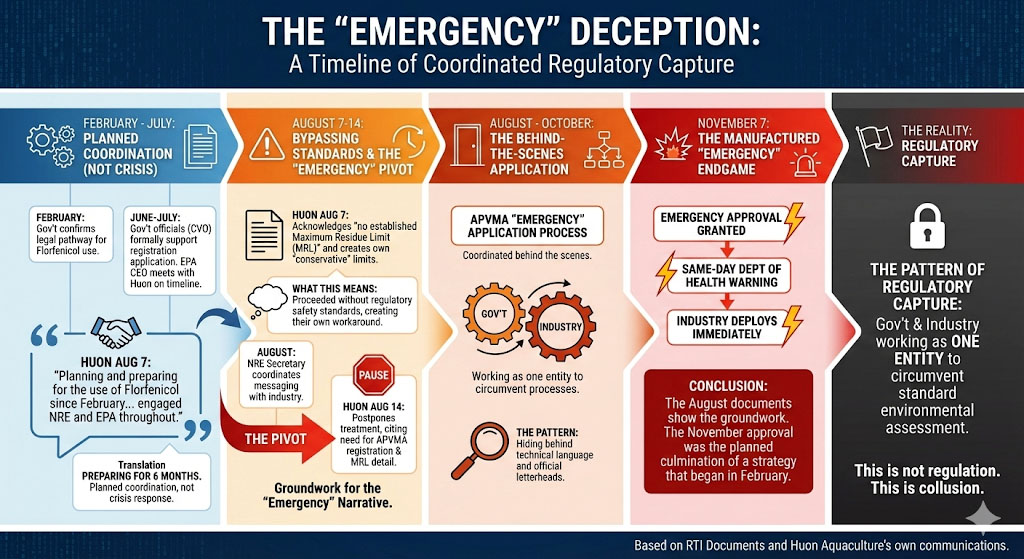
This lastest released NRE RTI 007 – 2025-26 – Stage 2 release adds a final, damning layer – when industry tested whether they could execute the strategy in secret, government did not refuse.
Instead, it manufactured an emergency to justify what had been planned all along.
The timeline is stark.
On 4 August 2025, Huon Aquaculture emailed the Department of Natural Resources and Environment (NRE) demanding approval to use florfenicol—a product registered only for use in pigs—within seven working days.
There was no environmental assessment and no public consultation.
NRE Secretary Jason Jacobi responded on 7 August 2025 stating he was ‘disappointed’ and ‘concerned’ at the lack of notice. He explicitly told Huon:
“I am concerned the notice given (seven working days) provides very little time for my department… the EPA and Public Health to appropriately socialise this with the broader community”.
Translation – we cannot approve this without public discussion.
So government did something extraordinary. Rather than enforcing public consultation requirements, it pivoted to support an ’emergency’ application to the APVMA—the federal mechanism that would bypass state-level public consultation entirely.
The documents confirm the specific product Huon intended to use was ‘Abbeyflor Premix Concentrate for Pigs’, APVMA Product Number 81128. The label for this product explicitly carries the restraint: “USE ONLY in pigs”.
The active ingredient was to be extracted and administered to farmed salmon at unprecedented scale—all without the manufacturer’s knowledge or public scrutiny.
The ’emergency’ narrative crumbles completely under the weight of Huon’s own correspondence.
On 14 August—the very day government support for an emergency permit was being solidified—Huon wrote to the NRE Secretary stating plainly: “Huon advises it is not proceeding with the proposed FFC treatment at Zuidpool, at this time”.
There was no emergency. There was no crisis. Yet the government proceeded to warn MPs of a “very serious event”, rushing them into briefings and manufacturing a political crisis to secure crossbench support.
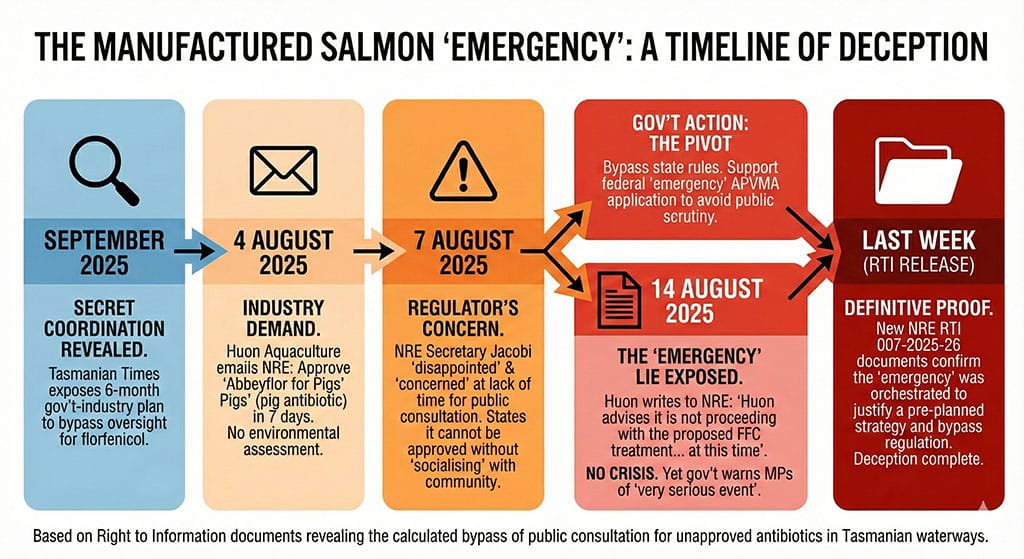
Graphics courtesy Gemini AI.
Tasmanian Times (TT) is a community-based news and current affairs service covering the island state of Tasmania. It exists to provide a diverse presentation of Tasmanian issues. TT creates and supports independent media content utilising the best of modern technologies and tried-and-true practices of public-interest journalism.
Support us in expanding our coverage and developing new content by and for Tasmanians.
New initiatives on the way include … what our contributors and readers suggest! Please get in touch with your suggestions.