
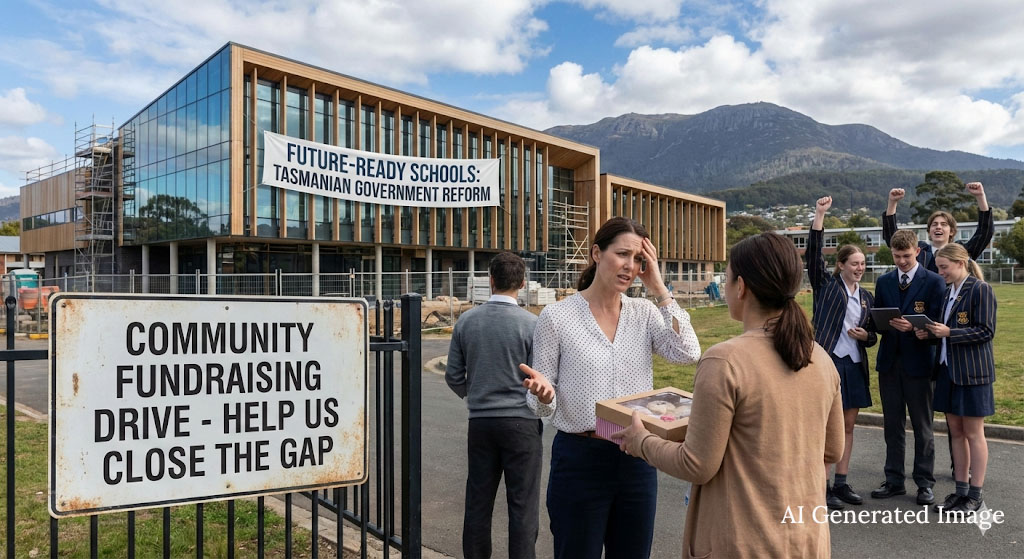
As the 2025 school year concludes, Tasmania’s education sector faces a complex transition between policy modernisation and immediate resource pressures. This collection of media releases highlights a period of significant change, as the Government implements legislative reforms and secures essential pay rises for school staff, while community school associations warn of widening funding gaps that leave local families to subsidise core learning support.
From the release of senior secondary results to the professionalisation of the teaching workforce, these updates reflect a system striving for improved outcomes against a backdrop of financial strain and high demand for student assistance.

Media release – Jo Palmer, Minister for Education, 18 December 2025
Fair and affordable pay rise secured for Education Facility Attendants before Christmas
The Tasmanian Government and the United Workers Union have finalised a one-year agreement, ensuring Education Facility Attendants receive a fair and affordable pay rise before Christmas.
The agreement, endorsed by UWU members earlier this week, includes a salary increase of 3 per cent for Education Facility Attendants working in Tasmanian Government schools.
Jo Palmer welcomed the agreement, which will deliver improved pay and conditions and will now be prepared for ratification by the Tasmanian Industrial Commission.
“We wanted to see our hard-working Education Facility Attendants receive a pay rise before Christmas,” Palmer said.
“Under the agreement, Education Facility Attendants will receive a 3 per cent pay rise, along with related conditions, from the first full pay period in December 2025.
“We are pleased to deliver this one-year agreement while we continue working the United Workers Union on a longer-term agreement during 2026.”
Education Facility Attendants play an important role in the daily operation of Tasmanian Government schools, providing maintenance, grounds management, cleaning and kitchen assistance.
The current Education Facility Attendants workforce comprises around 850 employees across full-time and part-time roles statewide.
In addition to the salary increase, changes to the Education Facility Attendants Salaries and Conditions and Job Security Agreements include the introduction of Christmas close-down leave, new allowances for employees working in schools with pools and spas, and increased staff allocations to better support schools and kitchen assistants across Tasmania.
“These improvements reflect a shared commitment to supporting the workforce that keeps Tasmanian schools safe, functional and welcoming for students and staff,” Palmer said.
Media release – Jo Palmer, Minister for Education, 17 December 2025
Years 11 and 12 students receive results
More than 15,000 senior secondary students receive their end-of-year 2025 results today from Tasmanian Assessment, Standards and Certification.
Jo Palmer congratulated all years 11 and 12 students on their achievements throughout the year.
“Exams can be stressful, but these results reflect months of hard work, resilience and determination, and our students should take real pride in what they’ve achieved,” Palmer said.
“I encourage everyone to take a moment to acknowledge how far they’ve come and to recognise the hard work behind these results.”
Palmer said senior secondary school is an important period of growth, where students develop knowledge, confidence and skills that prepare them for further study, training or employment.
“Our young people have many pathways ahead of them, and I encourage students to talk with their teachers about their goals and explore the options that best suit their interests and strengths.
“Every senior secondary student should feel proud of the effort and progress they’ve made this year, and I wish them a well-earned summer break.”
Results for 2025 courses are being progressively emailed to students from this morning.
Students will also receive printed copies of their results and certificates through the mail.
Students who have any queries about their results are encouraged to visit the TASC website page Your results, including the FAQs for students on your results.

Media release – Nicole Baxter, Dodges Ferry Primary School Association Secretary, 16 December 2025
Dodges Ferry Primary School Association joins TASSO in calling for full school funding for 2026
Dodges Ferry Primary School Association (DFPSA) joins the Tasmanian Association of State School Organisations (refer to recent TASSO media release dated 6 November 2025) in calling on the State government to adequately fund Tasmanian State schools.
DFPSA says school communities are being asked to fill the growing funding gap for student learning support.
This week, the School Association approved funding $5000 to train two staff in specialised literacy support with proven benefits for local students identified as ‘at risk’ of falling further behind.
Dodges Ferry Primary School alone has over 200 students identified as needing extra literacy support – that’s typical of the 40% of students in Tasmanian schools needing literacy support – yet dedicated funding for this kind of professional learning is not provided by the Education Department (DECYP), and school associations are increasingly being asked to fill the funding gap.
Nicole Baxter says full and fair school funding was supposed to apply for 2026.
“Our School Association is fully supportive of the school’s leadership. We’re asking DECYP to pass on the full and fair Schooling Resource Standard (SRS) funding,” Baxter said.
“We question why fundraising from sausage sizzles and the like is the only option for funding critical staff training,” Baxter explained.
“We’ve been asked to fund a range of core programs and resources, including staff specialist literacy training, base literacy resources such as books and shade in playgrounds.”
“These requests represent countless volunteer hours in fundraising efforts by School Association members, families and community supporters.”
“School Association funds raised by local communities are supposed to enhance the school environment and learning opportunities for students not to pay for core business, staff training, safe playgrounds and facility maintenance,” Baxter said.
This comes off the back of what Baxter describes as a ‘perpetually unreasonable’ funding situation for public schools in Tasmania.
The ever-increasing demand for Teacher Assistant staff to support children with learning and behavioural challenges both diagnosed and undiagnosed – is placing significant financial pressure on school budgets because the DECYP funding falls short.
Schools are being forced into mandatory payback arrangements with DECYP to recover unavoidable budget overruns, further compounding their dire financial positions.
“That’s why schools are increasingly turning to School Associations ‘out of desperation’ to fund critical resources they need to keep students learning and safe at school”, Baxter says.
“We know schools are increasingly being asked to deliver more, with less. Something has to change.”
These concerns come at a time when DECYP is due to deliver on Minister Palmer’s promise of fully funding all state schools by 2026 – [https://ministers.education.gov.au/clare/all-tasmanian-public-schools-be-fully-funded-beginning-2026](https://ministers.education.gov.au/clare/all-tasmanian-public-schools-be-fully-funded-beginning-2026)
To date, public schools are still in the dark about when and how DECYP will deliver on this promise, or whether it will eventuate at all.
Media release – Jo Palmer, Minister for Education, 16 December 2025
Final report on Teachers Registration Act Review released
The final report from the Teachers Registration Act Review Steering Committee has been released, delivering on a key commitment of the Tasmanian Government.
Jo Palmer said the report is another way the Government is ensuring Tasmanian children and young people get the best education possible.
“Teachers have a profound and lasting impact on our children and young people, which is why it’s essential that our education regulation is modern, clear and effective,” Palmer said.
“The final report outlines recommendations to ensure children are safe while learning, that teachers, including those in early childhood settings, are high quality and meet professional standards, and that the law is contemporary and fit-for-purpose.
“Importantly, the report’s recommendations will see us deliver on Commission of Inquiry recommendations and our commitment to register and better recognise Early Childhood Teachers.”
The Report recommends:
• Making the move from provisional to full registration simpler, giving teachers back more time for teaching.
• Expanding Commission of Inquiry protections for children to cover all forms of abuse, ensuring our children and young people are safe.
• Assisting teachers to move to the new legislative framework, by deeming experienced provisionally registered teachers fully registered provided they meet set criteria.
• Updating the law to support modern regulation, for example, allowing the voluntary relinquishment of a teacher’s registration.
• Registering university qualified early childhood teachers in Early Childhood Education and Care settings alongside school teachers, recognising the important role they play in teaching our youngest children and increasing safety.
Aligning with national standards by:
• Requiring 100 hours of professional development every five years, formalising the work teachers are already doing to maintain currency of professional knowledge
• Requiring provisional teachers to gain full registration within five years (with exceptions), recognising the initial period of registration as a period of learning and support for our teachers.
• Providing for a ‘non-practicing’ category of registration, giving teachers the flexibility to maintain their registration while they aren’t in direct teaching roles.
Palmer said the Department for Education, Children and Young People (DECYP) would begin work to implement the recommendations, including changes to legislation to support modern regulation.
“There will be more chances to provide input as this work progresses,” Palmer said.
“Our Government is committed to continuing to improve Tasmania’s education system, to better meet the needs of our children and young people, keep them safe and prepare them for the future.”
The final DECYP report is here.
Tasmanian Times (TT) is a community-based news and current affairs service covering the island state of Tasmania. It exists to provide a diverse presentation of Tasmanian issues. TT creates and supports independent media content utilising the best of modern technologies and tried-and-true practices of public-interest journalism.
Support us in expanding our coverage and developing new content by and for Tasmanians.
New initiatives on the way include … what our contributors and readers suggest! Please get in touch with your suggestions.