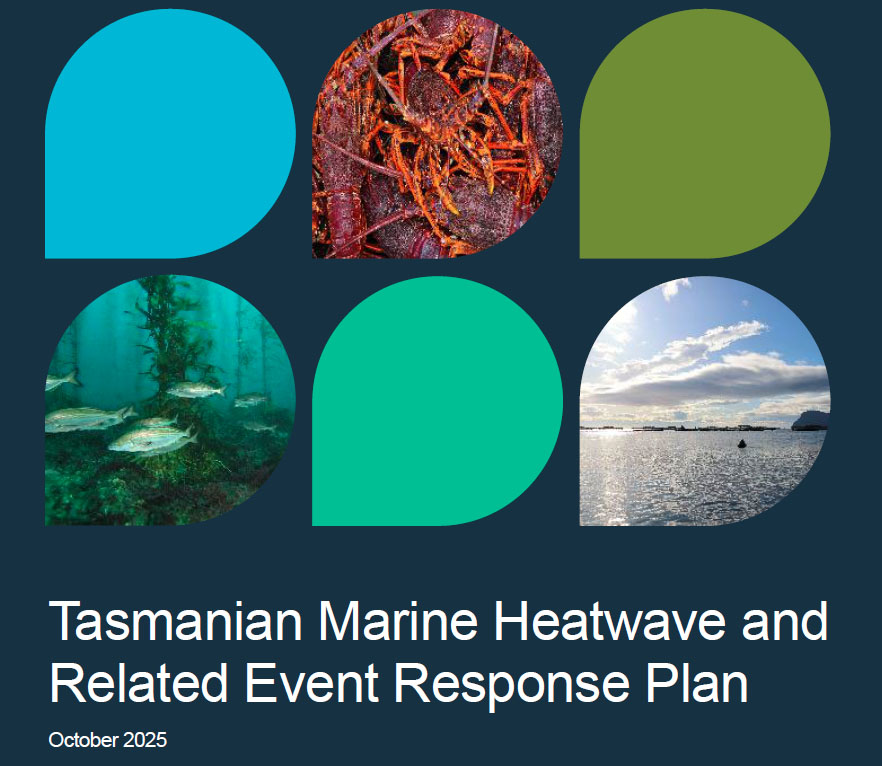
Environment Tasmania has criticised the state government’s newly released ‘Tasmanian Marine Heatwave and Related Event Response Plan’ for failing to address salmon farming’s impact on the critically endangered Maugean skate.
The October 2025 plan identifies the Maugean skate as facing “high risk” of population-level impacts during marine heatwaves, including unusual mortality events and sick or dying animals, yet conspicuously omits the aquaculture industry from the list of impacted stakeholders for skate protection.
The Tasmanian Marine Heatwave and Related Event Response Plan aims to guide Tasmania’s decision making and coordination in response to marine heatwaves and related events. The plan has two key objectives – to explain how and why Tasmania responds to marine heatwaves by documenting risks, existing monitoring activities and response actions; and to improve Tasmania’s resilience to future marine heatwaves by identifying current capacity and knowledge gaps and documenting actions to support future preparedness and adaptation strategies.
The plan was developed in response to forecasts that marine heatwaves will increase in frequency, intensity and spatial extent in Tasmania due to climate change and rising sea temperatures, with southern Australian oceans potentially experiencing permanent heatwave conditions by 2040.

Media release – Environment Tasmania, 22 October 2025
The Government’s Marine heatwave plan ignores salmon in Maugean Skate risk strategy
An announcement that captive skates will be released back into the wild comes on the heels of the Tasmanian Government’s quietly released ‘Tasmanian Marine Heatwave and Related Event Response Plan‘ that flags the Maugean skate is ‘of particular concern’ with a ‘high risk’ of population-level impacts when – not if – such a heatwave event occurs.
“The plan confirms that the government should be implementing the Conservation Advice in full, including the reduction of fish farms from the harbour, in order to make the skate’s only habitat as resilient to marine heatwaves and extreme weather events as possible.
It’s critical this happens as a priority to give released skates the best chance of survival.”
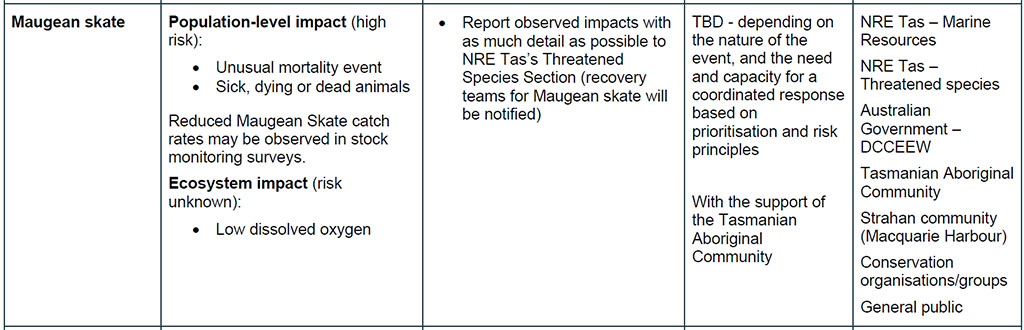
Page 95 of Tasmanian Marine Heatwave and Related Event Response Plan
The Tasmanian Marine Heatwave and Related Event Response Plan lists the threat of marine heatwaves on the skate (page 95) as:
Population-level impact (high risk):
• Unusual mortality event
• Sick, dying or dead animals
“It is very concerning that despite the conservation advice handed down by the federal Government calling for reduction in salmon biomass to restore oxygen levels in the harbour, this has not been mentioned at all in plans to safeguard the skate against heatwave-related risks in its final critical habitat, Macquarie Harbour” Says Jess Coughlan, Campaigner at Environment Tasmania. [Refers to p95]
The plan also asserts that any intervention and action in response to a marine heatwave to mitigate the impacts to marine threatened species will likely be “both costly, and risky for a species”. [Refers to p30]
“To date tax payers have already dedicated $55.8 million to keep salmon farming multi-national companies afloat in Macquarie Harbour despite the risk to the skate.
“Now this plan warns tax payers will likely be on the hook for greater expenses in the future.
“Removing salmon, the primary threat to the skate’s habitat, would result in a more resilient Macquarie Harbour and help avoid unnecessary costs on taxpayers.”
“The State government has a responsibility to take impacts on endangered animals into consideration in planning protocols and mitigate those impacts, regardless of industry profits. The fact that the salmon industry has not even been listed as an affected stakeholder when it comes to skate risk while environmental and indigenous communities have, is very very telling.” said Coughlan. [Refers to p95]
Tasmanian Times (TT) is a community-based news and current affairs service covering the island state of Tasmania. It exists to provide a diverse presentation of Tasmanian issues. TT creates and supports independent media content utilising the best of modern technologies and tried-and-true practices of public-interest journalism.
Support us in expanding our coverage and developing new content by and for Tasmanians.
New initiatives on the way include … what our contributors and readers suggest! Please get in touch with your suggestions.