As seismic activity continues and upgrade costs spiral, Huonville residents question whether they’re getting the full story about living downstream from high-risk infrastructure.
The recent magnitude 4 earthquake at the Pedder Impoundment on 25 September 2025 sent tremors through more than just the earth—it reignited deep-seated community anxieties about the Edgar and Scotts Peak Dams that Hydro Tasmania has spent years trying to quell.
Within 15 minutes of the quake, Hydro Tasmania staff were on site, their response swift and professional.
Executive General Manager Jesse Clark moved quickly to reassure the public – “Our infrastructure is designed to withstand earthquakes of this magnitude.”
The earthquake, he noted, occurred more than 30 kilometres from Edgar Dam and was well below the 6.8 magnitude the dam can currently withstand. The message was clear – nothing to see here, everything is under control.
But for many in the Huon Valley, the earthquake was a visceral reminder of what lies upstream—two dams rated as high-risk assets, built on or adjacent to the active Edgar Fault Line, holding back the massive Lake Pedder impoundment. And while Hydro emphasises the “extremely remote” probability of failure, the consequences of such an event would be nothing short of catastrophic.
The flood modelling that Hydro Tasmania concealed for years—only released after a Right to Information request by the Greens—paints a grim picture. If Edgar Dam fails, the flood discharge would reach an estimated 25,640 cubic metres per second, dwarfing the major 2003 flood that peaked at just over 2,000 cubic metres per second.
The river would peak in Huonville at nine metres after 19 hours, submerging the entire town centre with the main street under four metres of water.
Almost 600 buildings would be affected. Around 1,500 residents would need to evacuate, with only an estimated eight hours to do so.
Key emergency infrastructure, including the SES headquarters and some evacuation centres, would be underwater and unavailable when needed most.
And that’s just from Edgar Dam. If Scotts Peak Dam subsequently failed, a second, larger wave would peak at 15 metres in Huonville.
The annual probability? One-in-10,000 before the upgrades, dropping to one-in-a-million afterward, according to Hydro. As Jesse Clark stated, these are “extremely unlikely” events—a large earthquake like the magnitude 6.9 quakes that have occurred a few times on the fault in the last 60,000 years.
But low probability doesn’t mean no consequence. It’s a distinction that matters deeply when you’re the one living downstream.
The revelation of the flood maps only through an RTI request speaks to a broader pattern that has eroded community trust. Hydro Tasmania initially withheld the 2016 flood modelling to “avoid unnecessary concern” and prevent “panic,” preferring simplified communications over full transparency.
Greens spokesperson Tabatha Badger MHA pulled no punches in her media release – “Hydro Tasmania spent many years hiding the risk assessment and consequences of these dams failing in the event of an earthquake. Thanks to a Greens RTI, the community now knows the catastrophic consequences of a dam failure,” she said.
The Restore Pedder campaign has been even more pointed, questioning when Hydro will “take accountability” for infrastructure they describe as “two poorly built dams” with “an increased risk of failure.” They note that building the dams on the Edgar Fault Line was “an arrogant political move in the rush to submerge Lake Pedder.”
Hydro has acknowledged they might handle disclosure differently in the future, but for many residents, the damage to trust is done. When the government conceals information “for your own good,” it raises an uncomfortable question – what else aren’t they telling us?
Adding to community unease is the spiraling cost of the safety upgrades. The Edgar Dam project has grown from an initial $15 million estimate to more than $35 million—a figure Hydro now celebrates as an economic boost, with over 90% spent on Tasmanian contractors and suppliers.
In Hydro’s media release yesterday, project director Aaron McCreath emphasised local investment – “We’re incredibly proud that so much of our investment in Edgar Dam has been returned to Tasmanian businesses.”
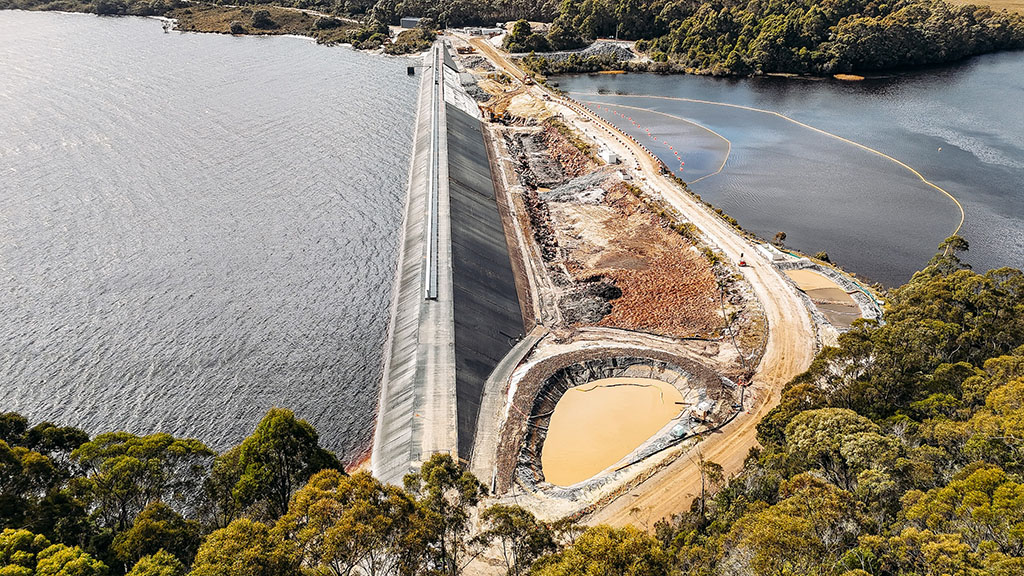
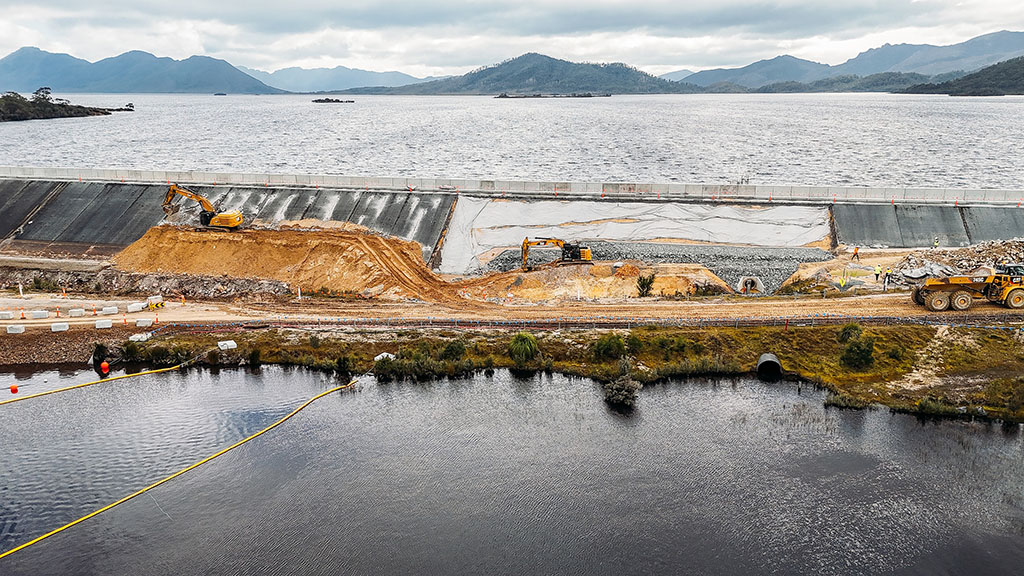
The project employs about 60 Tasmanians and involves around 20 local businesses, including third-generation Huon Valley family business Duggans, which poured the concrete for the dam’s new wave wall.
It’s a feel-good story about local employment and community benefit.
But it sidesteps a more troubling question – if the costs have more than doubled for Edgar Dam, what does that say about the original risk assessments and engineering specifications? The situation is even more concerning for Scotts Peak Dam, which has increased from a $50 million estimate to nearly $100 million—and work hasn’t even begun. Scotts Peak has been plagued by slumping and leakage since construction, according to Badger making it an even more problematic asset.
The Restore Pedder campaign notes the combined spending is now over $130 million, costs that “have doubled in the past 5 years and work has barely begun on the first and smaller dam.”
They expect costs to increase further before Scotts Peak work commences, as it hasn’t yet been referred to the Federal Environment Minister for environmental assessment.
The 25 September earthquake wasn’t an isolated incident—it was the second earthquake at Pedder in three weeks. The Restore Pedder campaign warned that “around the world it is recognised that the changing climate is increasing seismic activity.”
While the scientific consensus on climate change and seismicity is more nuanced than this claim suggests, the broader point resonates, seismic events do happen in Tasmania and they’re happening at Pedder. Badger put it bluntly “The earthquake at the Pedder Impoundment is a warning—bigger quakes can and do happen here in Tasmania.”
Both the Greens and Restore Pedder called for Hydro to pause work on Edgar Dam for a structural assessment following the earthquake. Hydro declined, stating the earthquake “has not impacted the Edgar Dam upgrade works” and that monitoring would continue over the coming days.
At the heart of this issue is a fundamental question about transparency and risk communication. Hydro Tasmania and their supporters argue that emphasising an extremely low-probability event creates unnecessary alarm.
The Huon Valley Council has echoed this message, posting that Hydro’s infrastructure is “as solid as a rock” and Edgar Dam remains “perfectly safe.”
Council Mayor Sally Doyle has focused public messaging on community preparedness and confidence in evacuation procedures, referencing a successful 2020 simulation and prior bushfire experience.
But activists counter that the community has a “right to know” to make informed decisions about evacuation plans, property insurance and where to live. The long delay in releasing the maps, obtained only through RTI, was “completely unacceptable,” according to the Greens.
It’s worth noting that the dams have actually reduced natural flooding in Huonville over the decades—a point some councillors and residents make when activists propose dam removal. Taking out the dams, they argue, would lead to more frequent natural river flooding, even if those floods would be less catastrophic than a dam failure.
The Edgar Dam upgrade is expected to be completed in the second half of 2026. The wave wall is complete, with Duggans’ project manager Patrick Duggan noting his team “poured two wave walls every day—rain, hail or snow we have not missed a single pour.”
It’s the kind of dedication that inspires confidence in the work being done.
But confidence in construction quality doesn’t eliminate the underlying reality that the dams will still sit on an active fault line. The probability will be reduced, but not eliminated. And if the worst happens, 1,500 people downstream will have eight hours to evacuate before their town is submerged.
The question isn’t whether Hydro Tasmania is doing good work—by all accounts, they are.
For the residents of Huonville, that’s not panic. That’s just wanting to know the truth about what lies upstream.
The question is whether communities living in the shadow of high-consequence, low-probability risks deserve full, unvarnished information about those risks, rather than reassurances calibrated to avoid “unnecessary concern.”

Media release – Hydro Tasmania, 7 October 2025
Hydro Tasmania’s Edgar Dam upgrade boosts Tasmanian economy
The majority of the $35m investment in Hydro Tasmania’s Edgar Dam upgrade will be returned to the Tasmanian economy, thanks to the use of local contractors and suppliers.
Over 90% of the project budget is being spent on services from businesses located in Tasmania, with the upgrade well underway and expected to be completed in the second half of 2026.
The project is being carried out in partnership with Hydro Tasmania’s consulting arm Entura, with Tasmanian civil construction company Hall Earthmoving contracted to carry out the majority of the upgrade works.
Around 20 local businesses are also involved in the project, covering a wide range of services including earthworks, vegetation management, building materials, environmental services, civil construction and trades.
Hydro Tasmania’s project director for the Edgar Dam upgrade, Aaron McCreath, said the use of local contractors and suppliers had employed about 60 Tasmanians either part-time or fulltime.
“We’re incredibly proud that so much of our investment in Edgar Dam has been returned to Tasmanian businesses,” said McCreath.
“To be able to complete an upgrade of this size with local businesses is a testament to the incredible talent we have here in Tasmania.”
“Our commitment to support local businesses is also consistent with the Tasmanian Government’s Buy Local Policy.”
Duggans, a third-generation Tasmanian family business based in the Huon Valley, provided the concrete casting for the dam’s wave wall, which is made up of 178 x 2.5-metre-high sections.
The wave wall will provide additional protection from waves that could occur during a large seismic event.
Duggans’ project manager for the Edgar upgrade, Patrick Duggan, said the team recently completed the final pour.
“Since we started in May, we’ve poured two wave walls every day – rain, hail or snow we have not missed a single pour,” said Duggan.
Patrick’s grandfather Harry Duggan founded the business in 1927 when he purchased his first truck for building the local roadways.
“We’ve been working with the Hydro for many years, from back when the dams at Strathgordon were being built.”
Duggan said the business had a dynamic team working on the project, including a couple of their own Duggan family members.
“All of us Duggans and many others that work here tend to go above and beyond to get the job done,” said Duggan.
“That’s how our grandad wanted us to work, as a team – together everyone achieves more.”
Images courtesy of Hydro Tasmania.
Media release – Restore Pedder, 25 September 2025
EARTHQUAKE AMIDST DAM WORKS AT PEDDER IMPOUNDMENT
When will Hydro take accountability?
News of a magnitude 4 earthquake today at the Pedder Impoundment comes as no surprise to the Lake Pedder campaigners who have been warning of increasing seismic activity in the region for years.
This is the second earthquake at Pedder in three weeks – how long until the next one?
Around the world it is recognised that the changing climate is increasing seismic activity, so the safest move for Hydro and the Tasmanian Government to remove the risk of dam failure, is to remove the dams.
Building the dams on the Edgar fault line was an arrogant political move in the rush to submerge Lake Pedder in the height of the environmental campaign.
The consequences of these two poorly built dams is an increased risk of failure, especially in the event of a large earthquake. A stronger earthquake in the region is possible.
The risk to downstream communities is exponential, Hydro Tasmania should halt works on the Edgar dam to assess any structural compromises and provide a full report on the recent seismic activities.
Previous risk assessment and flood mapping – concealed by Hydro Tasmania for years – revealed potential for flood waters to peak at 9 to 11 meters if the Edgar or Scotts Peak dams failed, leaving residents mere hours to evacuate. There is genuine concern for the loss of thousands of homes and potentially lives with failure to the Pedder Impoundment dams.
Over $130m is set to be spent on the Edgar and Scotts Peak dams to bring them up to contemporary seismic safety standards. These costs have doubled in the past 5 years and work has barely begun on the first and smaller dam, the Edgar. Scotts Peak is much bigger and hasn’t yet been referred to the Federal Environment Minister for EPBC assessment. We can expect the costs to increase again before that work commences.
The Pedder Impoundment is included in the Tasmanian Wilderness World Heritage with the intent of the original landscape being restored.
Knowing the risks of earthquakes to the dams and catastrophic risk to downstream communities in Huonville, it’s time for the Tasmanian Government to stop spending bad money after bad on doing up the dams and invest in the timely restoration of Lake Pedder and the important ecosystems.
Media release – Hydro Tasmania, 25 September 2025
No impact to Hydro Tasmania infrastructure after earthquake in southwest
Hydro Tasmania today (Thursday) confirmed there has been no damage identified to hydropower infrastructure following the 4.2 magnitude earthquake this morning in the State’s southwest.
Executive General Manager of Assets and Infrastructure Jesse Clark said staff were on site within 15 minutes of being notified of the earthquake.
“We have extensive seismic monitoring. This is a standard part of our dam safety procedures,” Clark said.
“Our infrastructure is designed to withstand earthquakes of this magnitude.
“We’ll continue to inspect and monitor over the coming days.”
Clark assured residents in the Huon Valley that there are no safety concerns relating to Edgar Dam, which is currently undergoing an upgrade.
The earthquake occurred more than 30 kilometres away from the dam.
“Edgar Dam as it currently stands can withstand major earthquakes up to 6.8 magnitude along the Lake Edgar fault line,” said Clark.
“This earthquake was well below that and was not on the fault line. The upgrade will strengthen the dam even further.”
The earthquake has not impacted the Edgar Dam upgrade works.
Hydro Tasmania will continue to inspect and monitor infrastructure over the coming days.

Media release – Tabatha Badger MHA, Greens Police, Fire and Emergency Management Spokesperson, 25 September 2025
Earthquake is Dam Warning
The earthquake at the Pedder Impoundment is a warning – bigger quakes can and do happen here in Tasmania. The Greens share the concerns of Tasmanians about the magnitude 4 event and its implications on the Scotts Peak and Edgar Dams.
There has been long standing anxiety over the Edgar and Scotts Peak dams. They are rated as high risk due to their position on the Edgar Fault line, with Scotts Peak plagued by slumping and leakage since construction.
This is a serious situation – Hydro Tasmania should pause work on the Edgar Dam while an assessment of any non-viable structural compromises is undertaken. Hydro Tasmania must provide Parliament with a full report on today’s seismic activity, its implications for the dams and the escalating costs of seismic safety upgrades.
Hydro Tasmania spent many years hiding the risk assessment and consequences of these dams failing in the event of an earthquake. Thanks to a Greens RTI, the community now knows the catastrophic consequences of a dam failure at both Scotts Peak and Edgar Dams.
Flood mapping revealed Huon Valley residents would have only hours to evacuate, with the loss of thousands of homes and potentially lives. The cost of strengthening Edgar Dam has already doubled from $15 million to more than $30 million, while Scotts Peak has blown out from $50 million to nearly $100 million.
With climate change driving more seismic events, and a magnitude 4 quake recorded today following a smaller one just weeks ago, the risks cannot be ignored. The only fool proof way to avoid disaster is to remove the dams entirely and restore Lake Pedder, delivering global value in the climate and biodiversity crisis.
Tasmanian Times (TT) is a community-based news and current affairs service covering the island state of Tasmania. It exists to provide a diverse presentation of Tasmanian issues. TT creates and supports independent media content utilising the best of modern technologies and tried-and-true practices of public-interest journalism.
Support us in expanding our coverage and developing new content by and for Tasmanians.
New initiatives on the way include … what our contributors and readers suggest! Please get in touch with your suggestions.