
Co-authors of Science Under Siege, Michael Mann, an atmospheric scientist and Peter Hotez, professor of tropical medicine, paediatrics, virology and microbiology, are two of world’s most lauded scientists – and every day they face death threats and campaigns that vilify them.
They’re defiant, but they struggle, not least because they’ve been dragged into the biggest war in human history – the war on science.
Science across the world is being demonised, defunded and driven to the margins, in part because it questions assumptions and accepted truths, while those attacking science prefer unquestioning faith, fear and loyalty to obtain profit and power.
Mann and Hotez aren’t using the term ‘war’ as a metaphor for the cultural struggle between rationality and pseudoscience – or between science and conspiracy theories. They mean it literally, and the terrifying thing about Science Under Siege is how well the corporate and state actors waging the war on science are doing.
Disinformation, destabilisation and political control are the weapons and ordinary people are both the enemy and the unwitting proxies of those funding and directing the war.
In totalitarian countries, scientists who say the wrong thing are threatened, jailed or killed. In democracies, scientists are being gagged by NDA’s or don’t dare speak for fear of funding cuts or, in some cases, death threats. Universities are increasingly less a place of enlightenment than a corporate business model to extract money for degrees.
Politicians on the far right openly promote conspiracy theories and wield anti-science agendas for ideological and pragmatic self-interest – donations and votes. Media owned by billionaires creates, promotes and monetises outrage, doubt and hate based on anti-science conspiracy theories. Even relatively independent media like our ABC is cowed by constant attacks from Murdoch’s Newscorp and politicians who loathe being held to account. Social media ranges from authentic, useful and enlightening to cynical grifting for clicks and cash – and disinformation brings both.
In the US, former Trump advisor Steve Bannon’s call is to ‘flood the zone with shit’ (produce a constant PR output of lies, half-truths and nonsense that sparks outrage, confusion and anger) and this is being used as an effective strategy pushing the Project 2025 agenda through to completion.
Project 2025, written and funded by far-right US libertarian and authoritarian billionaires, is being fulfilled by the Trump administration, and is fundamentally anti-science. Every day another US agency designed to protect health or the environment is axed, and qualified staff and leaders are sacked and replaced by disinformation-promoting and sycophantic Trump loyalists – all on the false premise that vaccines kill and climate change is a hoax.
Science Under Siege reveals the allies who run the war on science – the billionaires, the petrostates (nations like Russia, Australia and Saudi Arabia who depend on fossil fuel sales), the credentialed cranks (for example our own climate science denier, Ian Plimer), the influencers and bot armies, and corporate media (like US-based Newscorp) – and how they run it and why.
The war on science isn’t in the media, but it clearly explains inaction on climate and plummeting immunisation rates. Most of us are either oblivious, or drowning in disinformation, or despairing. Mann and Hotez urge us to fight, to call out disinformation wherever and whenever it occurs, and to never give up.
The planet, and the fate of our species depends on it.
This is a critical look beyond the headlines of our failing media at what’s really driving those headlines and our rotten politics. Essential reading.
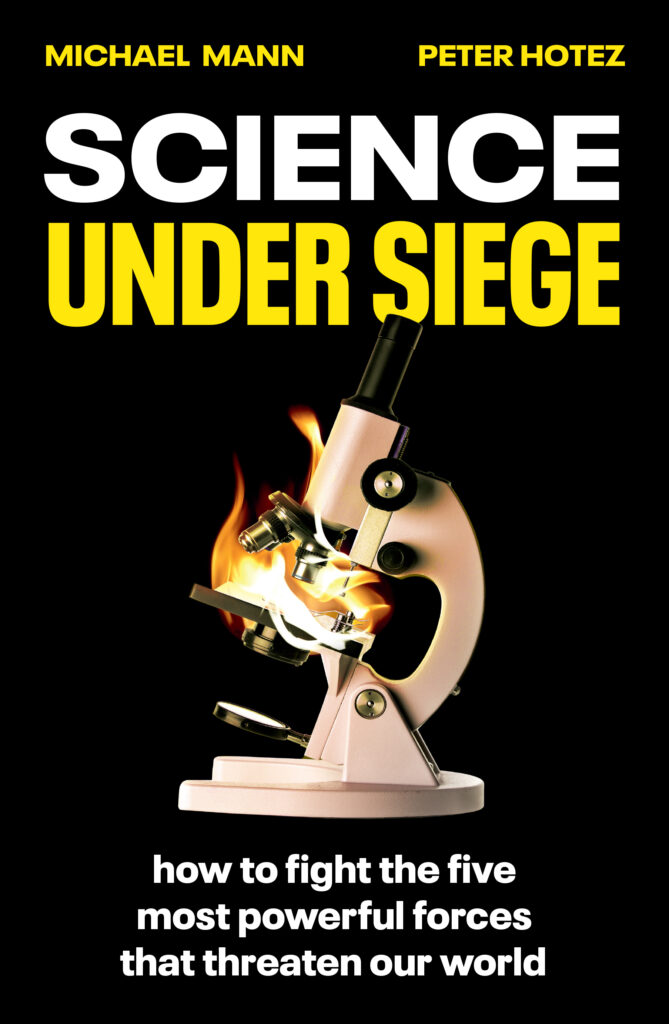
Science Under Siege, by Michael Mann & Peter Hotez
Scribe Publishing, ISBN: 9781761381669, 262pp, RRP $36.99
B.P. Marshall is a scriptwriter and author
Tasmanian Times (TT) is a community-based news and current affairs service covering the island state of Tasmania. It exists to provide a diverse presentation of Tasmanian issues. TT creates and supports independent media content utilising the best of modern technologies and tried-and-true practices of public-interest journalism.
Support us in expanding our coverage and developing new content by and for Tasmanians.
New initiatives on the way include … what our contributors and readers suggest! Please get in touch with your suggestions.